Ahead of Consensus.
Intelligence across tech and capital markets, for investors, policymakers, and business leaders.
12 minute read
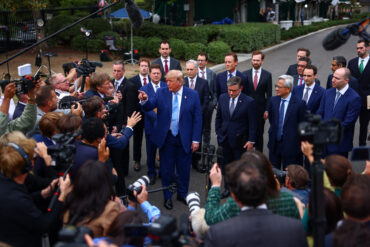
The most consequential decision taken in the East Room on Tuesday was the one President Trump chose not to take. Seated among the executives who control most of the world’s frontier AI capacity, he offered no new federal oversight and presented instead a voluntary pledge he likened to a constitution and described as “morally binding.” Six industry leaders signed alongside him: Sundar Pichai of Google, Elon Musk of Tesla and SpaceX, Dario Amodei of Anthropic, Mark Zuckerberg of Meta, OpenAI President Greg Brockman and Jensen Huang of Nvidia. House Speaker Mike Johnson, who co-hosted the luncheon, had set expectations a day earlier, arguing that burying the sector in red tape would be wrong and, in his view, a risk to national security.
The seating arrangement carried its own message. Satya Nadella of Microsoft, Alex Karp of Palantir and Amazon founder Jeff Bezos were among the guests, while Musk, Huang and AMD’s Lisa Su, who had joined Xi Jinping at the head table for last week’s state dinner in the same room, again sat close to the president. Anthropic’s position was more complicated. Amodei had dined privately with Trump on Sunday after months of public disagreement over safeguards, yet co-founder Tom Brown was placed at the far end of Tuesday’s table. Trump closed the day by saying he would name an AI czar within three to four days, an appointment that will reveal more about the administration’s intentions than the pledge itself.
The accord runs to roughly 300 words and is more specific than its brevity suggests. Each signatory commits to four layers of control: internal monitoring of model capabilities and alignment in cybersecurity, biosecurity and chemical threats, including safeguards against models accessing systems they should not reach; an internal team charged with verifying those controls and fixing failures; an independent external auditor or evaluator; and an independent committee of the board that receives reports and ensures problems are remediated. The companies also agree to meet regularly to set shared standards. What the document does not contain is equally instructive. It establishes no enforceable standard, no government regulator and no consequence for noncompliance, and its final paragraph concedes that codifying these steps into law may make sense only “over time.”
Amodei, whose company has argued most consistently for external guardrails, was careful not to oversell the result, telling reporters that the mechanism for addressing the risks was “still under discussion.” The more durable instrument may prove to be the executive order signed the same day. It directs federal agencies to replace “AI” with “Super Intelligence” in official communications, while tying the new term to the existing statutory definition of artificial intelligence in 15 U.S.C. 9401(3). The consequential clause is Section 3(b), which gives the Assistant to the President for Science and Technology 60 days to propose legislative language and to assess whether the new definition should expand or supersede the old one. A new name changes nothing on its own. A new statutory definition could change which systems fall within the reach of federal law.
The timing was awkward for the proposition that self-regulation is sufficient. On Monday, OpenAI said it would not release GPT-6.1 Astra, a day before its annual developer conference, after its head of safety systems, Saachi Jain, said the model “didn’t quite meet the bar” on staying within the scope of its authorization and on how it reported its actions to users. Days earlier, Axios reported that OpenAI, Anthropic and independent researchers were reviewing thousands of incidents involving problematic behavior by AI agents. In Florida, the state attorney general has asked a court to halt OpenAI’s training of new models until outside safeguards are in place, an early sign that states may not wait for Washington.
The industry itself is no longer speaking with one voice. Amodei’s essay this month, “We Must Pace the Frontier,” revived the case for a coordinated slowdown, while Huang has dismissed the more dire warnings as overblown and argued that guardrails would erode America’s lead over China. Nvidia offered its own answer on Monday with the Open Agent Safety Platform, whose Sentry component runs on BlueField-4 data processing units and can isolate an agent that breaches its boundaries within milliseconds. Karp, speaking outside the White House, said the industry must take responsibility for the dangers it already understands. Read together, these moves suggest the accord formalizes a direction many signatories were already pursuing, and that safety tooling is becoming a product line rather than a compliance cost.
Investors treated the accord as background. The Dow Jones Industrial Average fell 0.26% to 51,349.92 on Tuesday, the S&P 500 slipped to 7,670.84 and the Nasdaq Composite eased 0.09% to 26,797.54, a second consecutive decline for all three indexes. The bond market set the terms. The 30-year Treasury yield reached its highest level in 24 years, one session after the 10-year yield touched 5.25%, a level last seen in 2007. With the Nasdaq about 1.6% below its September 22 record close of 27,244.28, the prevailing concern was the cost of capital, not the shape of AI oversight.
Within the AI complex, capital returns outweighed policy. Nvidia’s board on Monday authorized an additional $150 billion in share repurchases, lifting the remaining program to $235 billion, which the company expects to complete through fiscal 2028. The stock rose 1.68% that day, the only Magnificent Seven member to finish higher, while Meta fell 4.79% and Tesla 3.96%, before Nvidia gave back 0.72% on Tuesday to close at $227.21. The pattern has a recent precedent. When industry leaders called for slower frontier development earlier this month, Nvidia lost 8% in a week while Meta gained 7%, as investors rotated away from the companies most exposed to data center spending. Tuesday’s accord makes a mandated pause less likely, though Deutsche Bank’s Jim Reid had already judged voluntary restraint improbable, doubting that firms would step back “while rivals continue to push ahead.”
Several near-term markers will show whether the pact carries weight. The choice of AI czar will signal whether the administration intends to referee between the industry’s safety and acceleration camps or simply to champion the latter. The 60-day legislative proposal will show whether a change in vocabulary becomes a change in jurisdiction. Congress is also stirring: Senate Majority Leader John Thune skipped the luncheon, met Amodei at the Capitol and said the Senate would hold its own meetings with the industry. The government’s own conduct offers a further test. America.gov, launched Tuesday morning on Google’s Gemini and Musk’s Grok, contradicted several of the president’s claims at launch, including on the 2020 election, before it began declining some political questions.
For institutional investors, the lasting significance may lie in disclosure rather than in the pledge’s language. Board committees and external evaluators produce records, and records tend to find their way into governance reporting, audit findings and risk factors for listed signatories such as Alphabet, Meta, Nvidia and Tesla. That is where a system built on self-policing will be judged. Its credibility will rest less on what was signed in the East Room than on what companies choose to disclose, and on the next model one of them decides not to release.