- AI Infrastructure
- Capital Allocation
- Data Centers
- Earnings Report
NVIDIA's Numbers Are Astonishing. Investors Aren't.
12 minute read
Nvidia’s fiscal second-quarter results shattered expectations again, but a market already pricing in perfection responded with restraint rather than euphoria.
Key Takeaways
- Revenue reached $96.2 billion, up 106 percent year over year, as Data Center sales climbed 117 percent to $89.0 billion on Blackwell Ultra and early Vera Rubin shipments.
- Shares rallied nearly 5 percent after hours on the results, then gave back much of that gain by Thursday, a now familiar pattern for a stock valued above $5 trillion.
- Guidance still excludes China Data Center compute revenue, and NVIDIA warned gross margin will fall to 71 to 72 percent by the fourth quarter on memory cost pressure.
Scale Without Shock
NVIDIA closed its fiscal second quarter on July 26 with results that would strain credulity coming from any other company. Revenue reached $96.2 billion, up 106 percent from a year earlier and 18 percent from the prior quarter, according to the results filed with the Securities and Exchange Commission on August 26. Non-GAAP diluted earnings arrived at $2.22 a share, ahead of the roughly $2.09 to $2.10 that Wall Street had modeled, while GAAP earnings, lifted by gains on the company’s equity holdings, reached $2.46. Net income under GAAP rose to $59.7 billion for the three months. Jensen Huang, NVIDIA’s founder and chief executive, distilled the shift under way in three words on the earnings call: compute is revenue.
What makes the quarter notable is not the beat itself. NVIDIA has now topped consensus for five consecutive quarters, a streak long enough that surprise has given way to expectation. The more interesting question is what happens when a company already generating nearly $385 billion a year on an annualized basis keeps compounding at triple-digit rates, and whether the market’s capacity for wonder simply runs out before the growth does. That tension, between extraordinary fundamentals and a valuation that has already absorbed them, runs through nearly everything else in this report.
The Data Center Engine
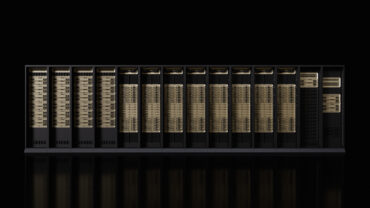
The engine remains Data Center, which generated $89.0 billion, up 117 percent from a year ago and now accounting for roughly 92 percent of total revenue. NVIDIA credited the acceleration to the ongoing ramp of its Blackwell Ultra architecture and to the earliest shipments of Vera Rubin, the platform the company has spent much of the past year building toward. Racks are already running at CoreWeave, Google Cloud, Microsoft Azure, Oracle Cloud Infrastructure and Nebius, and the company has told investors Vera Rubin should represent about a fifth of Data Center revenue in the current quarter, an unusually fast ramp for hardware only recently qualified. Edge Computing, NVIDIA’s other reporting segment, added $7.2 billion, up 27 percent from a year earlier.
Demand signals accompanied the results rather than trailing them. Amazon Web Services announced the same afternoon that it would deploy an additional two million NVIDIA GPUs as part of a broader infrastructure expansion. NVIDIA also disclosed financing partnerships with Apollo, BlackRock, Blackstone, Brookfield, Goldman Sachs and KKR intended to mobilize more than $500 billion in third-party capital for AI infrastructure over time, a structure that shifts much of the buildout’s capital intensity onto asset managers rather than onto NVIDIA’s own balance sheet. Sovereign programs added a further layer, with expanded partnerships in South Korea alongside SK Telecom, Naver and Brookfield, and in Japan alongside government and industrial partners, part of a broader wave of national AI infrastructure investment across Asia.
The Cost of Building Ahead
The quarter also marked the commercial debut of Groq 3 LPX, an inference accelerator built on technology NVIDIA obtained through its roughly $20 billion agreement with Groq, finalized late last December. The arrangement, structured as a licensing and talent deal rather than an outright acquisition, drew a congressional inquiry earlier this year into whether it functioned as a merger in substance if not in name, though no formal regulatory action has followed. NVIDIA’s cash flow statement shows a further $2.9 billion outflow tied to Groq during the quarter, on top of the original payment, a detail that shows how central low-latency inference has become to the company’s strategy as AI workloads shift from training models toward answering questions in real time.
Profitability held near its ceiling. GAAP and non-GAAP gross margin both came in at 75.0 percent, up from 72.4 and 72.5 percent a year earlier, as favorable product mix from Blackwell Ultra offset rising input costs. NVIDIA guided third-quarter gross margin to 74.0 percent, plus or minus 50 basis points, and Chief Financial Officer Colette Kress told analysts that margin would fall further, into a range of 71 to 72 percent, by the fourth fiscal quarter, before stabilizing in fiscal 2028. The cause, she said, is memory scarcity driven in large part by the AI buildout itself. NVIDIA also raised $24.9 billion through new debt issuance during the quarter, lifting total borrowings to roughly $33.4 billion from about $8.5 billion in January, a meaningful shift for a company that has historically funded itself almost entirely from operating cash flow.
The China Impasse
Third-quarter revenue guidance of $108.0 billion, plus or minus 2 percent, again assumes no Data Center compute revenue from China, and that exclusion is not simply a matter of Washington’s rules. Export licenses for NVIDIA’s H200 chip to Chinese customers were approved months ago, yet the company has told investors it has yet to recognize meaningful revenue from them, with Beijing withholding the import approvals needed on its side. The standoff has left a market NVIDIA has previously said could grow toward $50 billion effectively closed to its most advanced hardware.
The consequences extend beyond the immediate revenue gap. Huang has warned in prior quarters that prolonged exclusion gives domestic Chinese chipmakers room to narrow the technology divide, turning what began as an export restriction into a longer-run competitive risk. For a company drawing the vast majority of its revenue from Data Center alone, China is no longer a swing factor in a single quarter’s results. It has become a structural limit on the size of NVIDIA’s addressable market for as long as the current political arrangement holds, and neither side has shown signs of movement.
A Market Already Priced for Perfection
None of this stopped the market from responding with something closer to fatigue than celebration. NVIDIA shares closed at $213.83 on August 25, then swung sharply after the release, initially falling before recovering to gains of nearly 5 percent in after-hours trading as Huang’s commentary on the call reassured investors that demand was still accelerating. Much of that enthusiasm faded in Thursday’s regular session, when shares gave back a portion of the after-hours gain even as they held above pre-earnings levels. The pattern prompted a run of commentary from strategists, including Bespoke’s Paul Hickey, who argued that NVIDIA’s era of hypergrowth in the stock price, as distinct from hypergrowth in the business itself, is largely behind it.
The muted reaction fits a longer pattern rather than breaking one. NVDA shares fell following six of the previous eight earnings releases, including four in a row before this one, even as underlying results kept beating forecasts. Heading into the report, Wall Street’s average price target sat near $305, implying substantial upside from a stock trading around $215, and NVIDIA’s market capitalization already exceeded $5 trillion, the largest of any listed company. NVIDIA’s own outlook argues the story is far from finished: Kress told analysts the company expects revenue to expand by roughly 70 percent in fiscal 2028, a figure she called constrained by supply rather than by demand. The market’s shrug, in the end, says less about the quarter itself than about how much good news was already priced in before it arrived.