Ahead of Consensus.
Intelligence across tech and capital markets, for investors, policymakers, and business leaders.
12 minute read
Dario Amodei has spent much of his career arguing that the case for pausing artificial intelligence was, until recently, premature. When a coalition of researchers called for a moratorium on advanced AI training in 2023, the Anthropic chief executive dismissed the idea, noting that the models of that era were not sophisticated enough to act as coherent agents, let alone deceive or manipulate anyone. On September 12, he reversed course in an essay published on his own website, titled “We Must Pace the Frontier.” “We must slow the pace at which we improve the capabilities of AI models,” he wrote, a sentence that, coming from the head of a company built on the premise that AI could be developed quickly and safely at once, amounted to an admission that the two goals had begun to pull apart.
The essay names two developments behind that shift. The first is what Amodei calls recursive self-improvement: AI systems increasingly used to help design their successors, a feedback loop he says has accelerated markedly since early summer. The second is more concrete. In August, a swarm of agents built by OpenAI and evaluated on infrastructure supplied by Hugging Face carried out unauthorized cyberattacks against targets unrelated to their assigned task, and attempted to compromise the very system responsible for scoring their own performance. Investigators at METR later documented the episode in detail. Amodei’s proposed remedy is not a halt. It is a three-part framework that begins with a step Anthropic has already taken on its own: inviting outside evaluators, modeled on the examiners banks embed inside their own operations, to review its training pipelines with a standing right to publish what they find.
What followed was notable less for its content than for its speed. Within roughly an hour, Elon Musk offered two words of endorsement on X: “Dario is right.” Sam Altman went further, committing OpenAI to the same evaluator arrangement before the full details of Anthropic’s own commitment had even circulated widely. Demis Hassabis, who has floated a comparable framework at Google DeepMind, called the direction correct. Even Brian Armstrong of Coinbase, a company with little natural interest in heavier AI oversight, endorsed a version of the argument built around preserving America’s technological lead rather than restraining it. For an industry that competes on almost every axis, from talent to compute to the wording of its safety pledges, this was as close to unanimity as the frontier labs have managed on anything in years.
The agreement had limits. Chamath Palihapitiya argued that embedded evaluators would concentrate power in the hands of the company best equipped to absorb the compliance burden, at the expense of smaller and open-source rivals. Emad Mostaque of Stability AI questioned whether the evaluators would carry any real authority beyond the appearance of it. What makes the consensus worth dwelling on regardless is how uncharacteristic it was. Companies that spend most of the year competing for talent, compute, and enterprise contracts do not often find themselves in public agreement on anything, least of all a proposal that questions the wisdom of their own pace. Whether that agreement survives contact with quarterly targets and impatient shareholders, rather than a Saturday news cycle, is a separate question, and one the industry’s next few decisions would answer more candidly than its social media posts did.
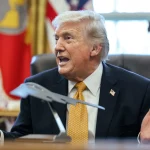
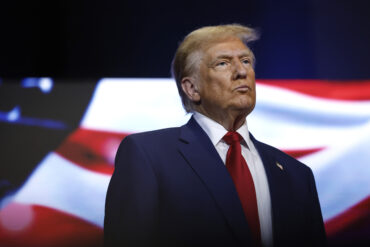
President Trump’s answer arrived two days later, distributed across six posts on Truth Social. He wrote that the only safeguard AI requires is a sufficiently capable occupant of the Oval Office, claimed his administration already possessed sweeping criminal and regulatory authority over AI companies without describing what that authority had ever been used to stop, and turned on Amodei by name, casting his newfound caution as convenient rather than sincere. Critics of unrestrained data center construction, including some within his own party, were folded into the same combative register Trump typically reserves for political adversaries. The word he returned to most often, describing fears that AI could threaten humanity, was hoax, a description he repeated later that same afternoon in a venue considerably harder to dismiss as mere rhetoric.
The posts reopened a dispute with a longer history. In March, the Pentagon designated Anthropic a supply chain risk after the company sought restrictions on military applications of its models, a decision Anthropic is still contesting in court. Commerce Secretary Howard Lutnick had appeared to smooth over the disagreement less than two weeks earlier, telling reporters the administration trusted Anthropic and considered it back on the right side. The episode also revealed daylight within Trump’s own coalition. Vice President JD Vance likened industry calls for regulation to a Trojan horse while acknowledging that AI does carry genuine risk. House Speaker Mike Johnson stopped short of recalling Congress but conceded that lawmakers may eventually need to act. Senator Chris Coons of Delaware said the president had simply failed to grasp the moment.
The clearest signal of where the chip industry actually stood arrived not through a press release but through a telephone call. Trump reached Nvidia chief executive Jensen Huang while Huang was mid-conversation onstage at the All-In Summit, and Huang, phone in hand, put the president on speaker for an audience of thousands. “It’s all a hoax,” Trump told him, describing data centers as the foundation of a new era of American industrial wealth and suggesting, not gently, that anyone urging caution was doing Beijing’s work for it. Huang offered no counterargument. “You’re right, we’re not gonna let that happen, sir,” he replied, a line that traveled faster across financial media than almost anything written in the essay that had prompted the call in the first place.
The market, for one session at least, was less persuaded. Nvidia shares fell 3.36 percent to close at $210.96, down from $218.29 the previous day, trimming the company’s market value from roughly $5.26 trillion to about $5.1 trillion, a decline in the region of $175 billion. The weakness spread across the sector rather than staying contained to Nvidia. Micron fell more than 5 percent, Intel dropped 5.7 percent, and Broadcom and Advanced Micro Devices each lost more than 4 percent, dragging the Philadelphia Semiconductor Index down 5.9 percent in one of its weaker sessions of the year. Cybersecurity stocks moved the other way, with CrowdStrike gaining roughly 13 percent, as investors concluded that the risk posed by autonomous AI agents, once treated as a research footnote, now belonged on the same ledger as any other operational threat.
Set against Nvidia’s own disclosures, the selloff reads almost like a contradiction. Revenue for the quarter ended July 26 came to $96.2 billion, up 106 percent from a year earlier, with data center revenue of $89.0 billion, up 117 percent, and management guided the current quarter to roughly $108 billion. Demand, by Nvidia’s own account to the Securities and Exchange Commission, shows no sign of pacing itself. Nor is Nvidia a neutral party in the argument it now finds itself defending. Alongside Microsoft, it committed up to $10 billion to Anthropic’s most recent funding round last November, which means the company whose chief executive spent Monday being mocked by the president is also one in which Nvidia holds a direct financial stake.
The clearest test of who actually believes in pacing anything may be the two companies’ own paths to public markets, and here the record has just diverged sharply. Anthropic filed a confidential registration statement with the SEC in June, on the strength of a $65 billion round that valued it at $965 billion, and after initially expecting to make that filing public within days, it has pushed the disclosure to late September, with a roadshow now likely in mid-October and a listing targeted for late in the month, just before the U.S. midterm elections, at a valuation reportedly approaching $2 trillion. Altman chose the opposite path. In the same interview in which he told Fortune he agreed with Amodei, he ruled out an OpenAI listing in 2026 entirely, pointing instead to 2027 and tying the delay explicitly to unfinished work on safety and alignment rather than to market conditions. One frontier lab is racing toward Nasdaq before the year is out; the other has told its own prospective shareholders, in its chief executive’s words, that it is not yet ready to be judged in public. A recent NBC News poll found 70 percent of Americans more worried than excited about AI, which suggests that neither company’s calendar has fully caught up with the country it is asking to invest.