- Cloud Computing
- Data Centers
- Earnings Report
- Semiconductors
Arm’s Q2 Beat Exposes the Gap Between Licenses and Royalties
9 minute read
Arm’s second-quarter revenue rose 27% to $1.44 billion, a record for the period, on a 50% surge in license fees, but royalties grew just 8% and missed forecasts, and investors noticed the difference.
Key Takeaways
- License and other revenue jumped 50% to $773 million, while royalties rose 8% to $670 million, short of the roughly $721 million LSEG consensus and Arm’s own low-teens growth guide.
- Data center royalties doubled and Arm expects more than 60% server share at top hyperscalers by the end of 2026, but pressure on smartphones from memory prices held royalty growth down.
- Arm guided third-quarter revenue to $1.54 billion and voiced greater confidence in up to $2 billion of AGI CPU revenue across fiscal 2027 and 2028. Shares slipped about 2% after hours.
Two Engines, Two Speeds
Arm Holdings has rarely needed to explain a beat. Its second quarter of fiscal 2027, the three months to September 30, may be the exception. Revenue rose 27% to $1.443 billion, above the top of the company’s own guidance range and the highest second-quarter figure in its history. Non-GAAP earnings per share climbed 33% to $0.52, five cents ahead of both the guidance midpoint and the LSEG consensus. It was the fifth consecutive quarter of growth above 20%, achieved while non-GAAP research and development spending rose 17% to $547 million.
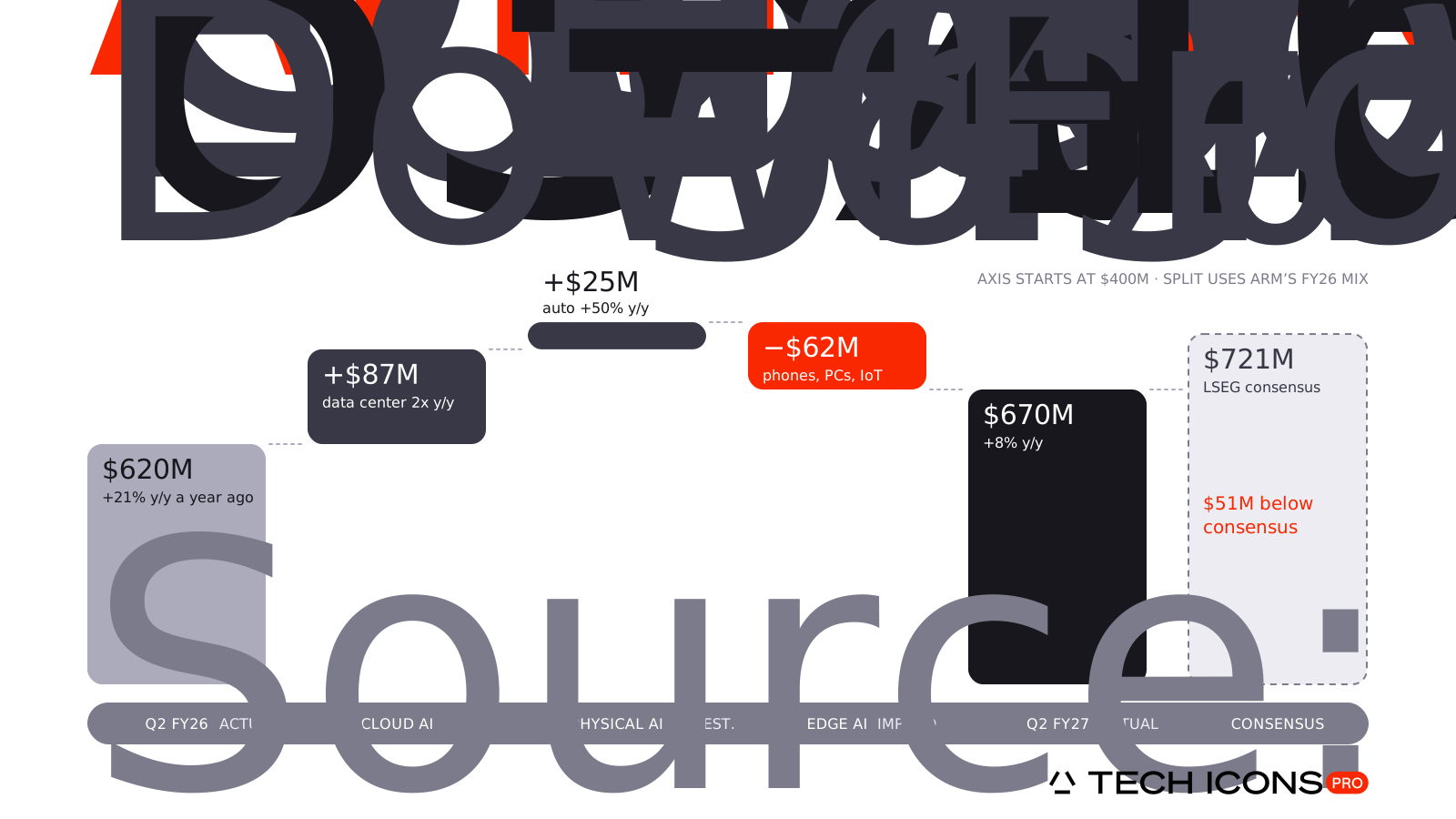
Beneath the total, the two halves of the business moved at sharply different speeds. License and other revenue rose 50% to $773 million. Royalty revenue, the recurring income that accrues each time a partner ships an Arm-based chip and the stream on which the company’s valuation chiefly rests, grew 8% to $670 million. Analysts surveyed by LSEG had expected about $721 million, and in July management itself had pointed to low-teens growth. Royalties also slipped from $715 million in the June quarter, a sequential decline the company had avoided in the same period in each of the previous two years. For the second time in three quarters, Arm earned more from signing contracts than from the chips those contracts produce.
Fees Running Ahead of Commitments
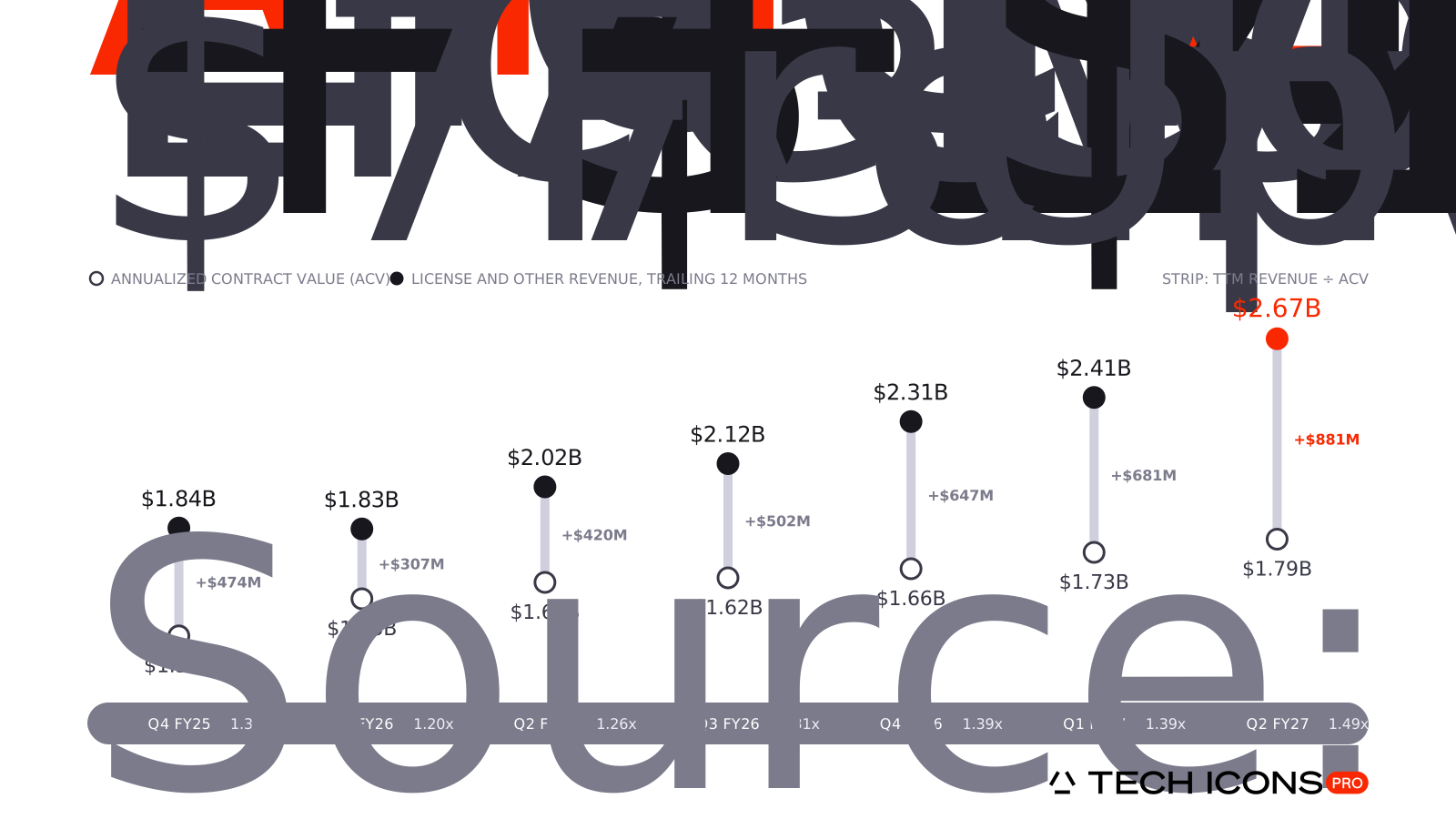
Arm credited the licensing surge to strong demand for its intellectual property, and also to the timing and size of several high-value agreements and contributions from backlog. The second explanation deserves more weight than the first. Annualized contract value, the company’s normalized measure of licensing commitments, grew 12% to $1.79 billion, little more than half the 22% pace of two quarters earlier. When recognized license revenue expands four times faster than the contract base beneath it, timing is doing much of the work.
“Our IP business continues to grow, with 50% licensing growth demonstrating the increasing investment in the power efficient Arm compute platform which will drive even higher royalty growth in the future.” Rene Haas, Chief Executive Officer, Arm
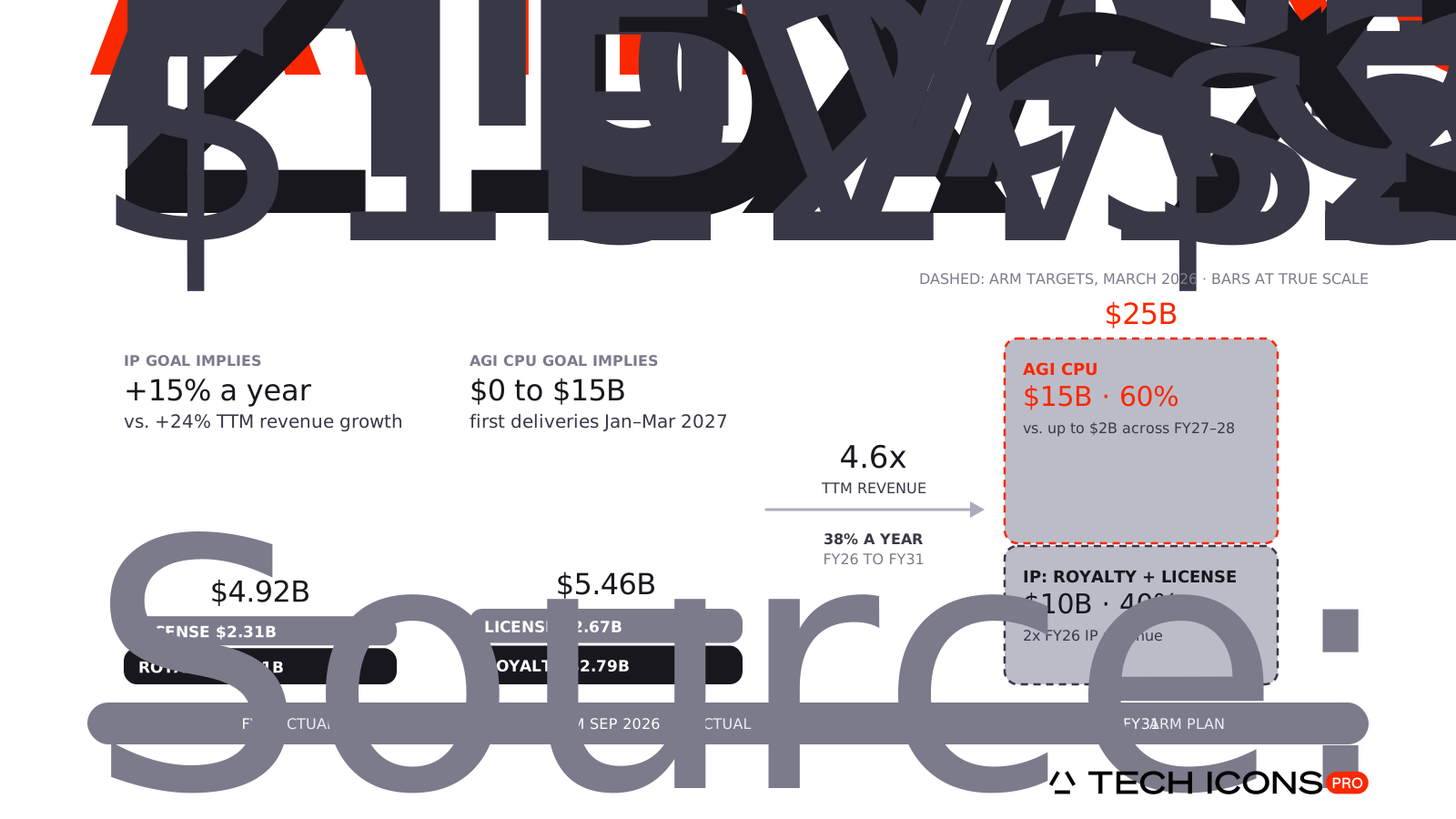
The mix carried one encouraging signal. Revenue from external customers rose 43% to $1.02 billion, while revenue from related parties, chiefly Arm China and SoftBank affiliates, held flat at $424 million. Skeptics have long argued that Arm’s growth leans too heavily on its controlling shareholder; this quarter’s expansion came almost entirely from outside that circle. Arm also signed four more Compute Subsystems licenses for data center and smartphone chips, designs that carry roughly double the royalty of a standard Armv9 CPU. Its March forecast calls for royalties to compound at 20% a year through fiscal 2031, with more than 70% of that total tied to rates already under contract. The case for patience is written into those contracts. The evidence will arrive only as the chips do.
Where the Royalties Are Growing
The data center is now the clearest source of royalty momentum. Data center royalties doubled year over year, and Arm says its share of servers at the largest hyperscalers rose from 15% in calendar 2024 to more than 50% in 2025, with more than 60% expected by the end of 2026 as Google Axion, AWS Graviton, Microsoft Cobalt and Nvidia platforms ramp. Amazon has reported a more than twentyfold increase in Graviton revenue commitments, and Nvidia’s Arm-based Vera CPU is generally available on Oracle Cloud Infrastructure. The new Neoverse CSS N4, which Arm says delivers up to twice the performance per socket and 25% better performance per watt than its predecessor, is aimed at operators for whom electricity, not floor space, has become the binding constraint. Physical AI royalties, driven by driver assistance and in-vehicle systems, rose 50%.
Smartphones account for the shortfall. Arm said higher royalty rates from Armv9 and CSS were partly offset by the effect of memory pricing on the handset market. It is a pressure Arm cannot answer with share gains, since it already holds more than 99% of the mobile applications processor market by value. The breadth of the platform is not in question. Partners shipped more than 10 billion Arm-based chips in a single quarter for the first time, and Arm-based machines now account for about 20% of global PC shipments. What the quarter exposed is how much the royalty line still depends on a consumer market whose input costs Arm does not control.
The Licensor Becomes a Supplier
The deeper change is to the business model itself. In March, Arm unveiled the AGI CPU, its first production silicon: a data center processor built on TSMC’s 3-nanometer process, with Meta as lead partner. The company now reports purchase orders from multiple customers extending through calendar 2027 and first commercial deliveries on track for the fiscal fourth quarter. It also cites greater confidence in up to $2 billion of AGI CPU revenue across fiscal 2027 and 2028, supported by additional supply and customer mix. The language has shifted with it. In July, $2 billion described customer demand; it now describes revenue, though “up to” marks a ceiling rather than a commitment. Oracle plans to offer AGI CPU instances in 2027, and Arm’s longer-range plan envisions about $15 billion of chip revenue by fiscal 2031. The price of that ambition is that Arm now sells into the same data centers as licensees such as Nvidia, Amazon and Google, a tension it addresses by stressing that both businesses run on one software ecosystem.
The financial profile will change accordingly. Non-GAAP gross margin was 97.9% in the quarter, a level no business carrying wafer and packaging costs can match. Non-GAAP operating margin widened to 44.2% from 41.1% as revenue outpaced a 19% rise in operating expenses, yet GAAP operating margin stood at 13.9% after $377 million of share-based compensation. Cash generation weakened. Operating cash flow fell to $207 million from $567 million and non-GAAP free cash flow to $110 million from $411 million, as contract assets grew by $203 million in the quarter. Arm also paid $249 million for acquisitions, consistent with the DreamBig Semiconductor deal that closed on July 1, and ended the period with $3.62 billion in cash and short-term investments.
A Market Asking for Proof
The results reached a stock that had already absorbed considerable pain. Arm’s shares fell about 37% in the month to November 4 and traded at less than half their 52-week high of $452.70, although they were still up roughly 85% year to date on November 3. They closed Wednesday 5.3% lower at $192.15 after Asian chip stocks fell on concerns about limits to AI data center growth. After the release, the shares slipped about 2% in extended trading. The reaction was measured, and it tracked the royalty shortfall more closely than the headline beat.
Guidance offered support without settling the debate. Arm forecast third-quarter revenue of $1.54 billion, plus or minus $50 million, against an LSEG consensus of $1.53 billion, implying growth of about 24% from $1.24 billion a year earlier. It guided non-GAAP earnings per share to $0.56, plus or minus $0.04, and non-GAAP operating expenses to about $825 million, a sign that investment will keep running hot. License fees are inherently lumpy and AGI CPU deliveries are still months away, so royalties remain the most reliable gauge of whether Arm’s design wins are becoming durable income. The company’s argument is that this quarter’s contracts are next year’s royalties. Until that conversion shows up in reported numbers, investors appear content to discount the beat.