- AI Investment
- Bond Market
- Cloud Computing
- Data Centers
AWS Hits 39%, but Amazon’s 2027 Capex Plan Sends Shares Lower
9 minute read
Amazon’s operating margin reached a record 13.9% and AWS grew at its fastest pace in nearly five years, but an EPS miss, soft guidance and a bigger 2027 capex plan weighed on the shares.
Key Takeaways
- AWS revenue rose 39% to $46.0 billion with $17.8 billion of operating income. That lifted group operating profit to $28.1 billion, $1.6 billion above the top of Amazon’s own guidance.
- Diluted EPS of $1.89 missed consensus near $1.96 and advertising fell short of forecasts, while trailing free cash flow swung to a $42.4 billion outflow as capital spending surged.
- Fourth-quarter guidance came in below consensus at the midpoint, and Jassy said 2027 capital spending will be “meaningfully more” than this year’s roughly $220 billion.
Two Ledgers, One Company
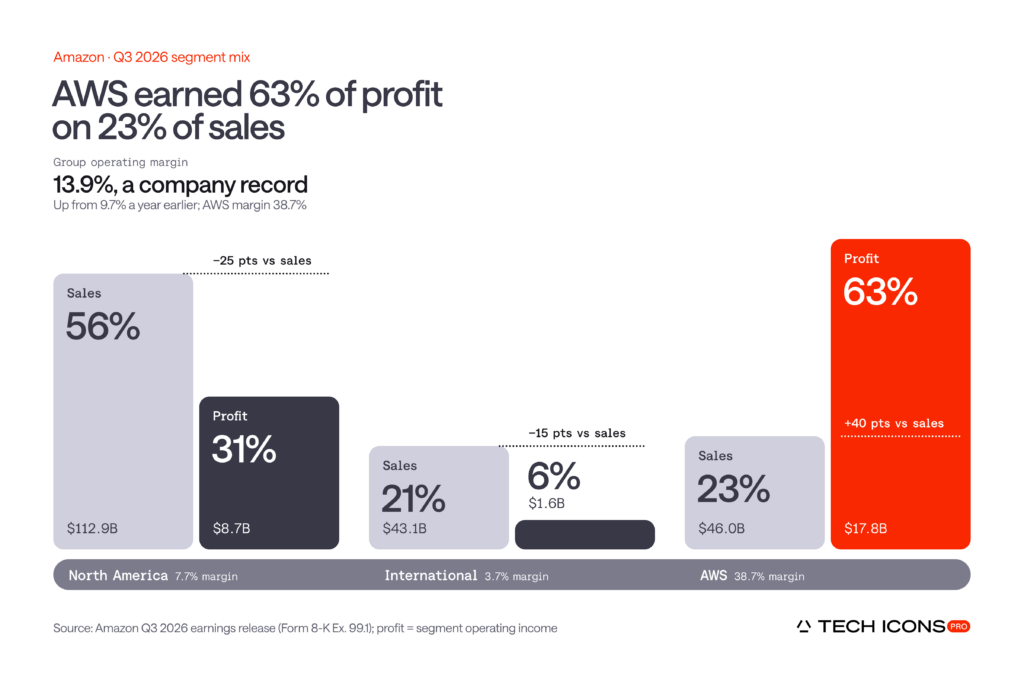
Amazon’s third-quarter results, released after the Nasdaq close on October 29, read like two documents bound in a single cover. The first is an operating report of unusual strength. Net sales rose 12% to $201.9 billion, or 13% excluding a $0.9 billion currency drag. Operating income reached $28.1 billion, up from $17.4 billion a year earlier. The resulting 13.9% operating margin is the highest in Amazon’s history, and profit beat the top of the company’s own $22.5 billion to $26.5 billion guidance by $1.6 billion.
The second document is less comfortable. Net income fell to $20.7 billion, or $1.89 per diluted share, from $21.2 billion, or $1.95, a year earlier. That missed the roughly $1.96 analysts surveyed by LSEG had expected. The explanation lies below the operating line. Non-operating items swung to a net expense of $1.2 billion from income of $10.7 billion in the prior-year quarter, when Amazon booked $9.5 billion of pre-tax gains on its Anthropic stake. Revenue came in fractionally below the $202.3 billion consensus, though at the top of the guided range. Markets trade the headline first. Shares fell more than 7% in after-hours trading, extending a 4% decline in a regular session overshadowed by Alphabet’s post-earnings slide.
The Cloud Is Still Accelerating
AWS remains the center of gravity for the investment case, and it strengthened rather than leveled off. Segment sales rose 39% to $46.0 billion, the fastest growth in nearly five years, taking the annualized run rate to $184 billion. The progression deserves the most attention. Growth has moved from 20% a year ago to 24%, 28%, 37% and now 39% in consecutive quarters, each time on a larger base. Operating income climbed to $17.8 billion from $11.4 billion, and the margin widened to 38.7% from 34.6%. That held close to the second quarter’s 39%, even though finance chief Brian Olsavsky warned in July that margins would shift with investment levels and the mix of AI work.
Our AWS investment in functionality and infrastructure is working.
The forward indicators point the same way. Fortune 500 spending on Bedrock, Amazon’s managed model platform, rose nearly sevenfold from a year earlier, and token volume rose nearly seventeenfold. Customers of AgentCore, its agent platform, deployed twice as many agents in the quarter as in the previous three combined. The contracted book extends the view: on the call, Jassy put the AWS backlog at $578 billion, more than double a year earlier and up from $496 billion at the end of June. Jassy used the release to put a number on that visibility, projecting AWS growth above 40% in both 2027 and 2028. He has also said next year’s capacity is already “largely sold out.” In cloud, the constraint has moved from demand to delivery.
Stores Hold Firm, Advertising Wobbles
The retail segments carried a calendar distortion. Most large markets held Prime Day in the second quarter rather than the third, and Amazon estimates growth would otherwise have been about 400 basis points higher. North America sales rose 6% to $112.9 billion. International rose 5% to $43.1 billion, or 8% in constant currency. Online store sales grew just 2% to $68.5 billion, while third-party seller services rose 9% to $46.5 billion. Profitability was sturdier than the top line. North America operating income rose to $8.7 billion from $4.8 billion, a margin near 7.7%. The prior year absorbed a $2.5 billion Federal Trade Commission charge, so the cleaner comparison is with $7.3 billion, an underlying gain of about 19%.
Advertising was the quarter’s clearest weakness. Ad revenue rose 11% to $19.6 billion, or 12% excluding currency. That is less than half the second quarter’s 26% and short of the roughly $20.8 billion analysts had expected. Management blamed part of the slowdown on Prime Day timing and guided to high-teens growth in the fourth quarter. It also launched Amazon Ads Agent and Full-Funnel Campaigns for U.S. advertisers. The wider store looked healthy. Groceries and everyday essentials grew about three times faster than the rest of the store and made up about half of units sold. Amazon Now reached more than 450 towns and cities, with items ordered up tenfold. The open question is whether the ad slowdown is only about timing. It could instead be an early sign that AI shopping agents are coming between shoppers and the sponsored placements that made the business so profitable.
Financing the Customers
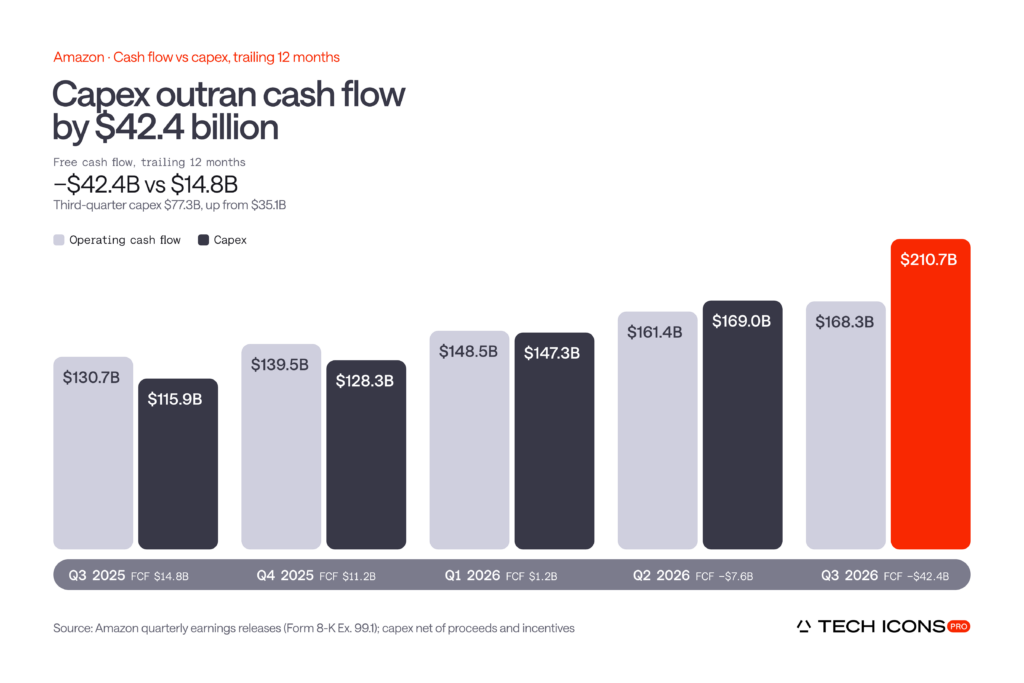
The cost of AWS demand shows up in the cash flow statement. Trailing twelve-month operating cash flow rose 29% to $168.3 billion. Free cash flow, however, swung to an outflow of $42.4 billion from an inflow of $14.8 billion a year earlier, as net purchases of property and equipment rose $94.8 billion. In the third quarter alone, purchases of property and equipment reached $77.3 billion, more than double the $35.1 billion of a year earlier. Amazon reaffirmed its plan for about $220 billion of 2026 cash capital spending, a target raised from roughly $200 billion in July because of higher memory and component costs. On the call, Jassy said Amazon expects to spend “meaningfully more” in 2027.
There has never been a trillion dollar revenue business, and we may have two.
The balance sheet has adapted accordingly. Long-term debt reached $128.9 billion at June 30, nearly double the $65.6 billion at the end of 2025. More striking is Amazon’s role as financier to the AI labs that fill its data centers. At mid-year it carried Anthropic nonvoting preferred stock at about $92.5 billion and convertible notes at an estimated fair value of $97.9 billion. After June 30 it invested a further $21.3 billion in OpenAI, bringing that Series C position to $50 billion. These holdings lift reported earnings when private valuations rise, as the $53.4 billion non-operating gain in the second quarter showed. They also cut the other way, as this quarter’s swing below the line demonstrates. A growing share of AWS demand now comes from customers in which Amazon is also a major investor.
What Friday Will Price
Guidance offered less comfort than the quarter itself. For the fourth quarter, Amazon expects net sales of $240 billion to $247 billion, up 12% to 16% despite a currency headwind of about 60 basis points. It expects operating income of $28.5 billion to $33.5 billion, against $25.0 billion a year earlier. Both midpoints sit below consensus: $243.5 billion against roughly $244.5 billion in sales, and $31.0 billion against about $32.9 billion in operating income. Before the report, options markets had priced a move of roughly 7.5% in either direction. The week has shown little patience for capital budgets without visible returns: Alphabet shares fell more than 12% after its own results.
Friday’s session will turn on which ledger investors choose to weight. Amazon’s operating business has never run at a wider margin, AWS is still accelerating, and management is guiding to a record holiday quarter. Jassy went further, arguing that Amazon may build two trillion-dollar revenue businesses within five to ten years, which he identified on the call as AWS and the stores business. Against that stand a free cash outflow that is still widening, an advertising business growing at less than half its recent pace, and reported earnings that move more and more with the valuations of private AI stakes. The call has already answered the question on 2027 spending, though not in the way investors hoped. Investors will learn whether the after-hours discount was prudence or an overreaction to a quarter that was stronger than its headline.