
Ahead of Consensus.
Intelligence across tech and capital markets, for investors, policymakers, and business leaders.
9 minute read
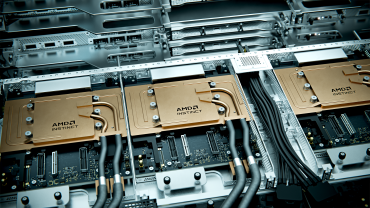
For most of the past decade, Advanced Micro Devices occupied an enviable but ultimately secondary position in the semiconductor industry: a credible challenger, perpetually competitive, rarely commanding. That characterization no longer holds. Results reported on May 5 for the first quarter of 2026 confirm what the company’s recent trajectory has been signaling for several quarters: AMD has crossed into different territory, one defined by structural demand rather than cyclical fortune.
Revenue reached $10.25 billion for the three months ended March 2026, a 38% increase from the same period a year earlier. Non-GAAP diluted earnings per share climbed to $1.37, up 43% year-on-year. Both figures exceeded analyst expectations. More significant than the headline numbers, however, is where the growth is coming from and what it reflects about the durability of AMD’s position in an industry undergoing rapid, sustained transformation.
The Data Center segment is now unambiguously the center of gravity for AMD’s business. It generated $5.8 billion in first-quarter revenue, a 57% increase from Q1 2025 and enough to account for the majority of the company’s total growth. CEO Dr. Lisa Su described the trajectory as a “clear inflection,” and the data supports that framing.
Two forces are driving this: sustained momentum in EPYC server processors and an accelerating ramp of Instinct GPU accelerators. EPYC “Turin” fifth-generation processors delivered record server CPU revenue for the fourth consecutive quarter. Cloud providers including AWS, Google Cloud, Microsoft Azure, and Tencent have continued to expand EPYC-powered deployments, using them to underpin training, inference, and increasingly complex agentic AI applications. The processor’s architectural competitiveness in large-scale, memory-intensive workloads has made it a default consideration for any serious infrastructure procurement decision.
The GPU story is more nuanced but no less consequential. AMD’s Instinct accelerators operate in a market where NVIDIA’s ecosystem advantages remain formidable. Yet the competitive picture is evolving. Meta’s commitment to deploy up to six gigawatts of AMD Instinct capacity, starting with a custom MI450-based solution, represents a relationship of strategic depth rather than opportunistic diversification. Partnerships with Samsung on HBM4 memory and with TCS on Helios rack-scale systems point to an expanding integration into the full infrastructure stack, not simply component-level substitution. Sovereign AI initiatives in Korea and India add further breadth, reflecting AMD’s emergence as a supplier of genuine geopolitical relevance to governments seeking to build domestic AI capacity outside single-vendor dependencies.

What distinguishes AMD’s current phase from previous periods of revenue expansion is the quality of earnings accompanying the growth. GAAP gross margin expanded to 53% from 50% a year earlier; non-GAAP gross margin reached 55%. Free cash flow hit a record $2.6 billion for the quarter, more than tripling year-on-year. Non-GAAP operating margins held at 25%, even as operating expenses rose in absolute terms to fund expanded R&D and go-to-market investments.
This is the operational signature Su has cultivated across a multi-year reinvention of the company. The expansion of product roadmaps and ecosystem investments has not come at the expense of financial rigor. Capital is being returned to shareholders through repurchases while the balance sheet retains the flexibility required for continued investment cycles. The combination of record cash generation and sustained margin discipline at a moment of rapid scaling is precisely what institutional investors have been waiting to see at this scale.
Beyond data centers, the picture is constructive without being exceptional. The Client and Gaming segment posted $3.6 billion in revenue, up 23% year-on-year. Client revenue grew 26% to $2.9 billion, supported by Ryzen processor share gains in consumer and commercial markets, including AI-optimized Ryzen AI 400 series units positioned for edge inference applications. Gaming revenue rose 11% to $720 million, with Radeon GPU demand partially offset by softer semi-custom sales. Embedded revenue reached $873 million, up 6%, reflecting a gradual recovery in industrial and automotive end markets after a prolonged inventory correction. Its diversified exposure to industrial automation and connected vehicles provides long-term optionality that markets have yet to fully price.
Investors responded decisively to the overall results. Advanced Micro Devices, Inc. (NASDAQ: AMD) shares rose between 6% and 15% in after-hours trading on May 5, extending a strong year-to-date performance. The reaction was less about surprise than confirmation: that the AI revenue cycle is real, measurable, and extending into forward guidance with credibility. For the second quarter, AMD guided revenue of approximately $11.2 billion, implying sequential growth of roughly 9% and year-on-year expansion of around 46% at the midpoint. Non-GAAP gross margin is expected at approximately 56%. Management expressed particular confidence in accelerating deployments of MI450 Series accelerators and Helios rack-scale systems as supply scales to meet demand commitments already in place. The company’s “Advancing AI 2026” event, scheduled for July, is expected to outline next-generation roadmap developments across both Instinct and EPYC product lines.
Supply constraints at advanced nodes remain a near-term variable, with the ability to scale production matching the pace of commercial commitments a recurring challenge across the sector. Export restrictions continue to shape AMD’s China exposure, though management characterized the financial impact as contained within existing guidance. Broader macroeconomic conditions, currency headwinds, and the potential for inventory corrections in non-AI segments merit attention as the year progresses. Competition in AI GPUs remains the most consequential long-term variable. NVIDIA’s installed base, software ecosystem, and customer relationships represent structural advantages that do not erode quickly. AMD’s path is not displacement but differentiation: offering hyperscalers and sovereign buyers a credible alternative with meaningful cost, performance, and supply-chain diversification benefits. The Meta partnership, in particular, demonstrates that this argument is resonating at the highest levels of infrastructure investment.
AMD’s first-quarter results are the clearest evidence yet that the company’s transformation from a challenger brand into a structural participant in AI infrastructure is complete, or very nearly so. The combination of CPU leadership in the server market, credible GPU momentum, record cash generation, and deepening relationships with the world’s largest technology operators defines a different kind of AMD from the one that existed even two years ago. The coming quarters will test the company’s ability to scale supply, defend margins, and extend its roadmap advantages against a competitive field that is neither standing still nor conceding ground.
What is already apparent, however, is that AMD has built the kind of institutional relationships, financial profile, and product depth that sustain competitive relevance through full technology cycles, not just favorable quarters. For senior investors and policymakers monitoring the semiconductor industry’s role in national competitiveness and AI infrastructure buildout, that distinction matters considerably. The foundation is in place; the question now is how high AMD chooses to build on it.