
- AI Chips
- Data Centers
- Earnings Report
- Semiconductors
Qualcomm Tops Forecasts but Its Future Now Rests on the Data Center
9 minute read
Automotive sales nearly doubled and revenue reached the top of guidance, but a 26% handset decline, Apple’s exit and rising chip costs make fiscal 2027 the test of Qualcomm’s reinvention.
Key Takeaways
- Non-GAAP revenue of $10.44 billion reached the high end of guidance and beat consensus by roughly $300 million, while adjusted EPS fell 28% to $2.17 as handset weakness and costs weighed.
- Automotive revenue rose 89% to a record $1.99 billion, lifting combined automotive and IoT sales 36% and winning back more than half of the $1.8 billion lost in handset chips.
- Amazon’s warrant, vesting against up to $60 billion of purchases, supports a $5 billion data center target for fiscal 2027, but the investment behind it trims three points from chip margins.
A Quarter That Cleared a Lowered Bar
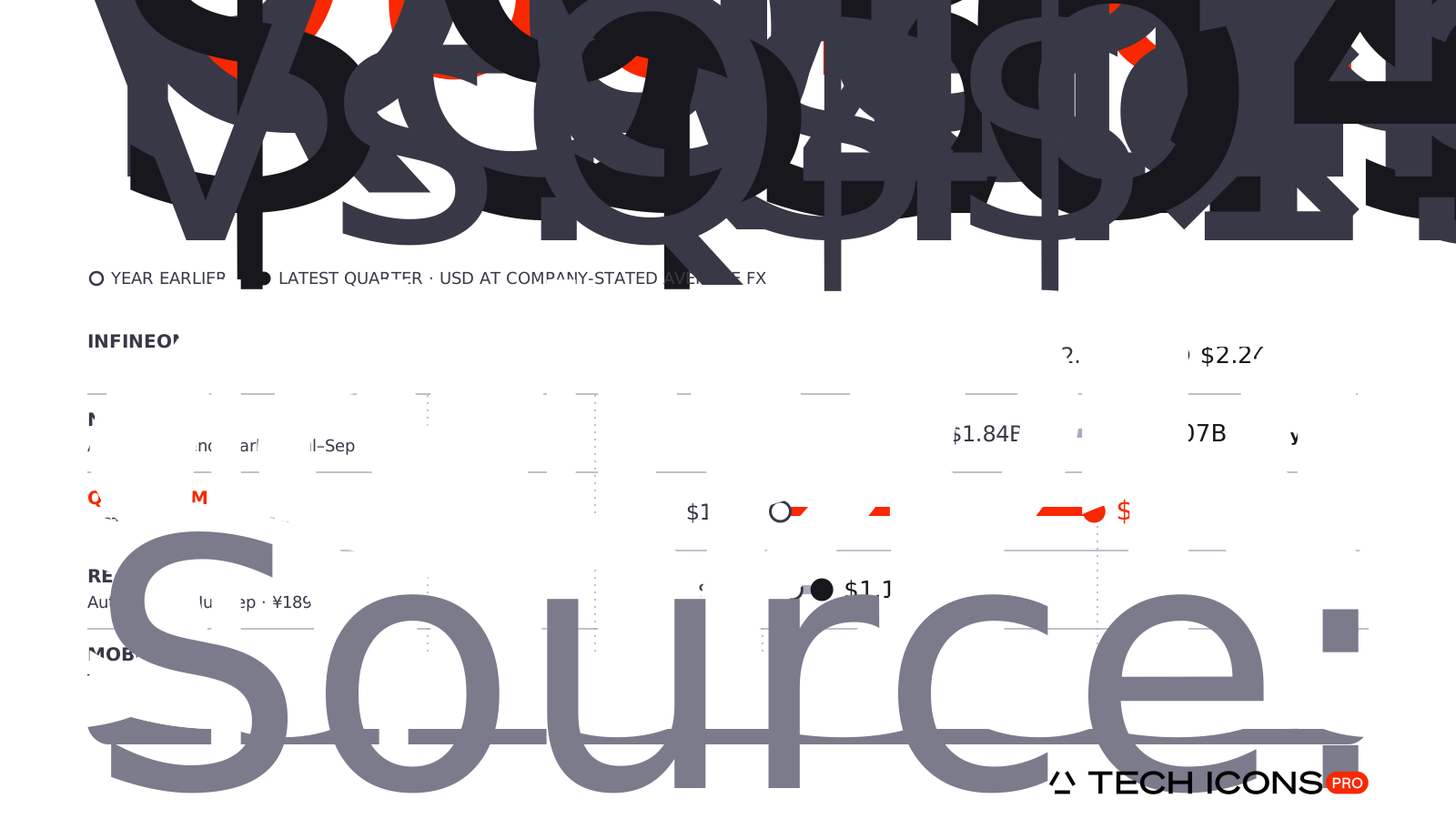
Qualcomm ended fiscal 2026 as investors had expected: ahead of forecasts, behind its own recent past. For the three months to September 27, non-GAAP revenue fell 7% to $10.44 billion, at the top of the $9.7 billion to $10.5 billion range management set in July and roughly $300 million above consensus. Adjusted earnings per share declined 28% to $2.17, a cent ahead of the Street. Reported revenue was $10.32 billion; the $120 million gap reflects a payment to a customer under a legal settlement, which Qualcomm leaves out of its adjusted results.
The full-year figures carry the same restraint. Non-GAAP revenue slipped 2% to $43.24 billion and adjusted EPS fell 12% to $10.54. GAAP net income more than doubled to $13.63 billion, yet $5.7 billion of it came from reversing a tax valuation allowance recorded a year earlier, an accounting entry rather than evidence of operating strength. The market had already priced much of this in. The shares fell almost 9% in the week before the report, rose about 3.6% in Wednesday’s session after SpaceX chose Qualcomm to supply its Starlink Mobile 5G network, and added roughly 1.8% in early after-hours trading. Options had implied a move closer to 10%. The muted reaction suggests investors are no longer trading the quarter. They are trading the transition.

The Handset Engine Loses Power
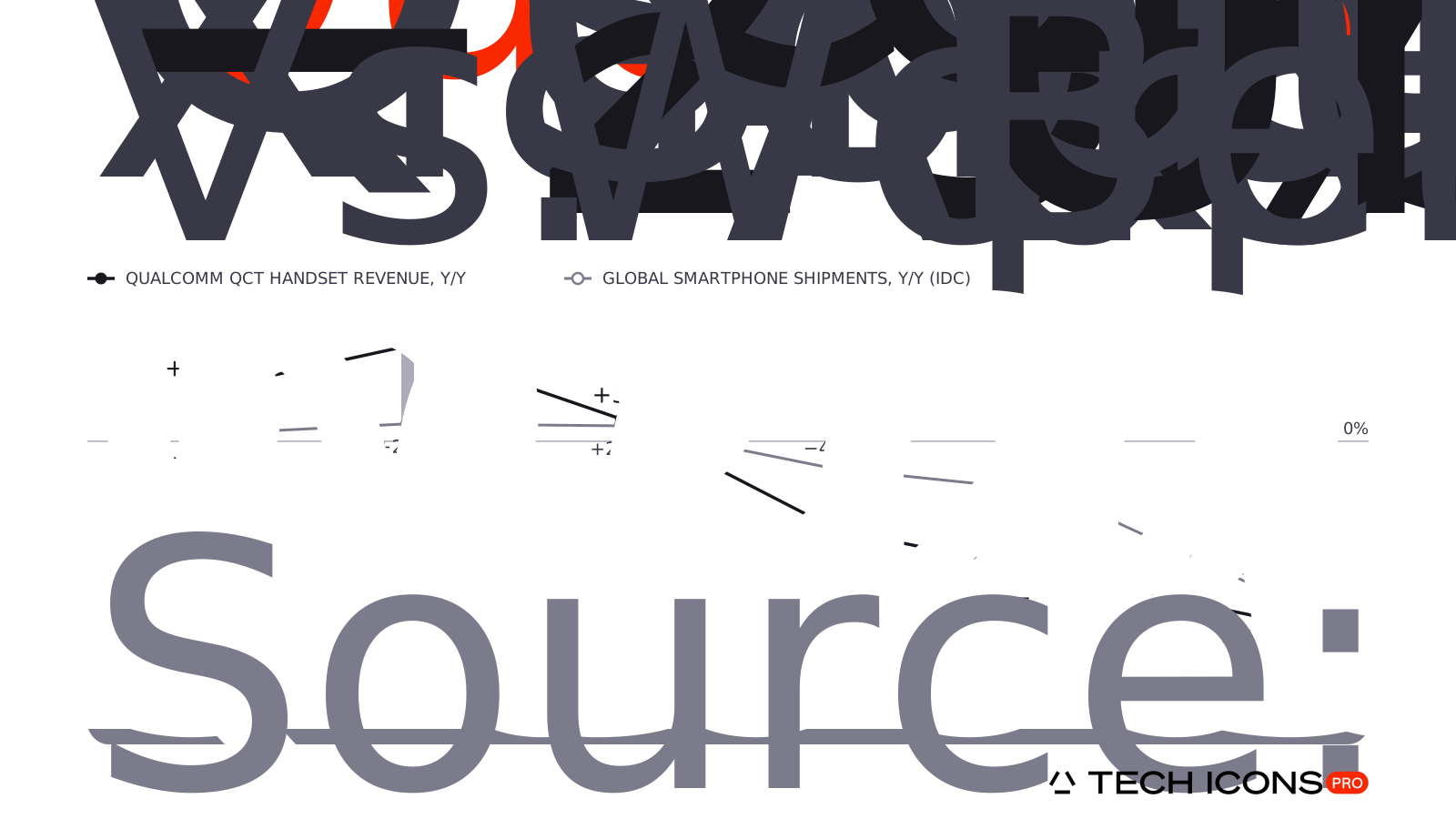
The pressure came where everyone expected it. Handset chip revenue fell 26% to $5.14 billion, short of the $5.25 billion consensus and a third below the record $7.82 billion reported only three quarters earlier. Qualcomm’s annual report attributes the decline to large phone makers cutting build plans and drawing down inventory as memory shortages pushed component prices higher, cost and capacity pressures the filing links in part to demand for AI and data center chips. IDC estimates global smartphone shipments fell 22% in the September quarter, the steepest decline it has recorded.
Apple turns a cyclical problem into a structural one. The 10-K states that Apple is expected to rely primarily on its own modems, a shift the company warns will significantly reduce chip revenue, even though Apple and Samsung each still accounted for at least 10% of fiscal 2026 sales. Qualcomm’s reduced share of iPhone 18 modems was shipped in the September quarter, and Chief Executive Cristiano Amon said the December-quarter outlook assumes no further chip revenue from Apple. In July, Qualcomm had expected Apple revenue to roughly halve from the September quarter to December. Geography adds a second layer of exposure. China, measured by customer headquarters, represented 42% of revenue, down from 46%, a concentration the filing continues to identify as vulnerable to U.S.-China trade and security tensions.
Cars Carry More of the Load
Automotive absorbed much of the strain. Revenue rose 89% to a record $1.99 billion, which management presents as its first $2 billion quarter, and grew 52% for the year to $6.0 billion. The 10-K credits $1.3 billion of the annual increase to a richer product mix and higher selling prices, and $712 million to volume from new vehicle programs built on Snapdragon digital cockpit and driver-assistance platforms. That composition matters, because growth driven by content per vehicle tends to outlast growth tied to a single model cycle. IoT expanded a more modest 4% to $1.89 billion.
Together, automotive and IoT reached 43% of chip revenue in the quarter and 35% for the year, up from 28% in fiscal 2025, as non-handset sales grew 24%. Licensing remains the ballast. QTL revenue was flat at $5.56 billion with a 72% pre-tax margin, and renewed long-term agreements with Apple, Huawei and Transsion complete the 5G-era renewal cycle. The next cycle does not open until fiscal 2030, which removes a recurring source of negotiating risk and ties royalty income more closely to handset volumes than to the courtroom.
Amazon Turns a Plan Into Purchase Orders
The data center strategy gained its second anchor customer in September. According to a Form 8-K filed with the SEC, Qualcomm issued Amazon a warrant for up to 25 million shares at $161.26, about 2.3% of shares outstanding, vesting against as much as $60 billion of purchases through 2036, with 3.75 million shares vested at once on initial commitments. The deal covers custom AI inference chips and optical links of up to 1.6 terabits per second, and it sits alongside an existing CPU partnership with Meta. Management expects at least $650 million of data center revenue in the December quarter, $5 billion for fiscal 2027, a $7 billion annualized run rate by the end of that year and more than $15 billion in fiscal 2029.
Amazon earns equity only as it buys, which ties the warrant’s value to the revenue it brings Qualcomm. Much of the capability behind the deal, however, was acquired rather than built. Qualcomm closed Alphawave for $2.3 billion in December 2025, AI software developer Modular for $2.6 billion in July and eight smaller businesses for $1.1 billion, lifting goodwill to $16.4 billion from $11.4 billion. Research and development spending rose to $10.2 billion from $9.0 billion, and capital spending roughly doubled to $2.5 billion. The costs arrive before the revenue: data center investment will cut three percentage points from the chip unit’s margin in the December quarter.
Margins, Cash and a Year of Proof
Rising input costs are the near-term constraint. Qualcomm reports higher prices across wafer fabrication, packaging, test and memory, and says its own price increases will not reach full effect on gross margin until the second half of fiscal 2027. The chip unit’s pre-tax margin fell to 24% from 29% in the quarter, well short of its 30% long-term target. Inventory rose 32% to $8.64 billion, purchase commitments reached $18.6 billion and restructuring, mostly severance, cost $343 million. Free cash flow of $8.65 billion fell short of the $11.67 billion returned through buybacks and dividends, and cash and marketable securities declined to $7.7 billion from $10.2 billion.
The guidance explains the measured response. December-quarter revenue of $10.4 billion to $11.2 billion sits above the $10.48 billion LSEG consensus, and chip revenue of $9.0 billion to $9.6 billion beats expectations. The $2.25 EPS midpoint, however, trails the $2.27 forecast and sits 36% below the $3.50 earned a year earlier. One overhang eased in October, when a Delaware jury found that Arm had breached its license agreement with Qualcomm; remedies still await the court. What remains is a question of timing. Fiscal 2027 will show whether Amazon, Meta and the automakers can scale quickly enough to replace Apple, and whether pricing can rebuild margins while the market is still willing to wait.