- AI Infrastructure
- Cloud Computing
- Data Centers
- Earnings Report
Alphabet's Cloud Doubles as AI Spending Drains Free Cash
9 minute read
Google Cloud revenue rose 103% to $30.7 billion in the third quarter, but a Search shortfall, an $8.7 billion equity loss and $51.4 billion of capex left free cash flow negative.
Key Takeaways
- Revenue rose 25% to $127.6 billion, Alphabet’s fastest growth since 2021. Search advanced only 12%, down from 17% in the second quarter, even as query growth reached a five-year high.
- Google Cloud earned $11.1 billion of operating income on $30.7 billion of revenue, a 36.2% margin. That defied July’s warning of margin pressure, and sales of TPU systems became a meaningful contributor.
- Capex of $51.4 billion left free cash flow at negative $9.1 billion. Alphabet bought back no stock, sold $12.4 billion of shares and lifted long-term debt to $125.1 billion.
Two Readings of One Quarter
Alphabet’s third quarter supports two readings, and the tension between them is the story. Judged by its operations, the company has seldom been in better shape. Revenue rose 25% to $127.6 billion, the fastest growth since 2021, and operating income climbed 30% to $40.6 billion, a margin of 31.8%. Sundar Pichai now describes a business on a “half-trillion dollar revenue run rate.” The phrase would have sounded fanciful a year ago, when Alphabet first crossed $100 billion in quarterly sales. Even so, revenue landed fractionally below the $128.2 billion analysts expected.
Judged by its bottom line, the quarter looks weaker. Net income available to common stockholders fell 25% to $26.2 billion, and diluted earnings per share slid to $2.12 from $2.87. Most of the gap came from an $8.7 billion loss on equity securities, which Alphabet says reduced EPS by $0.55. In the second quarter, the same portfolio, including stakes in SpaceX and Anthropic, delivered a gain of about $98 billion. Reported profit now moves with the valuations of companies Alphabet does not control, and experienced investors have learned to set it aside. The difficulty is that the underlying figure also disappointed: adjusted EPS of roughly $2.67 fell short of the $3.02 consensus.
The Search Puzzle
Google Search & other revenue grew 12% to $63.4 billion. That was below expectations near $65.0 billion and well off the 17% pace of the second quarter. Management’s own commentary sharpens the question rather than settling it, because Pichai said year-over-year query growth, including commercial queries, is the highest in five years. When usage accelerates and revenue growth slows, the explanation lies in monetization: how ads are priced, how many appear, and how queries now move through AI Overviews and AI Mode. One quarter does not make a trend. It is still the number the market will examine most closely, because Search funds nearly everything else Alphabet does.
The rest of Google Services offered stability rather than momentum. YouTube ads rose 9% to $11.2 billion, slower than the 13% recorded three months earlier, and Google Network was essentially flat at $7.5 billion. Subscriptions, platforms and devices grew 11% to $14.3 billion, helped by more than 150 million YouTube Music and Premium subscribers, and the Gemini app has reached one billion users. Traffic acquisition costs increased 10% to $16.4 billion. The segment still earned $39.2 billion at a 40.7% margin. The engine is intact, but it is no longer where the acceleration comes from.
Cloud Takes the Lead
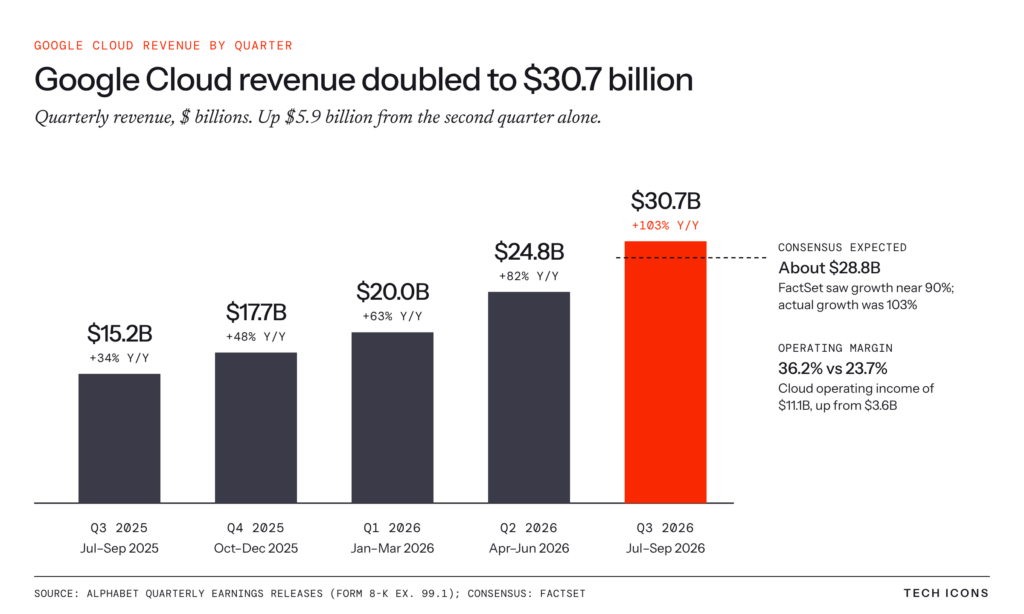
That role has passed to Google Cloud. Revenue rose 103% to $30.7 billion, and the unit now accounts for nearly a quarter of group sales. Operating income tripled to $11.1 billion, lifting the margin to 36.2% from 23.7% a year earlier and 35.6% in the second quarter. In July, management cautioned that renting third-party capacity as a stopgap would weigh modestly on Cloud margins. The quarter showed no trace of it. Alphabet also said sales of TPU systems, its custom AI accelerators, contributed meaningfully to growth. It is the clearest evidence yet that a chip program built for internal use can stand as a commercial business.
The geography of growth shows where the demand sits. United States revenue rose 39% to $67.7 billion, against 9% in EMEA and 12% in Asia-Pacific, a gap that follows the concentration of AI infrastructure spending. The product pipeline has helped. Google introduced Gemini 4 Argon on September 30 and opened it to AI Pro and Ultra subscribers on October 13. On results day, Pichai presented a Carbon variant that he said outperforms Argon “on almost every domain.” Cloud backlog stood at $514 billion at the end of June, with just over half expected to convert within 24 months. The release offered no updated figure, and investors will want one.
Paying for Capacity
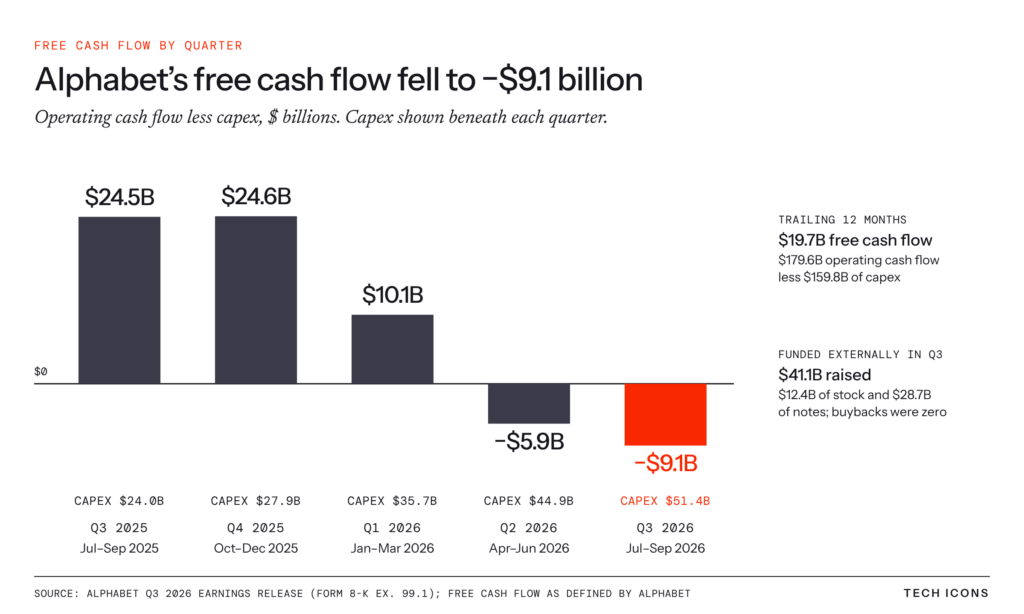
The price of this growth shows up in the cash flow statement. Capital expenditures rose 114% to $51.4 billion, below the roughly $55 billion analysts had modeled but enough to bring nine-month spending to $132.0 billion. Operating cash flow fell to $42.3 billion from $48.4 billion a year earlier, so free cash flow was negative $9.1 billion, a second straight negative quarter. Consolidated margin slipped from 34% in the second quarter even though Cloud and Services held firm. The cause was unallocated Alphabet-level costs, which include shared AI research and widened to a $7.7 billion loss from $4.5 billion. Full-year guidance of $195 billion to $205 billion implies fourth-quarter capex of $63 billion to $73 billion.
What has changed most is how the spending is financed. For most of its history, Alphabet paid for its ambitions from internal cash, and in recent years it returned the surplus through buybacks. In June it announced an $80 billion equity program, anchored by a $10 billion private placement with Berkshire Hathaway. In the third quarter it sold $12.4 billion of stock through its at-the-market facility, with $27.6 billion still available, and raised $28.7 billion in senior notes. Long-term debt reached $125.1 billion, up from $46.5 billion in December, and repurchases were zero against $11.5 billion a year earlier. With $265.1 billion of cash and marketable securities, liquidity is not in question. The share count, however, is now rising, and that changes the economics of ownership.
What the Market Is Pricing
Investors responded to the whole report rather than to Cloud alone. Shares fell as much as 7% in extended trading on Wednesday, and some reports put the decline near 9% as the call got underway. The pattern is familiar. In July, a higher capex range sent the stock down 7.1% the following day despite a revenue beat, and the shares entered this report about 20% below their May record. The market accepts that Alphabet can sell AI capacity at attractive margins. It does not yet accept that the returns will arrive fast enough to justify the capital, or the dilution and leverage now needed to raise it.
Regulation, for once, is a secondary concern. In September, Judge Leonie Brinkema declined the Justice Department’s request to force a sale of the AdX exchange and imposed behavioral remedies and a compliance monitor for six years instead. Google intends to appeal the liability ruling, and remedies in the search case remain on appeal. The variables that matter now sit with management. They are a 2027 capital budget that consensus already places above $300 billion, the pace at which backlog becomes revenue, and proof that rising query volume can again lift Search. Alphabet has shown it can generate demand on an extraordinary scale. It has yet to show it can meet that demand and remain the self-financing company its shareholders thought they owned.