- Aerospace Defense
- Defense Industry
- Earnings Report
L3Harris’s $20 Billion Missile Backlog Is Outrunning Its Factories
9 minute read
Orders of $19.3 billion lifted backlog to $53.2 billion and the shares 6.8%. But segment margin didn’t move and the 2028 cash target came down, so the stock’s recovery now depends on execution.
Key Takeaways
- PAC-3 and THAAD propulsion awards worth about $11 billion drove an 11.8x book-to-bill in Missile Solutions and lifted group backlog 47% from a year earlier to a record $53.2 billion.
- Revenue rose 7% to $6.06 billion in a quarter with one fewer week, and EPS of $3.28 beat the $2.95 consensus. Lower corporate costs, interest and tax did much of the lifting.
- The company raised 2026 EPS guidance to $12.25 to $12.35 and cut its 2028 free cash flow target to $3 billion. The shares closed at $278.43, still about 27% below their 52-week high.
The Order Book Speaks
For most of 2026, L3Harris Technologies has asked investors to judge it by what it has been promised rather than what it has delivered. On October 29, that promise came with a number. The Melbourne, Florida contractor booked $19.3 billion of orders in the third quarter, more than three times its revenue, and ended the period with a record backlog of $53.2 billion. That is 47% higher than a year earlier and more than $11 billion above the $42 billion reported in July. All of it arrived under a chief executive who had been in the job for ten weeks.
The income statement was steadier, and better than it first appears. Revenue rose 7% to $6.06 billion, or 9% organically, even though the quarter contained thirteen weeks against fourteen a year earlier. Chief Financial Officer Ken Sharp put the missing week at about $200 million of revenue, which takes underlying growth into double digits. Diluted earnings per share climbed 33% to $3.28, well ahead of the $2.95 consensus. Free cash flow of $1.26 billion was nearly triple last year’s $427 million. On the headline numbers, skeptics had little to work with.
An Arsenal on Paper
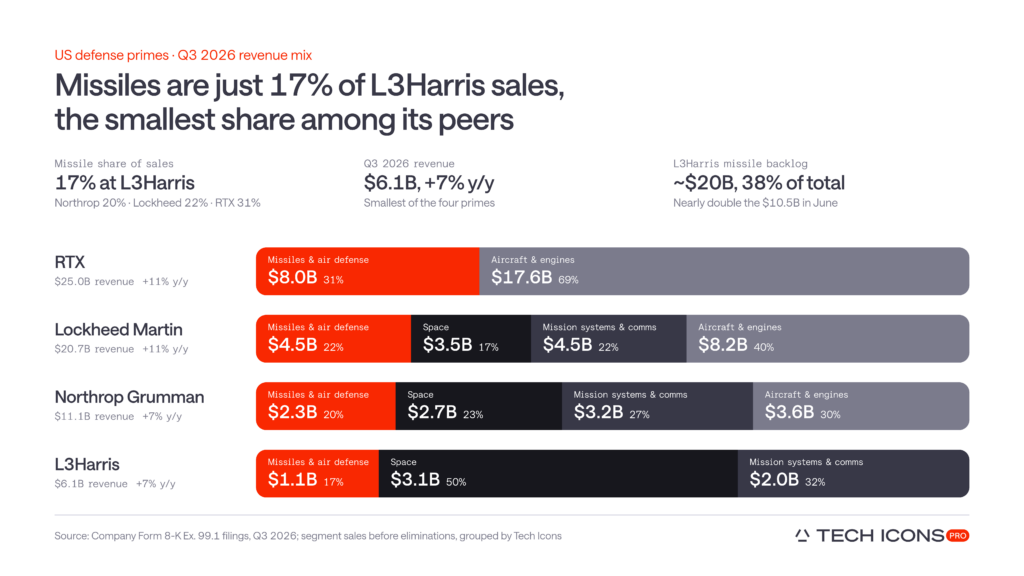
The orders came overwhelmingly from Missile Solutions. L3Harris formed the unit early this year by combining its missile operations, including the legacy Aerojet Rocketdyne business. In September, Lockheed Martin awarded it two seven-year undefinitized contracts. One was worth $4.7 billion for PAC-3 MSE interceptor propulsion. The other was a THAAD award the company now values at $6.3 billion before escalations. Together they gave the segment an 11.8x book-to-bill and lifted its backlog to roughly $20 billion from $10.5 billion. Sam Mehta, the new chief executive, called the quarter “a watershed moment” for the business, and the description is fair. The contracts formalize framework agreements reached with the Department of War in July. They are part of a deliberate effort in Washington to clear the solid rocket motor bottleneck that has held back interceptor production for years.
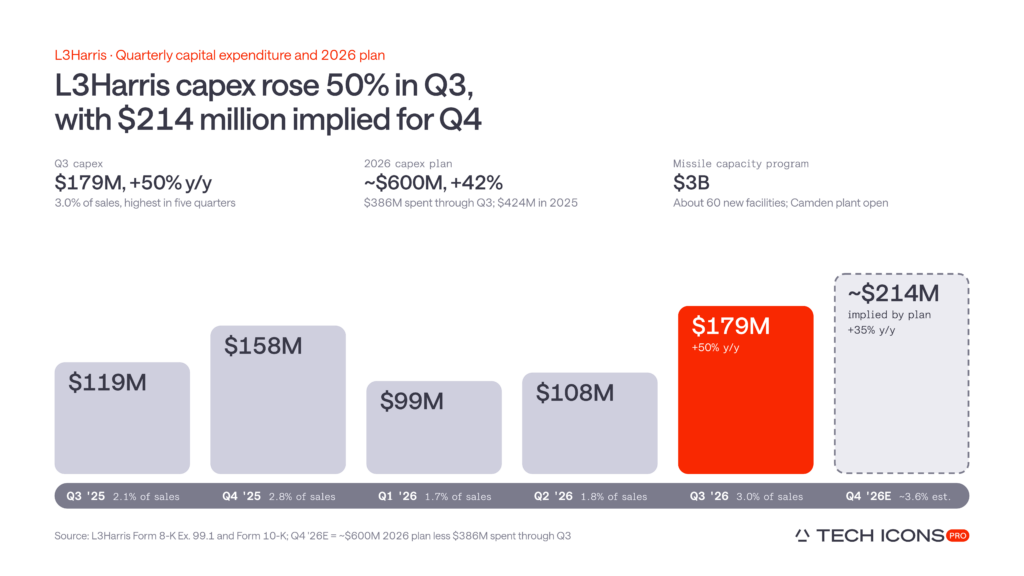
Contracts on paper do not intercept anything. Segment revenue grew 5% to $1.06 billion. Excluding the divested commercial space propulsion business, growth was 17%, and solid rocket motor sales rose 29%. Management says PAC-3 motor deliveries doubled this year and will double again in 2027, while THAAD boost motor output is planned to triple. A new motor facility opened in Camden, Arkansas in October. It is one of roughly 60 buildings in a $3 billion capacity program. Automation has also cut the manual inspection of a PAC-3 motor from 21 hours to 6.5. Demand is no longer what limits this business, so details like that one now drive the story.
Reading the Margin Line
The beat looks different on closer inspection. Operating margin widened 200 basis points to 13.0%, yet segment operating margin was unchanged at 15.9%. The difference came from headquarters. Unallocated corporate items fell to $181 million from $279 million, and net interest expense dropped to $116 million from $152 million. The effective tax rate declined to 14.9% from 18.5%. Segment operating income, the cleaner measure of what the businesses actually earned, rose 7% to $967 million. That is solid progress, but far short of the 33% gain in earnings per share.
The three segments grew at different speeds. Space & Mission Systems, the largest, grew 10% to $3.09 billion on space programs, missile warning and tracking, and airborne surveillance (ISR) aircraft, and its margin edged up to 10.9%. Communications & Spectrum Dominance is the group’s most profitable franchise, but it grew only 3% to $2.0 billion because a shortage of circuit-board laminates disrupted supply. Its margin still improved to 25.2%, and a 1.9x book-to-bill points to firmer quarters ahead. Missile Solutions margin slipped 30 basis points to 12.0% because of mix. International revenue rose 18% and now makes up 24% of the total. L3Harris expects to ship more tactical radios to foreign customers this year than to the Pentagon, driven by European demand for communications built to withstand electronic warfare.
A Raised Year, a Trimmed Horizon
For 2026, guidance moved up. L3Harris raised the bottom of its revenue range to $23.5 billion and held the top at $23.7 billion. It lifted GAAP earnings per share guidance to $12.25 to $12.35 from $11.80 to $12.00, a 40-cent increase at the midpoint. The free cash flow target stayed at $3.0 billion. With $1.84 billion generated through September, that leaves about $1.2 billion to deliver in the fourth quarter. Within the segments, the Space & Mission Systems revenue outlook rose to about $11.9 billion, while Communications & Spectrum Dominance was trimmed to about $7.9 billion.
The longer-range plan moved down. Management cut its 2028 free cash flow target to $3 billion from $3.5 billion. It gave three reasons: paying roughly $250 million a year of 401(k) contributions in cash rather than stock, a less favorable segment mix, and missile capital spending brought forward. The 2028 segment margin target eased to about 16% from 16.3%, while the target of 8% organic growth was reaffirmed. Part of the cash revision is an accounting choice, since contributions paid in stock cost shareholders through dilution instead. The repeated delays are harder to dismiss. Three months after postponing the Missile Solutions IPO, L3Harris is again asking investors to wait longer for returns on its investment program.
The Conversion Test
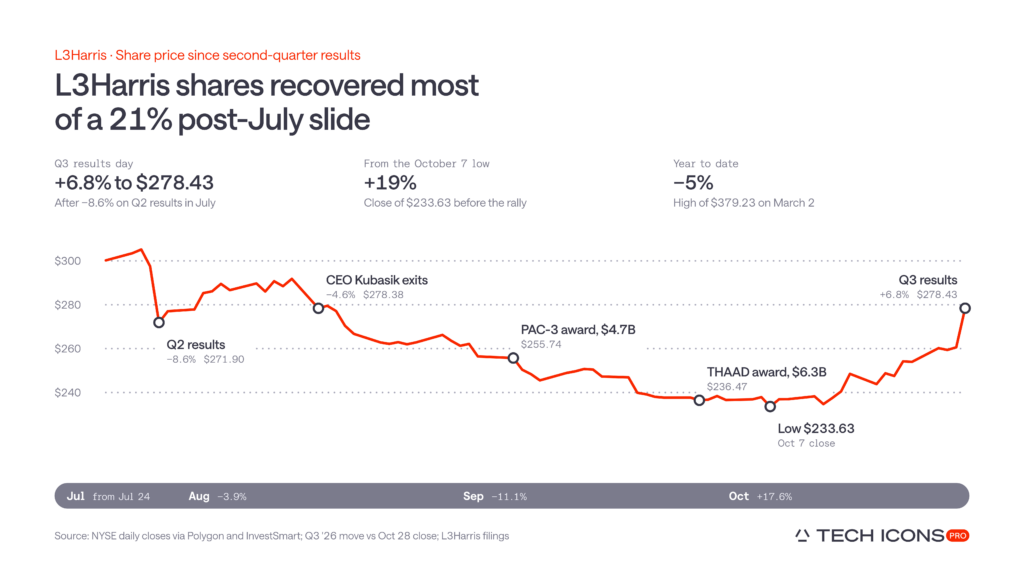
The market cared more about the order book than the trimmed 2028 plan. The shares closed up 6.8% at $278.43 on October 29, up from $260.61 the previous session, after trading as high as $281.11. The rally recovered part of a difficult stretch. The stock fell 8.6% the day after second-quarter results, when the delayed IPO overshadowed an earnings beat. It slipped again in August when Christopher Kubasik stepped down as chairman and chief executive after a board review of his conduct. In October, Goldman Sachs, Bernstein, RBC Capital and TD Cowen each lowered their price targets. Even after Thursday’s move, the shares remain about 27% below their 52-week high of $379.23.
That gap is the measure of Mehta’s task, and he appears to know it. His stated priority, “to convert that demand into results,” concedes that backlog is no longer what the company lacks. Execution risk now sits between the order book and the income statement. The PAC-3 and THAAD contracts remain undefinitized, and much of the new missile work is fixed-price. The Missile Solutions IPO is now targeted for mid-2027 and backed by a $1 billion Department of War convertible preferred investment, but it depends mainly on valuation. Leverage is down to about 1.9 times, and management calls buybacks highly attractive at current prices, so L3Harris can afford to be patient. The next several quarters will show whether its factories can keep pace with its orders.