- Aerospace Defense
- Commercial Aviation
- Defense Industry
- Earnings Report
RTX Raises 2026 Outlook as Order Book Hits $340 Billion
9 minute read
Third-quarter sales rose 11% to $25.0 billion and adjusted EPS climbed 33%, but tariff refunds, a $363 million bankruptcy charge and thinner cash flow make the headline less clean.
Key Takeaways
- RTX earned $2.26 a share on an adjusted basis against a $1.78 consensus. Excluding $0.25 of tariff refunds still leaves a beat of roughly 13% on underlying operations.
- Backlog reached a record $340 billion after more than $81 billion of awards. Defense backlog stood at $164 billion as multiyear Tomahawk and AMRAAM contracts entered the order book.
- Free cash flow fell 47% to $2.1 billion as customer advances unwound and inventory built. RTX still raised its full-year sales, earnings and cash guidance, and the shares rose about 2% early.
The Quarter Behind the Headline
RTX has spent two years asking investors to judge it on execution rather than demand. Demand was never in doubt: air traffic recovered, airlines kept old engines flying longer, and governments on three continents began buying munitions at a pace not seen since the Cold War. The open question was whether a company of 180,000 people, still managing one of the most expensive engine recalls in commercial aviation, could turn that demand into deliveries at improving margins. On Tuesday, its third-quarter results offered the most persuasive answer yet. Sales rose 11 percent to $25.0 billion, or 12 percent organically. Adjusted earnings per share reached $2.26, up 33 percent from a year earlier, against a consensus of $1.78. Revenue cleared expectations of roughly $24.1 billion by a comfortable margin, extending a record of earnings beats that now runs to 38 consecutive quarters.
The headline number deserves scrutiny, and the company’s own release supplies the reason. Twenty-five cents of the adjusted figure came from recovering tariffs paid under the International Emergency Economic Powers Act. The Supreme Court ruled in February that the statute gave the president no authority to impose those tariffs, and the Court of International Trade subsequently ordered refunds. Of the $1.1 billion increase in adjusted segment operating profit, $0.4 billion came from that source. Removing it leaves adjusted EPS of about $2.01. That figure still beats consensus by around 13 percent and exceeds last year’s $1.70 by 18 percent. The underlying performance, in other words, was strong on its own terms. The refund turned a good quarter into an eye-catching one, and investors who look past it will find the operating improvement intact.
An Order Book Reshaped by Munitions
The figure most likely to endure from this report is the backlog. It reached a record $340 billion, comprising $176 billion of commercial work and $164 billion of defense, after more than $81 billion of new awards in the quarter. At the end of June, the backlog stood at $289 billion. A $51 billion increase in three months, for a company with annual sales of under $100 billion, represents roughly half a year of revenue added to the order book in a single quarter. Most of that increase sits in defense, and two contracts explain much of it. In August the Navy awarded Raytheon a seven-year, $22.9 billion contract to lift Tomahawk production above 1,000 missiles a year. In September came an AMRAAM award worth up to $20.7 billion over five years, with two option years, supporting output of at least 1,900 missiles annually.
These are significant commitments, but they are not yet fully settled. RTX itself describes both as undefinitized, meaning prices and terms remain to be finalized. Reuters has reported that Congress has not yet appropriated funding for the full multiyear commitments, which could slow how fast contractors invest in capacity. The distinction matters for anyone modeling the next five years: a contract ceiling is not funded revenue. Still, the operating evidence already points the right way. Raytheon’s third-quarter sales rose 14 percent to $8.0 billion on Patriot, Standard Missile and Tomahawk volume. Segment margin widened to 14.1 percent from 12.2 percent, although about $85 million of the quarter’s productivity came from an international contract modification and an offset adjustment that will not repeat in every period.
Two Engines, Two Stories
Collins Aerospace delivered the cleanest result in the portfolio. Sales rose 10 percent to $8.4 billion, or 12 percent organically. Commercial original equipment grew 23 percent on narrowbody and widebody volume, while aftermarket sales rose 9 percent and defense 7 percent. Adjusted operating profit rose 50 percent, and margin reached 21.3 percent against 15.7 percent a year earlier. Approximately $250 million of that profit came from tariff recovery. Excluding it, margin would have been roughly 18.3 percent, still about 260 basis points better than last year. That is the improvement that matters: higher volume and better pricing, with a one-time gain on top rather than underneath.
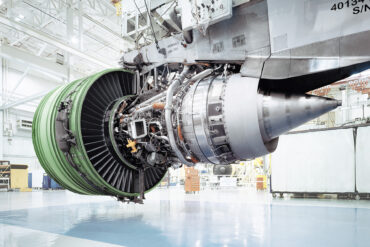
Pratt & Whitney presents a more complicated picture. Sales rose 10 percent to $9.2 billion, driven by a 21 percent increase in commercial aftermarket revenue, largely from the geared turbofan. Commercial original equipment fell 5 percent on engine mix. Reported operating profit fell 19 percent to $608 million, weighed down by a $363 million charge tied to a customer bankruptcy. RTX did not name the customer. Adjusted operating profit, which excludes the charge, rose 29 percent to $968 million, helped by about $160 million of tariff recovery. The contrast is instructive. The powder-metal problem that grounded hundreds of geared turbofan engines has turned into a large source of maintenance revenue for Pratt, and management reported in July that aircraft on the ground had fallen by a quarter since the start of the year. Yet the same groundings have strained the finances of some operators, and the bankruptcy charge shows that some of that strain now flows back to Pratt itself.
Where the Cash Went
Cash was the one metric that fell short of the earnings. Operating cash flow was $2.9 billion, including roughly $0.3 billion of tariff recovery, against $4.6 billion a year earlier. After $0.7 billion of capital spending, free cash flow came to $2.1 billion, down 47 percent. The cash flow statement shows where the money went. Contract liabilities, largely customer advances, consumed $980 million after contributing $986 million in the same quarter last year. Inventory absorbed $543 million, compared with a $182 million release a year ago. In plain terms, RTX is delivering against payments it already received while building stock for a production ramp. That is the normal pattern for a manufacturer scaling up, and nine-month free cash flow of $6.3 billion remains well ahead of last year’s $4.7 billion. Even so, cash is where investors will look first for evidence that this growth is self-funding.
Management raised guidance on every major line. Adjusted sales are now expected at $97.0 billion to $97.5 billion, up from $95.0 billion to $96.0 billion, with organic growth of 10 to 11 percent. The adjusted EPS range moved to $7.65 to $7.75 from $7.10 to $7.25. Free cash flow guidance rose to $9.0 billion to $9.2 billion from $8.50 billion to $8.75 billion. The arithmetic is revealing. Nine-month adjusted EPS stands at $5.93, which implies fourth-quarter earnings of $1.72 to $1.82, well below the third quarter’s $2.26. Management is clearly not projecting the tariff refunds into the coming quarters. The cash range implies roughly $2.7 billion to $2.9 billion of free cash flow in the fourth quarter. During the third quarter, RTX paid $984 million in dividends and bought back no stock.
A Measured Market Verdict
The market’s response was approving but restrained. RTX shares rose about 2 percent in early trading, to roughly $196 from a prior close of $192.11. Options had priced a move of about 4.3 percent in either direction, so the reaction fell short of what traders had braced for. Expectations explain the restraint. Full-year EPS consensus had already reached $7.25, the top of the previous guidance range, so a raise had effectively been priced in before the release. The stock entered the day about 15 percent below its August high, and RBC Capital had trimmed its price target to $235 from $250 the week before while keeping an Outperform rating. A peer offered a useful contrast. GE Aerospace slipped about 1.4 percent before the open despite raising its own full-year outlook, which suggests investors are currently paying more for defense exposure than for commercial engine leverage.
Three questions will shape how RTX is valued into 2027. The first is whether the Tomahawk and AMRAAM contracts are finalized and funded at anything like their headline values, since an order book is only as firm as the appropriations behind it. The second is whether Pratt’s aftermarket strength can outpace the financial strain its engine problems have placed on weaker airline customers. The third is whether cash conversion recovers once the inventory build gives way to deliveries. This quarter settled the question of demand and made a credible case on margins. RTX now has to convert a record backlog into cash at the pace the guidance implies.