- Biotech
- Drug Discovery
- Earnings Report
- Pharmaceuticals
Gilead's Prevention Surge Buys Time Before Biktarvy's Medicare Reset
9 minute read
Base business sales grew 16% and guidance rose for a third time in 2026, but a 38% Medicare price cut on Biktarvy from 2028 now frames how investors value Gilead’s HIV franchise.
Key Takeaways
- HIV sales rose 18% to $6.2 billion, the fastest pace since 2018, as Yeztugo reached $305 million and Descovy grew 49%, evidence that long-acting prevention is enlarging the market.
- Gilead lifted 2026 product sales guidance to $31.0 billion to $31.3 billion, yet cut its EPS outlook to a deeper loss as $12.4 billion of acquired R&D charges flow through the income statement.
- Shares rose 4% before the report and 2.2% after hours, extending a 36% gain this year, while Biktarvy’s $1.5 billion Medicare hit in 2028 and the December 23 anito-cel decision remain ahead.
The Strongest Growth in a Decade
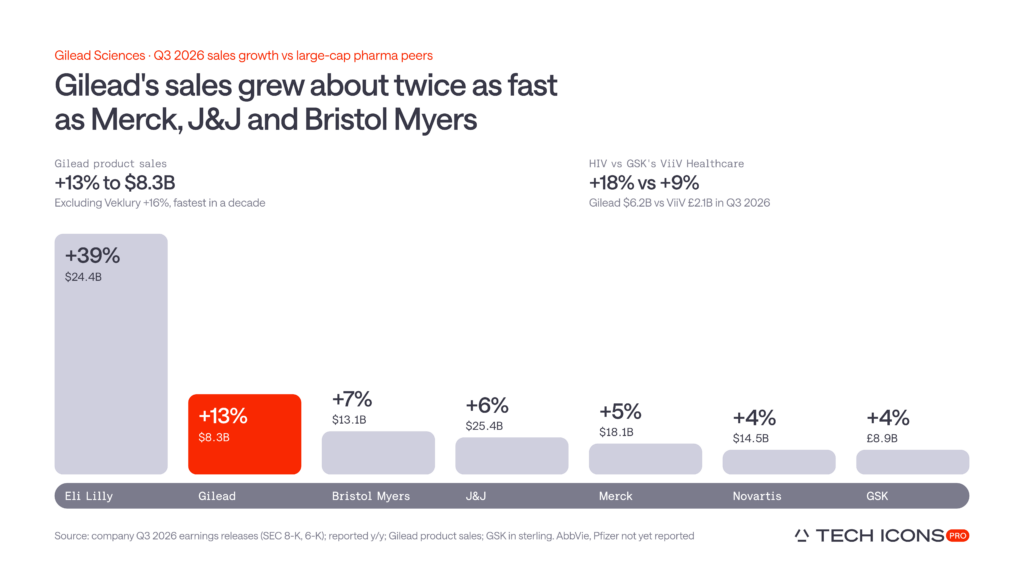
Gilead Sciences came into its third-quarter report facing high expectations. The shares had risen by roughly a third this year and set a 52-week high on the afternoon of the release. The company still cleared the bar with room to spare. Product sales rose 13% to $8.3 billion. Excluding Veklury, the COVID-19 antiviral whose demand has largely receded, sales climbed 16% to $8.2 billion, the fastest growth in the underlying business in more than a decade. Non-GAAP diluted earnings per share reached $2.55, compared with $2.47 a year earlier and an LSEG consensus of $2.19. Revenue also came in ahead of the roughly $7.8 billion analysts had forecast.
Reported earnings fell, but the decline says little about the business itself. GAAP diluted earnings per share dropped to $1.94 from $2.43 on losses from equity holdings, higher operating costs and a heavier tax charge. The comparison also carried an awkward base. Royalty, contract and other revenue fell to $11 million from $424 million because last year’s quarter included a one-time sale of intellectual property. Stripping that out, the company’s own bridge shows adjusted earnings growth of 15%. Expenses rose quickly, with non-GAAP R&D up 19% and SG&A up 14%. Even so, a richer product mix lifted non-GAAP product gross margin to 88.1% from 86.5%. Gilead is spending more while earning more on every dollar of sales.
Prevention Becomes a Second Engine
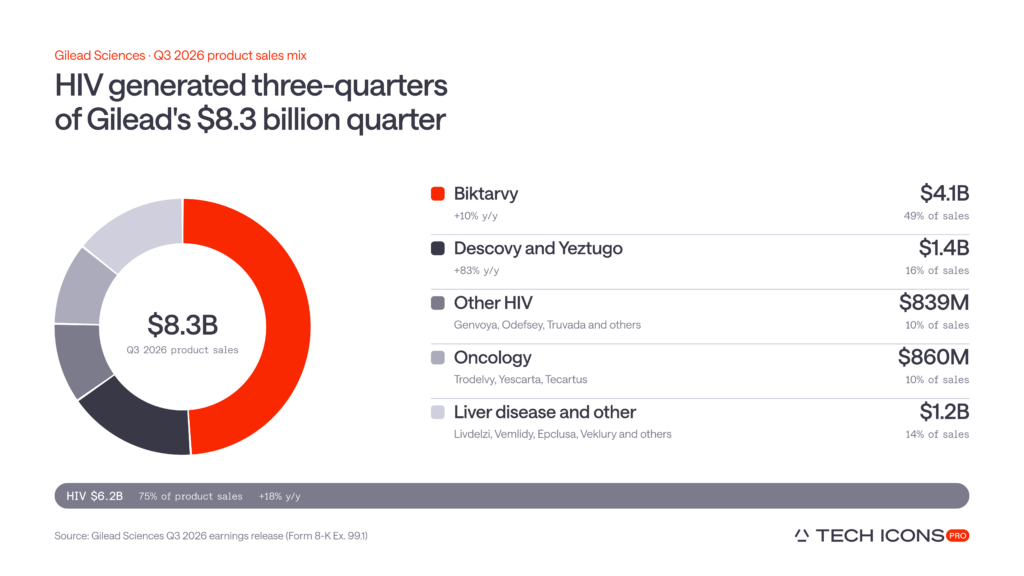
HIV produced three-quarters of product sales and nearly all of the momentum. Franchise revenue rose 18% to $6.2 billion, the fastest year-over-year growth since late 2018. Gilead credited higher realized prices, stronger demand for prevention and favorable inventory movements. Biktarvy, the daily single tablet that has anchored Gilead’s treatment business for most of a decade, grew 10% to $4.1 billion. That beat the $3.86 billion analysts expected, and the drug reached a record 53% share of the U.S. treatment market. It is unusual for a product of that age to keep gaining share, and it shows how little room competitors have found.
Our HIV business grew 18% and HIV prevention sales nearly doubled year-over-year.
The bigger story is in prevention, where sales nearly doubled. Yeztugo, the twice-yearly lenacapavir injection launched in June 2025, generated $305 million. That compares with $39 million a year earlier and is 31% above the second quarter, and Gilead reaffirmed its target of about $1 billion for the year. More than 70% of patients return for their second injection. That matters more than any single quarter’s revenue, because prevention economics depend on people staying on therapy. Descovy, the daily oral alternative, rose 49% to $1.05 billion, which suggests the injection is widening the market rather than taking sales from Gilead’s own pill. Together the two hold about half of U.S. prevention at a $4 billion annual run rate. Management did add one note of caution. After an unusually large inventory build in the third quarter, the fourth-quarter build should be smaller than usual.
Oncology Remains a Work in Progress
Outside HIV, most of the portfolio is growing, and one business is still waiting for help. Trodelvy, the antibody-drug conjugate acquired with Immunomedics, grew 42% to $506 million. The European Commission also approved it with Merck’s Keytruda as a first-line treatment for metastatic triple-negative breast cancer in patients whose tumors express PD-L1. Liver disease sales rose 13% to $927 million, led by Livdelzi for primary biliary cholangitis, which nearly doubled to $203 million.
Cell therapy is the exception. Sales of Yescarta and Tecartus fell 18% to $355 million under steady competitive pressure, and Gilead expects a decline of about 15% for the full year. Its response is anito-cel, a BCMA-directed CAR T-cell therapy for multiple myeloma secured through the $7.8 billion acquisition of Arcellx, completed in April. The FDA is due to rule on its fourth-line application by December 23. Approval would give Kite a new product in a large market just as its existing therapies lose ground. A setback would leave the franchise with nothing near-term to replace them. Veklury, meanwhile, fell 69% to $86 million and no longer moves the consolidated numbers.
Why Guidance Rose and Earnings Fell
Read quickly, the outlook seems to say two opposite things. Gilead raised 2026 product sales guidance to $31.0 billion to $31.3 billion, up from $30.1 billion to $30.4 billion. It was the third increase this year and brings the total raise to its base business forecast to $1.6 billion since January. The new midpoint sits above the roughly $30.77 billion analysts had expected, and expected HIV growth moved to about 12% from 9% to 10%. Yet the company also lowered its earnings guidance. It now projects a non-GAAP loss of $0.85 to $1.20 per share, compared with a prior range of $0.30 to $0.65, and a GAAP loss of $4.05 to $4.40.
The explanation is deal accounting. Both ranges include about $9.88 per share, or $12.4 billion, of acquired in-process R&D charges. They are tied to Arcellx, Tubulis, Ouro Medicines and the PepStar transaction announced on October 22. That $1.275 billion purchase of an oral IL-23 receptor inhibitor is expected to reduce earnings by $0.79 to $0.83 per share on its own. That is more than the $0.55 cut at the midpoint of the adjusted range, which implies the operating outlook actually improved. The cost of the deals shows up on the balance sheet instead. Cash and marketable securities fell to $6.4 billion from $10.6 billion at the end of 2025 after $11.3 billion of acquisition outflows. Third-quarter operating cash flow of $5.0 billion still easily covered $1.0 billion in dividends and $370 million in buybacks.
The Market’s Verdict and the 2028 Test
The share price moved twice. The stock rose 4% during the October 29 session, touching $165.70 before the release, then gained another 2.2% to $169.25 after hours. That extended its advance in 2026 to 36%. Jefferies had raised its price target to $185 a week earlier. RBC Capital Markets analyst Brian Abrahams offered a more cautious reading. He said the results met “increasing expectations” but questioned how long HIV growth can last against branded and generic competition and Inflation Reduction Act pricing.
That concern has a date attached. Biktarvy was among 15 drugs selected in January for the third round of Medicare price negotiation. Its maximum fair price of $2,600 for a 30-day supply takes effect January 1, 2028, and represents a 38% reduction. Gilead estimates the 2028 sales impact at about $1.5 billion but still expects total product sales and earnings per share to grow that year. That depends on prevention growing fast enough. Gilead is also building out its lenacapavir products, including Bixlenvo, a once-daily bictegravir and lenacapavir tablet approved in August, and a once-yearly prevention injection still in development. The third quarter shows a business that can absorb considerable pressure. The next two years will show whether that is enough once the price reset arrives.