- Aerospace Defense
- Defense Industry
- Earnings Report
Lockheed Martin's Record Backlog Signals a Turnaround
9 minute read
Sales rose 11 percent and free cash flow swung to $2.9 billion, as Lockheed raised guidance, expanded its missile order book, and moved to acquire Ultra Maritime.
Key Takeaways
- Sales climbed 11% to $20.1 billion and diluted EPS hit $7.94, beating Wall Street’s $7.22 consensus, as the $1.6 billion in program losses from a year earlier did not repeat this quarter.
- Backlog reached a record $230.4 billion after $65 billion in new orders, led by a $35 billion multi-year THAAD contract with the Missile Defense Agency that turned earlier framework deals into firm commitments.
- Lockheed raised full-year guidance across sales, earnings, and cash flow for the second time this year, and agreed to acquire Ultra Maritime for $3.45 billion, expanding its undersea and anti-submarine warfare capabilities.
A Quarter That Erases the Last One
Lockheed Martin’s second quarter did something rarer than a headline beat: it closed the argument that had followed the company since spring. Sales reached $20.1 billion, up 11 percent from $18.2 billion a year earlier, and diluted earnings per share came in at $7.94, against $1.46 in the same period of 2025. Six analysts surveyed by Zacks Investment Research had modeled $7.22 per share on revenue of $19.43 billion. Lockheed cleared both figures with room to spare.
The comparison owes much of its size to what did not happen this time. A year ago, the company absorbed $1.6 billion in reach-forward losses, on a classified Aeronautics program and on two international helicopter contracts, plus another $169 million in charges. None of that recurred. Strip away the arithmetic of absence, though, and the quarter still holds up. Consolidated operating margin expanded to 12.4 percent from 4.1 percent, and business segment operating profit very nearly quadrupled, to $2.16 billion. This was not simply a friendlier year-over-year comparison. It was a company converting demand into delivered profit at a rate it had not managed in some time.
Where the Growth Was Real
Segment by segment, the story separates into two distinct narratives, one about genuine expansion and one about the absence of prior wounds. Missiles and Fire Control, the smallest of Lockheed’s four divisions, supplied the former. Sales rose 19 percent, to $4.1 billion, as production accelerated on the PAC-3 and THAAD interceptor lines and on the Precision Strike Missile program. Operating margin climbed to 14.5 percent from 14.0 percent. This is the segment now absorbing the bulk of allied restocking demand, after years in which munitions inventories were drawn down faster than they could be replenished, a consequence of sustained conflict in Ukraine and the Middle East.
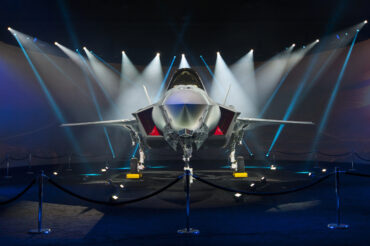
Aeronautics and Rotary and Mission Systems tell the other story. Aeronautics swung to a $760 million operating profit from a $98 million loss, and Rotary and Mission Systems moved to $437 million from a $172 million loss. Both reversals trace almost entirely to the non-recurrence of last year’s charges rather than to fresh operational strength. That distinction matters for anyone assessing durability rather than optics. F-35 production volume did add $475 million in Aeronautics sales, but deliveries fell, from 50 aircraft in the quarter a year ago to 19 this year, and from 97 over six months to 51. Sustainment revenue on the F-16 and C-130 lines declined as well. Space, the steadiest of the four, grew a modest 6 percent, with strategic missile defense programs offsetting softer commercial activity.
Cash, Taxes, and a Cleaner Balance Sheet
If the segment results require interpretation, the cash flow statement does not. Operating cash flow reached $3.2 billion, up from $201 million, and free cash flow was $2.9 billion, against negative $150 million a year ago, driven by the timing of customer receipts and lower tax payments. The effective tax rate fell to 15.7 percent from 18.0 percent, aided by a February ruling from the U.S. Treasury exempting Lockheed from the corporate alternative minimum tax for 2026 under the One Big Beautiful Bill Act. Stockholders’ equity rose to $8.8 billion from $6.7 billion at year-end, though long-term debt remains near $20.5 billion, a reminder that the balance sheet still carries a pension book with a $7.5 billion accumulated comprehensive loss.
The capital allocation choices behind those numbers are worth pausing on. Over the first six months of 2026, Lockheed paid down $1.17 billion in long-term debt, against just $142 million a year earlier, while repurchasing no shares at all, compared with $1.25 billion in buybacks over the same period in 2025. Dividends kept flowing, $1.61 billion paid out through June, and the board has since declared a third-quarter payment of $3.45 per share. Independent research and development spending, meanwhile, held at $558 million for the quarter, alongside $318 million in capital expenditures. Read together, these choices describe a company that chose to retire debt and protect its dividend rather than support the stock through repurchases, a defensible stance when free cash flow is already climbing and the backlog demands sustained investment in production capacity rather than financial engineering.
The Backlog and the Undersea Bet
The number that will outlast this earnings cycle is the backlog: $230.4 billion, up from $193.6 billion at the end of 2025, built on $65 billion of new orders in the quarter alone. Missiles and Fire Control backlog nearly doubled, to $87.9 billion, propelled by a $35 billion multi-year contract with the Missile Defense Agency for THAAD interceptors, converting into firm commitments the framework agreements the company had flagged earlier in the year.
That order flow sits inside a wider pattern. Global defense spending reached roughly $2.89 trillion in 2025, according to the Stockholm International Peace Research Institute, with European governments driving much of the increase as they rearm against a hostile security environment and face pressure from Washington to carry more of NATO’s cost. Lockheed’s peers have felt the same tailwind. What distinguishes this quarter is the speed at which the company is turning framework agreements into signed, dollar-denominated contracts, across programs including THAAD, a counter-drone system called Sanctum that moved from concept to live-fire testing in 45 days, and new manufacturing partnerships with General Motors Defense and Rheinmetall for European production of ATACMS.
The clearest expression of that ambition, though, does not appear in any financial table. On July 6, Lockheed agreed to acquire Ultra Maritime, a sonar and anti-submarine warfare specialist owned by the private equity firm Advent, for $3.45 billion. The business, which builds sonobuoys, towed and hull-mounted sonar arrays, and torpedo defense systems for the American, British, Canadian, and Australian navies, will be absorbed into Rotary and Mission Systems once regulators clear it. Lockheed’s guidance pointedly excludes the deal until it closes, consistent with a longstanding company practice of leaving pending acquisitions out of its outlook. Together, the backlog and the acquisition describe a company positioning itself less as a single-platform builder and more as an integrator of allied manufacturing capacity.
Guidance, the Market, and What Follows
Management raised every meaningful guidance figure for 2026: sales to a range of $79.75 billion to $81.75 billion, diluted earnings per share to $29.95 to $30.65, and free cash flow to $7.0 billion to $7.2 billion. By the company’s own math, that implies roughly 8 percent sales growth and a 28 percent increase in segment operating profit for the year.
Investors responded without hesitation. Shares rose more than 5 percent in early trading, touching $541.01, relief as much as celebration, since it resolved doubts that had shadowed the stock since April, when unfavorable F-16 adjustments and C-130 delivery delays weighed on the first quarter. The rally also reflects a quieter form of reassurance: that the two problem programs behind last year’s losses appear fully reserved for, rather than left to reappear across future quarters, a pattern that has punished the stock before.
What happens next depends less on this quarter’s numbers than on execution. Lockheed now carries roughly $230 billion in unfilled orders against sales guided to just above $80 billion, a ratio that speaks to the strength of demand but also to the operational discipline required to deliver on schedule, as this quarter’s F-35 shortfall illustrates. The other variable is regulatory. Ultra Maritime must clear antitrust review in four jurisdictions before it can be folded into Rotary and Mission Systems, and the pace of that clearance, not this quarter’s beat, will likely shape the segment’s composition heading into next year.