- Aerospace Defense
- Commercial Aviation
- Defense Industry
- Earnings Report
RTX Raises 2026 Outlook After Strong Second-Quarter Results
9 minute read
RTX’s second quarter showed a rare alignment of aerospace recovery and defense rearmament, lifting sales, margins and backlog to record levels and prompting a second guidance increase this year.
Key Takeaways
- Adjusted earnings per share rose 21 percent to $1.89 as sales reached $24.7 billion, with every RTX segment expanding operating margin over last year’s second quarter.
- Backlog climbed to a record $289 billion, up 22 percent year over year, as defense bookings and commercial aftermarket demand both accelerated through the quarter.
- Management raised full-year 2026 guidance for sales, earnings and free cash flow for the second time this year, citing backlog visibility and first-half execution.
Two Cycles, One Quarter
For most of the last decade, RTX’s fortunes have swung between two stories that rarely moved in the same direction. When commercial aviation recovered, defense budgets tended to plateau. When conflict abroad pushed governments toward rearmament, airlines were usually cutting capacity, not adding it. The second quarter of 2026 broke that pattern. Sales rose 14 percent to $24.7 billion, and on an organic basis, once currency and portfolio changes are stripped away, growth reached 16 percent. Adjusted earnings per share climbed 21 percent to $1.89, comfortably ahead of the $1.66 to $1.67 range analysts had modeled before the release.
The more revealing number sits beneath the headline. GAAP diluted earnings per share came in at $1.57, with the gap to the adjusted figure explained by $0.27 of acquisition-related amortization tied to the 2020 merger of Raytheon and United Technologies, along with $0.05 of restructuring charges. Net income attributable to shareowners rose 29 percent, to $2.1 billion. What matters here is not the size of the beat but its composition. Collins Aerospace, Pratt & Whitney and Raytheon each expanded adjusted operating margin over the prior year. That kind of uniformity is unusual, and it tells a more disciplined story than a single blockbuster segment carrying the rest of the portfolio. Consolidated operating margin reached 11.4 percent, up from 9.9 percent, evidence that the additional revenue is converting into profit rather than simply absorbing higher labor and material costs.
Collins and Pratt Turn Volume Into Margin
Collins Aerospace, the company’s avionics and aerostructures business, generated $8.21 billion in sales, up 8 percent on a reported basis and 13 percent organically once the effect of 2025 divestitures is removed. Commercial original equipment sales jumped 26 percent on higher narrowbody and widebody build rates, while commercial aftermarket revenue rose 10 percent and defense sales grew 7 percent. Operating profit rose 11 percent to $1.31 billion, and margin expanded 50 basis points to 15.9 percent, reaching 16.7 percent on an adjusted basis.
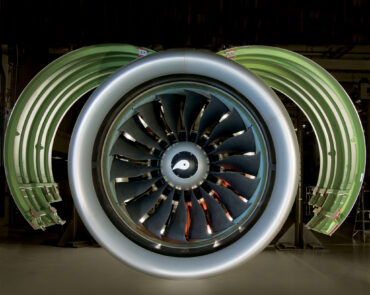
Pratt & Whitney’s quarter requires a closer read. Sales rose 16 percent to $8.89 billion, powered by a 25 percent increase in commercial aftermarket revenue and 23 percent growth in military sales, the latter reflecting higher F135 fighter engine volume. Commercial original equipment sales fell 8 percent, though that decline reflects engine mix rather than softening demand, since large engine deliveries actually increased during the period. Reported operating profit jumped 50 percent to $738 million, a comparison flattered by a roughly $100 million customer bankruptcy charge that weighed on results a year earlier. Strip that out, and adjusted operating profit still rose 22 percent, to $740 million, with the Geared Turbofan aftermarket ramp doing most of the work. Management also pointed to continued progress on the fleet’s powder-metal inspection program, with aircraft-on-ground counts down roughly 25 percent this year as overhaul turnaround times improve. For a program that has weighed on sentiment since 2023, that is meaningful progress, even if the full aftermarket payoff has not yet arrived.
Raytheon and the Weight of the Moment
Raytheon delivered the sharpest growth in the portfolio. Sales rose 18 percent to $8.27 billion, driven by higher volume across land and air defense systems, naval programs and integrated air and missile defense platforms, including Patriot, Standard Missile and AMRAAM. Operating profit rose 29 percent, to just over $1.04 billion, with margin expanding roughly 110 basis points to 12.6 percent.
The demand backdrop explains much of this. Continued conflict in the Middle East, and the pressure it has placed on allied air and missile defense inventories, has kept order books full. Executives described booking activity across Patriot variants, AMRAAM and classified programs as running well ahead of shipments, consistent with a backlog that reached $289 billion companywide, up 22 percent year over year and 6 percent sequentially. Of that total, $170 billion is commercial and $119 billion is defense, a split that gives RTX unusually long revenue visibility compared with most industrial peers, and one that insulates the company from the quarter-to-quarter volatility that troubles less diversified defense contractors.
The quarter also brought a smaller but clarifying move: Raytheon agreed to sell Blue Canyon Technologies, its small-satellite and spacecraft component subsidiary, to Canada’s MDA Space for $620 million in cash. It is not a transformative transaction, but it narrows Raytheon’s space exposure toward its core missile defense and radar franchises, a sensible trim rather than a strategic pivot.
The Second Upgrade
RTX raised its full-year 2026 outlook for the second consecutive quarter. Adjusted sales guidance moved to $95.0 billion to $96.0 billion, up from $92.5 billion to $93.5 billion after the first quarter, itself an increase from the $92.0 billion to $93.0 billion range issued in January. Organic sales growth guidance rose to 8 to 9 percent, from 5 to 6 percent. Adjusted earnings per share guidance climbed to $7.10 to $7.25, from $6.70 to $6.90, and free cash flow guidance moved to $8.50 billion to $8.75 billion.
Cash generation supports the case. Operating cash flow reached $3.5 billion against capital expenditures of $669 million, leaving free cash flow of $2.9 billion, a sharp improvement from the roughly break-even figure RTX posted in the same quarter last year, when working capital swings and legal charges weighed on collections. The effective tax rate ticked up to 18.0 percent, from 15.4 percent, mostly reflecting the absence of favorable prior-year tax settlements rather than any shift in underlying tax posture. None of this is the language of a company managing expectations downward. It is the language of a management team that has raised guidance twice in six months and still describes demand as exceptional.
What the Market Is Pricing
Investors responded with conviction. RTX shares rose roughly 5 to 6 percent in the hours after the release, a notable move given that broader equity indices were under modest pressure the same week, as oil prices climbed on renewed hostilities in the Middle East. That divergence is the more interesting story. RTX’s defense exposure, which has at times been treated as a source of political and budgetary uncertainty, functioned this quarter as a hedge against exactly the macro forces pressuring more cyclical corners of the market.
Sell-side reaction was constructive without being unanimous, and RTX still carries an unusually wide dispersion of analyst price targets, a sign that the debate over its long-term trajectory has not been settled by one strong print. The more cautious view centers on 2027, when elevated oil prices and a softer travel environment could eventually cool commercial aftermarket demand, even as defense spending holds firm. What the second quarter established, at minimum, is that RTX’s dual exposure to rearmament and aviation recovery is compounding on schedule, and that a management team confident enough to raise guidance twice within six months is, for now, being proven right by the backlog it is converting.