- Biotech
- Drug Discovery
- Earnings Report
- Pharmaceuticals
Eli Lilly Raises Its Outlook as Volume Outruns a Steep Price Slide
9 minute read
Third-quarter revenue rose 39% to $24.4 billion as tirzepatide volume absorbed a 15% price decline, lifting 2026 guidance to $91 billion to $92 billion and margin targets with it.
Key Takeaways
- Volume rose 53% while realized prices fell 15%, yet gross margin widened to 83.9%; Mounjaro and Zepbound generated $16.1 billion, roughly two-thirds of quarterly revenue.
- Acquired R&D charges of $4.57 a share held non-GAAP EPS to $7.48, up 7%; stripped of those deal costs, per-share earnings grew about 56%, a truer measure of the franchise.
- Retatrutide more than doubled Ozempic weight loss in an 80-week head-to-head trial, giving Lilly a credible successor to tirzepatide ahead of a planned U.S. filing in early 2027.
Volume Over Price
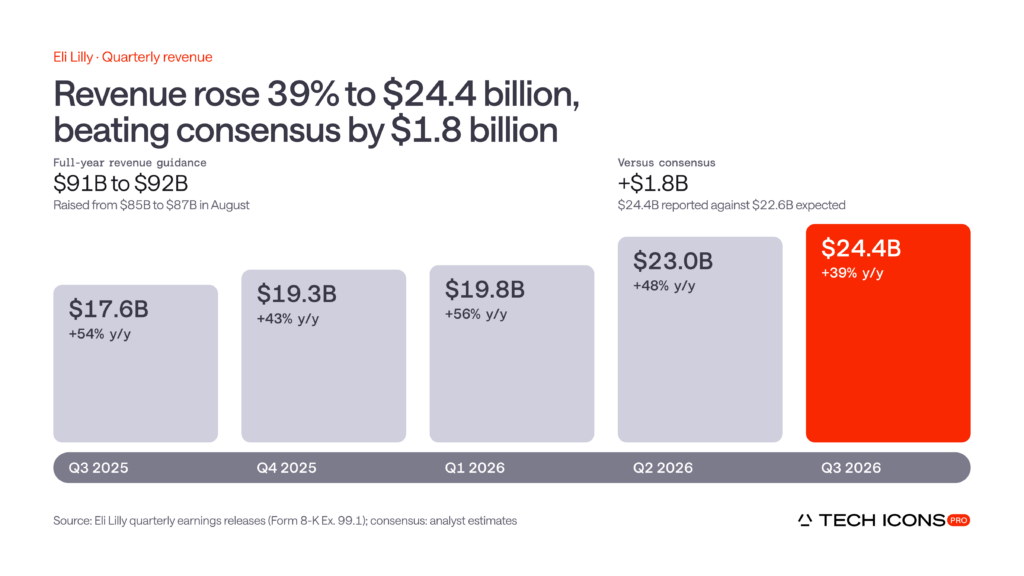
Eli Lilly’s third quarter turned on a trade most drugmakers spend years trying to avoid. Worldwide volume rose 53% while realized prices fell 15%. The result was revenue of $24.4 billion, up 39% from $17.6 billion a year earlier and roughly $1.8 billion above the consensus estimate near $22.6 billion. That growth came on top of a 54% increase in the same quarter of 2025. In the United States, revenue rose 34% to $15.1 billion on 41% higher volume and prices 7% lower, with Zepbound behind most of the decline. Abroad, revenue climbed 47% to $9.3 billion as volume surged 76% and prices fell 29%, largely because Mounjaro entered China’s National Reimbursement Drug List.
A company cutting price this quickly would ordinarily be giving up margin. Lilly is doing the opposite. Gross margin widened by a full percentage point to 83.9%, and reported net income reached $6.5 billion, a sign that manufacturing scale is absorbing the discounts that buy access. The quarter did include about $900 million of items that will not recur. Among them were $410 million in final Jardiance milestones and favorable revisions to rebate estimates. Remove them and underlying revenue sits near $23.5 billion, still comfortably ahead of forecasts. Chief executive David Ricks spoke of results “exceeding our prior expectations and allowing us to raise our full-year outlook.” The claim holds without the one-time help.
One Molecule, Two Markets
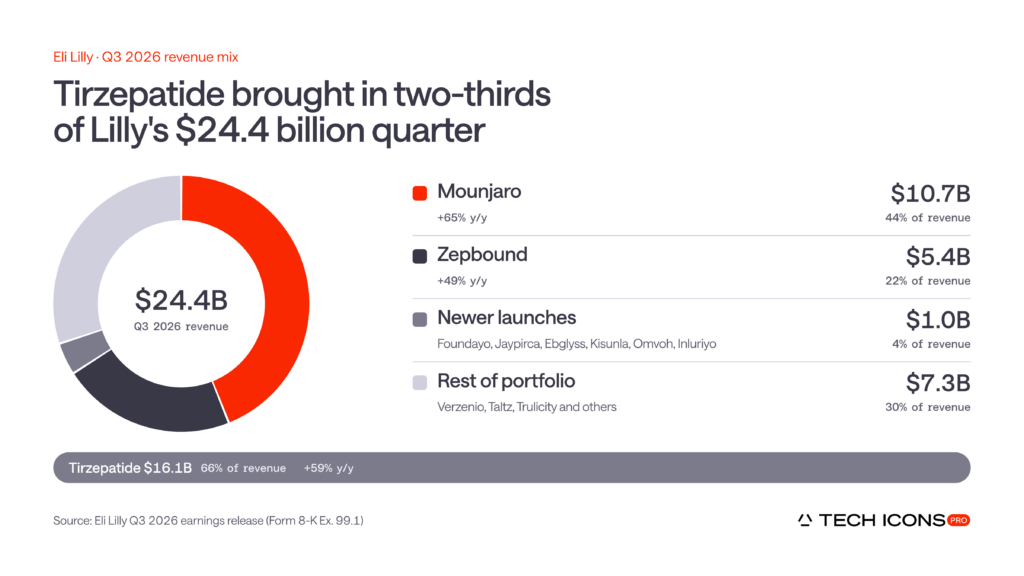
Tirzepatide remains the engine. Mounjaro generated $10.7 billion, up 65%, and the center of that business has quietly moved overseas. International sales of $5.7 billion rose 93% and now exceed the $5.0 billion earned in the United States, where growth was 41%. Zepbound, the same molecule sold for obesity, added $5.4 billion, up 49%, almost entirely at home. Together the brands delivered $16.1 billion, about two-thirds of revenue, rising 8% and 9% respectively from the second quarter. Abroad, demand is now doing the work that domestic pricing no longer can.
At home, policy has widened the funnel. The Medicare GLP-1 Bridge Program, which began on July 1, extended obesity coverage to about 20 million eligible beneficiaries at $50 a month out of pocket. Lilly said in August that the program had increased U.S. covered lives for its obesity medicines by roughly 35%. The third quarter was the first full period under that arrangement, which explains how Zepbound could gain volume while acting as the principal drag on U.S. pricing. Self-pay channels extend the reach further, accounting for about 45% of Zepbound prescriptions in the second quarter. The concentration is hard to miss. One molecule now carries Lilly’s growth, its margin profile and most of its $1.2 trillion valuation.
Building Beyond Tirzepatide
Foundayo, the oral GLP-1 approved in the United States in April, is beginning to repay the patience it required. Sales reached $184 million, nearly double the $98 million of the prior quarter, for $281 million year to date, after a launch analysts had questioned as slow. Ricks said in September that roughly one in three new patients starting an oral GLP-1 was choosing Foundayo. Lilly also reported that the drug demonstrated cardiovascular safety in its largest and longest type 2 diabetes study. A positive recommendation from the European Medicines Agency’s scientific committee on October 15 prepares the ground for the international rollout planned for 2027. At under 1% of revenue, the pill is a next-year story, but a credible one.
The more durable diversification lies outside metabolism. Lilly’s newer immunology, oncology and neuroscience products doubled their revenue from a year earlier. Kisunla, the Alzheimer’s antibody, rose 175% to $193 million; Jaypirca reached $228 million, Ebglyss $202 million and Omvoh $114 million. These are modest sums beside tirzepatide, yet they form the portfolio Lilly will need once the incretin cycle matures. Regulators kept pace. The FDA approved Mounjaro to reduce cardiovascular risk in type 2 diabetes and cleared Onswik as a once-weekly basal insulin. It also approved Inluriyo with Verzenio for ESR1-mutated breast cancer and extended Jaypirca to previously untreated chronic lymphocytic leukemia.
What the Earnings Line Conceals
On the surface, profit growth looked pedestrian. Reported earnings per share rose 16% to $7.22 and non-GAAP EPS rose 7% to $7.48. Both carried $4.57 per share of acquired in-process research and development charges, against $0.71 a year earlier. Lilly expensed $4.2 billion tied mainly to its acquisitions of AtaiBeckley, a developer of mental health therapies, and Curevo. Because those charges are not tax deductible, the non-GAAP tax rate climbed to 24.0% from 17.7%. Set the deal costs aside and per-share earnings grew about 56%, a figure much closer to operating reality. Analysts had cut their EPS estimates by roughly a third in the preceding month, so a beat was expected in kind, if not in size.
Guidance tells the clearer story. Lilly raised its 2026 revenue forecast to $91 billion to $92 billion from $85 billion to $87 billion, implying fourth-quarter sales of roughly $23.8 billion to $24.8 billion. It also lifted its performance margin target to 52.0% to 52.5% from 49.0% to 50.5%. The EPS range slipped to $35.00 to $36.00 only because the $4.57 charge outweighed a $4.07 underlying increase. More charges may follow, since guidance excludes deals after September 30 and Lilly has since closed its purchase of Merida Biosciences. Costs are rising more slowly than sales. Research and development grew 23% to $4.2 billion, about 17% of revenue, and marketing and administrative expenses rose 14%, even as new plants broke ground in Houston and Richmond, Virginia.
The Market’s Verdict and the Road to 2027
Investors arrived with little tolerance for disappointment. The shares closed Wednesday at $1,288.30, up roughly 19% this year, and options were pricing a move of about 6.6% in either direction. The true hurdle sat above Lilly’s own outlook, since analysts were already modeling about $88.7 billion of 2026 revenue. A range of $91 billion to $92 billion clears that bar with room to spare. It arrived much as Goldman Sachs had predicted, carried by international Mounjaro and Medicare-supported Zepbound volume. The question has moved from whether Lilly can beat estimates to how long volume can keep outrunning price.
The evening before the results, Lilly offered part of the answer. TRANSCEND-T2D-2 was an 80-week trial of 1,298 adults with type 2 diabetes. In it, retatrutide lowered A1C by 2.2 percentage points against 1.8 for Ozempic 2 mg and produced weight loss of 19.5% to 20.9%, more than double the 9.4% seen with Novo Nordisk’s drug. The shares rose 1.9% after hours on the data. More patients stopped retatrutide because of adverse events, a tolerability question regulators will examine. Still, it was the drug’s sixth positive Phase 3 readout, and Lilly plans a U.S. filing in early 2027. Price erosion, the terms of Lilly’s voluntary pricing agreement with Washington and the pace of diversification will define the year ahead. Few drugmakers have entered that kind of debate holding so many of the answers.