- Data Centers
- Earnings Report
- Memory Chips
- Semiconductors
Sandisk Tops $11 Billion as AI Rewrites the Economics of Flash
9 minute read
Data center sales rose 61% and margins held above 85%, yet a stock that had already fallen sharply in October met a guidance beat and an 8-for-1 split with notable restraint.
Key Takeaways
- Revenue of $11.03 billion rose 23% sequentially and 378% from a year earlier, beating guidance for a fifth straight quarter as non-GAAP EPS of $49.51 topped the $47.20 consensus.
- Data center revenue reached $4.80 billion, or 44% of sales, and volume rather than price drove most of the quarter’s growth, a shift that strengthens the case for durable earnings.
- Long-term contracts worth at least $93.9 billion and a model targeting 80% margins offer visibility, but investors are now pricing the slope of the cycle rather than the quarter.
The Quarter Outran the Forecast
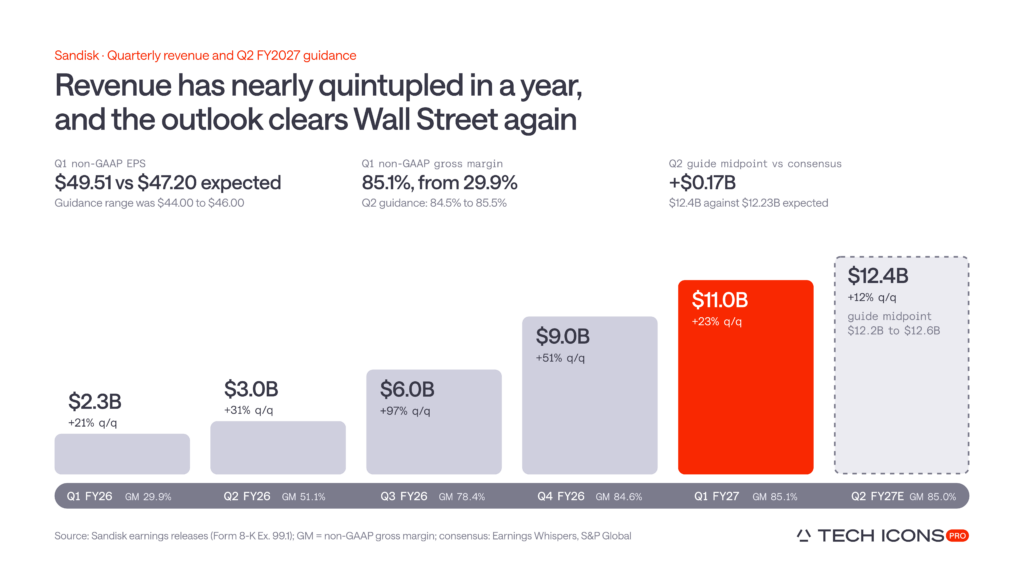
For most of its history, a Sandisk earnings report was an exercise in reading the NAND cycle: how far prices had fallen, how much inventory customers were carrying, how long the trough might last. The fiscal first quarter of 2027 read differently. Revenue for the three months to October 2 reached $11.03 billion, up 23% from the prior quarter and 378% from a year earlier, according to the company’s Form 8-K. That was above the top of Sandisk’s own $10.3 billion to $10.8 billion range, the fifth consecutive quarter in which sales cleared guidance. Non-GAAP earnings of $49.51 a share compared with a forecast of $44 to $46 and a Street consensus of $47.20. GAAP net income was $8.1 billion, or $52.60 a share, helped by a $513 million gain on equity securities.
The margins are what separate this company from its past. Non-GAAP gross margin rose to 85.1% from 84.6% in the prior quarter, against 29.9% a year earlier. Adjusted operating expenses of $513 million consumed less than 5% of revenue, leaving an operating margin of 80.4%, according to the earnings release. Twenty months after its separation from Western Digital, a business long valued as a commodity manufacturer now reports profitability more typical of software. David Goeckeler, chairman and chief executive, credited “robust and growing demand,” with the data center business growing fastest.
Where the Growth Came From
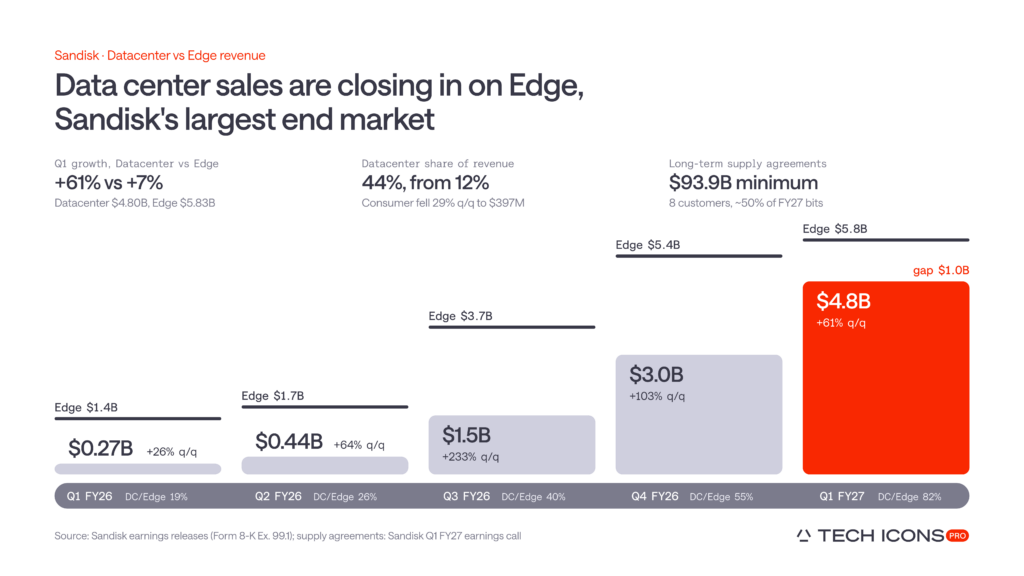
Datacenter revenue rose 61% sequentially to $4.80 billion, from $269 million a year earlier, and now accounts for roughly 44% of sales, up from 33% three months ago. Edge, which spans PCs, smartphones and automotive, grew 7% to $5.83 billion. Consumer revenue fell 29% to $397 million. On the earnings call, Chief Financial Officer Luis Visoso put that decline down to a market adjusting to higher prices. The detail matters. At the low end, where buyers have alternatives and little urgency, elevated NAND pricing is already eroding demand. The quarter’s strength sits with customers for whom storage limits how much AI capacity they can deploy, and for whom it is no longer a discretionary purchase.
How growth was earned matters as much as how much there was. In the fiscal fourth quarter, about two-thirds of the sequential revenue gain came from higher prices. This quarter, volume supplied roughly 60%, according to the company’s earnings presentation. Growth led by price tends to reverse once supply catches up. Growth led by volume reflects demand a company can see and plan for. Management told analysts that data center workloads, led by AI inference and the key-value caches that sustain it, have risen from about a fifth of industry bits early in the decade to roughly half today. At its August investor day, Sandisk projected enterprise data center flash demand of 1.2 zettabytes by 2030.
Contracts in Place of Cycles
The most consequential change at Sandisk is contractual. Under what it calls its New Business Model, the company sells through multiyear agreements built on committed volumes, minimum financial guarantees and pricing that moves within floors and ceilings. Eight customers have signed. At floor pricing the agreements represent at least $93.9 billion of revenue, with $88.9 billion in remaining performance obligations at quarter-end and $16.5 billion in deposits and other guarantees. Two agreements closed during the quarter. Together they cover about half of fiscal 2027 bit shipments and roughly two-thirds of fiscal 2028, with a weighted average term above four years. Visoso said 95% of the counterparties are investment grade.
The arrangement trades some spot-market upside for visibility, and Sandisk has been candid about the cost. Its model for fiscal 2028 through 2030 calls for revenue growth in the mid-to-high teens, non-GAAP gross margins near 80%, operating margins near 75% and an adjusted free cash flow margin of about 50%. The company is in effect telling investors that today’s margins sit roughly five points above the level it regards as sustainable. Visoso expects prices to rise only modestly through the year, and the backlog is being consumed as revenue is recognized. Remaining obligations stood at $91.1 billion in August, counting two agreements signed after that quarter closed. Holding that figure will require new signings at a steady pace.
Cash, Buybacks and the Split
Cash flow told a more complicated story than the income statement, and the headline figure moved the wrong way. Operating cash flow fell to $6.36 billion from $7.13 billion, according to the earnings release. The shortfall has two identifiable sources. Accounts receivable rose to $6.59 billion from $4.71 billion, and customer prepayments under the long-term agreements fell to $465 million from $1.94 billion. Sandisk excludes those prepayments from adjusted free cash flow, which rose 13% to $5.70 billion, a margin of 51.6%. Stripped of contract timing, the business generated more cash than it did three months earlier.
Almost all of it went back to shareholders. Sandisk repurchased $5.0 billion of stock, about 3.2 million shares, bringing buybacks over two quarters to 6.0 million shares, roughly 4% of the share count. It ended the period with $5.1 billion in cash and no debt, and it reaffirmed a policy of returning all excess cash after investment. The board also approved an eight-for-one forward split. Holders of record on November 9 will receive seven additional shares after the close on November 19, and split-adjusted trading is expected to begin November 20. The company said the move would make the stock more accessible, including to employees through its stock purchase plan.
Pricing the Slope, Not the Level
Guidance cleared expectations. Sandisk forecast second-quarter revenue of $12.2 billion to $12.6 billion and non-GAAP earnings of $55 to $57 a share before the split, against consensus estimates of $12.23 billion and $53.30, with gross margin of 84.5% to 85.5%. The reception was guarded. The shares had closed at $1,330.05 on October 29, down 5.3% before the release as a Samsung profit miss weighed on memory stocks. They had lost about a fifth of their value over the preceding month while remaining up more than 450% for the year. In extended trading the stock moved between modest gains and losses before settling near $1,264 overnight, roughly 5% lower.
Investors have little quarrel with the quarter itself. Their attention has moved from the level of earnings to their trajectory. The guidance midpoint implies sequential growth of about 12%, roughly half the pace just delivered, and Visoso noted that the fiscal third quarter is usually the weakest of the year. A week earlier, Western Digital’s shares had fallen despite a beat, a reminder of how little patience the group has for anything short of acceleration. The longer test is technological. Sandisk taped out its first High Bandwidth Flash die during the quarter and expects samples next calendar year, while its BiCS10 node offers 60% greater bit density than BiCS8. If those products and fresh contracts can sustain volume growth as price gains moderate, Sandisk will have shown that its margins rest on structure rather than scarcity.