Ahead of Consensus.
Intelligence across tech and capital markets, for investors, policymakers, and business leaders.
12 minute read
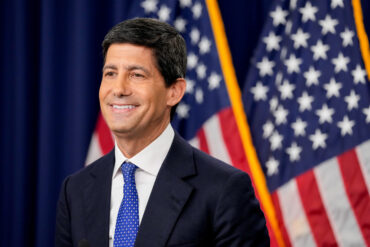
For three years, the only question the Federal Reserve had to answer was how much further rates should fall, or how long they should sit still. On Wednesday, Kevin Warsh answered a different one. The Federal Open Market Committee raised the federal funds rate a quarter point, to a target range of 3.75 percent to 4.00 percent, the first increase since July 2023 and the first of Warsh’s five-month-old chairmanship. The vote was 12 to 0, a rare show of unity from a committee divided over the same question two months earlier, closing out five consecutive holds that had carried the Fed from winter into late summer without a single change in either direction.
The statement accompanying the decision was notably spare, in keeping with the plainer style Warsh has favored since taking the gavel from Jerome Powell in May. Where July’s release had attributed elevated inflation to “supply shocks” in specific sectors, September’s simply called inflation “elevated” and moved directly to justification, stating that the increase would support a swifter return to the Committee’s 2 percent goal. The brevity mattered less than the arithmetic behind it. In July, three regional presidents, Cleveland’s Beth Hammack, Minneapolis’s Neel Kashkari and Dallas’s Lorie Logan, had broken ranks to push for an immediate hike, forcing a 9 to 3 vote that left the committee looking fractured heading into autumn. By September, the remaining members, including Vice Chair Philip Jefferson, Governors Michael Barr, Michelle Bowman, Lisa Cook and Christopher Waller, and New York Fed President John Williams, had come around. Two months of data had done what argument alone could not.
The argument, when it arrived, was difficult to dismiss. Consumer prices rose 3.4 percent over the twelve months through August, holding at July’s pace, with gasoline alone climbing 3.9 percent for the month, the Bureau of Labor Statistics reported on September 11. Core inflation ticked down to 2.4 percent annually from 2.5 percent, a figure that on its face argued for patience, except that the monthly core reading of 0.3 percent ran hotter than economists had modeled, and shelter costs, the most stubborn line in the household budget, rose again. Retail sales, meanwhile, rebounded 1.2 percent in August after a downwardly revised 0.6 percent decline in July, and employers added 162,000 jobs with the unemployment rate unmoved at 4.1 percent. None of it read as an economy in need of rescue.
What made the picture harder to ignore was its source. Much of the inflationary pressure now facing the committee originates outside the channels a central bank ordinarily governs. Oil prices have risen roughly 20 percent since the start of September as conflict in the Middle East strains global energy supply, with West Texas Intermediate trading above 100 dollars a barrel through the meeting itself. Tariff costs continue working their way into consumer prices, and capital spending tied to the artificial intelligence buildout has added its own upward pull on goods prices, a dynamic the committee’s own June minutes acknowledged. A dollar that has kept appreciating against a widening rate gap has done little to offset any of it. For a chairman who staked his early tenure on restoring inflation credibility, the case for patience had simply expired.
At his press conference thirty minutes after the announcement, Warsh made no attempt to soften the message. Inflation, he told reporters, remained too high, and had remained too high for too long; this summer’s readings, whatever comfort they offered on paper, did not convince him that the underlying trend had genuinely turned. The language tracked almost word for word with his August 28 address at Jackson Hole, his first major speech as chairman, in which he warned that the Fed still had work to do before declaring the inflation fight won. He cited a labor market still generating job openings and hours worked, and a jobless rate that remained low by historical standards, as evidence the economy could bear the weight of tighter policy without buckling. Too many categories of goods and services, he said, were still showing price behavior inconsistent with a durable return to target.
Consistent with the “quieter” institution he sketched out at Jackson Hole, one that refuses to indulge a habit of investors treating every Fed appearance as a trading signal, Warsh offered almost nothing on what comes next. “I’m not in the forward guidance business,” he told the room, deflecting questions about October and December alike. Pressed on whether the new rate now counts as restrictive, he gave no clean answer, saying only that he had found it difficult to call policy tight enough even before Wednesday’s move, a phrase that read, to anyone listening closely, as an invitation to expect more rather than less. He allowed that price stability had eluded the Fed for five and a half years, longer than his own tenure and most of his predecessor’s, and cast continued discipline on inflation as the clearest way to protect households at the lower end of the income scale, who depend most, he argued, on the combination of steady work and steady prices.
The Summary of Economic Projections released alongside the statement gave Warsh’s remarks a numerical backbone. The median committee member now expects one further quarter-point increase before the year is out, followed by another in 2027, with core PCE inflation projected at 3.3 percent by the end of this year and 2.5 percent the year after, both revised upward from June. Growth forecasts for 2026 edged up to 2.2 percent, unemployment is expected to finish the year near 4.3 percent, and officials now see the federal funds rate eventually settling somewhere between 3.0 percent and 4.0 percent over the longer run. Perhaps most tellingly, the committee no longer expects inflation to reach its 2 percent target until 2029, a full year later than the June forecast implied. The timeline, not the destination, had shifted.
That the Fed moved at all carried a political weight the statement itself never acknowledged. President Trump has pressed for lower rates since before Warsh took office and has kept an unusually open line to him since the confirmation, according to reporting in the Wall Street Journal, while White House National Economic Council Director Kevin Hassett said over the weekend the president respected the Fed’s independence completely, even if a rate increase would not please him. Warsh proceeded regardless, joined by every voting member of the committee, including Powell, who remains on the Board of Governors until his own term expires in 2028. The next meeting, on October 27 and 28, falls close enough to the midterm cycle that a second increase then would almost certainly draw sharper criticism. Wednesday’s decision, in that light, looked less like an isolated judgment than the opening move of a cycle the Fed intends to see through.
Wall Street had positioned for the outcome with unusual conviction, CME’s FedWatch tool showing better than 90 percent odds of a hike heading into the announcement, and equities absorbed the news with relative calm after a cautious, mixed open. The mood shifted once Warsh began speaking. His insistence that inflation remained unresolved sent the 10-year Treasury yield back above 5 percent, its highest close since 2007, and pulled equities down with it. The Dow Jones Industrial Average, already tracking its weakest start to a September since 2008, fell roughly 500 points, or about 1 percent, led lower by rate-sensitive financials; Bank of America and Wells Fargo each dropped close to 3 percent, and American Express slipped alongside them. The S&P 500 gave up roughly half a percent, while the Nasdaq Composite held nearer flat, insulated by technology names even as transportation stocks fell on a separate earnings warning from trucking carrier J.B. Hunt.
Strategists, for the most part, read the session as recalibration rather than alarm. Yardeni Research trimmed its year-end S&P 500 target to 7,900 from 8,400, a cut that still implies further gains from current levels, while Citi’s David Groman noted that global equities have historically wobbled at the start of hiking cycles before resuming their climb within six to twelve months, provided economic growth holds alongside them. What remains unresolved is not whether the Fed intends to keep fighting inflation, a point Warsh left in little doubt, but how much room markets are prepared to give him while he does. With energy prices still capable of surprising in either direction and two meetings left before the year closes, the Fed’s next moves will say as much about its tolerance for political friction as about the inflation numbers themselves.