- AI Chips
- Rare Earths
- Trade Policy
- U.S.-China
Two Powers, One Table: Trump and Xi Rewrite the Rules in Beijing
14 minute read
In Beijing, Trump and Xi met to do what great powers now do instead of fighting: negotiate, with elaborate courtesy, the enduring terms of a rivalry neither can win and neither will end.
Key Takeaways
- Xi and Trump agreed to a “constructive strategic stable relationship,” diplomatic language introduced for the first time, signalling a deliberate attempt to institutionalise managed competition rather than allow the rivalry to drift toward confrontation.
- Jensen Huang’s last-minute addition to Air Force One crystallised the summit’s central commercial paradox: Washington approved H200 exports months ago, Beijing has not permitted a single shipment, and Nvidia’s China revenue stands at zero despite the company’s $5.4 trillion valuation.
- With the trade truce expiring in November 2026, every agreement reached in Beijing, on rare earths, agriculture, aircraft, and AI, is a time-bound transaction, not a settlement; the relationship has matured into perpetual renegotiation, with each deadline shaping the next.
The Weight of the Room
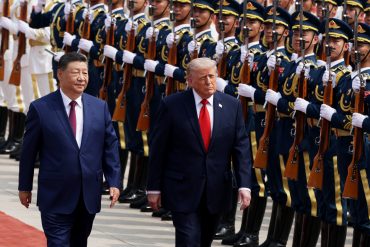
BEIJING, China — There is a quality of light in the Great Hall of the People that seems engineered to remind visitors of their comparative smallness. The chandeliers are vast, the ceilings recede into institutional shadow, and the architecture of the space communicates, with the quiet precision of decades of deliberate use, that the institution endures longer than any of the figures seated within it. When Donald Trump and Xi Jinping faced each other across a long table flanked by more than a dozen suited officials on Thursday morning, both men understood this. The meeting that followed, more than two hours and fifteen minutes of closed-door bilateral talks, was not merely a summit between two presidents. It was a renegotiation of the terms under which the world’s two largest economies will continue to do business with, and against, each other.
Trump’s visit was his first to Beijing since November 2017. Then, Xi had staged what observers called a “state visit-plus,” a private dinner in the Forbidden City, a parade through Tiananmen Square, and a Great Hall ceremony unveiling $250 billion in business deals. That encounter carried the texture of a seduction. This one carried the texture of a negotiation between parties who know each other too well for illusions. Nine years of accumulated friction, punishing tariffs, a global pandemic, an ongoing war in the Middle East that had closed the Strait of Hormuz and sent oil markets into disorder, had stripped the meeting of its earlier romanticism. What replaced it was something more durable, if less photogenic: a relationship being consciously redesigned for permanence.
By the time the talks concluded, Xi had announced that the two leaders had agreed to establish a “constructive strategic stable relationship” as the new orientation for bilateral ties over the next three years and beyond. The formulation, introduced publicly for the first time, was Xi’s attempt to reframe the volatile pattern of recent years into something more predictable. “Constructive strategic stability,” he said, “should be a positive stability characterised primarily by cooperation, a benign stability with well-regulated competition, a normal stability with manageable differences, and a lasting stability with predictable peace.” The phrase was new. The underlying aspiration, that two rival powers can manage their competition without it becoming catastrophic, is as old as the Cold War.
The Delegation as a Market Signal
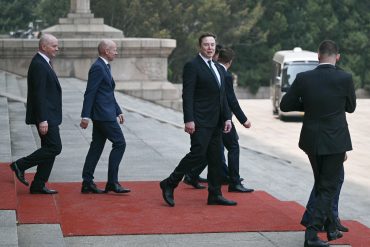
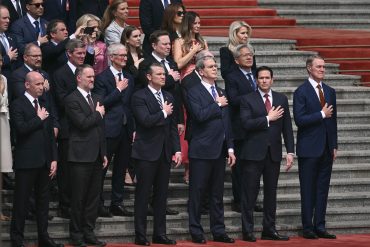
Before the talks began, the composition of the American party told its own story. The delegation included Boeing CEO Kelly Ortberg, BlackRock’s Larry Fink, Blackstone’s Stephen Schwarzman, Citi’s Jane Fraser, and Goldman Sachs’s David Solomon, among others. Their presence mapped the summit’s commercial agenda with precision: aircraft sales, capital markets access, financial services liberalisation, agricultural purchases. For Xi, the calibre of the American business community in the room carried a specific kind of diplomatic currency. In China’s protocol-sensitive political culture, the signal was unmistakable: the most powerful private capital in the world had come to Beijing.
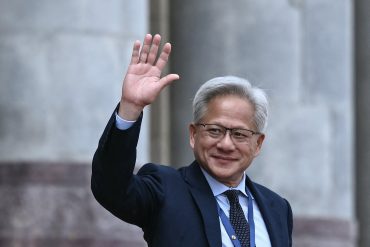
But no figure in the delegation said more about the underlying tensions of the relationship than the man who almost was not there. Jensen Huang was not on the White House’s published guest list as of Monday. After media coverage flagged his absence, Trump called Huang directly; Huang flew to Anchorage and boarded Air Force One during a refuelling stop on Tuesday. The sequence, a presidential phone call, a scramble to Alaska, a seat on the presidential aircraft, was unusual enough to command its own news cycle. It deserved one. Huang’s company, Nvidia, is the most valuable corporation on earth. On May 13, the day Huang boarded Air Force One, Nvidia’s market capitalisation reached $5.4 trillion. It is also a company whose China revenue has fallen to exactly zero, despite possessing a product that Beijing’s AI industry desperately wants.
The Trump administration approved sales of the H200 chip to China in December 2025, attaching a condition requiring the U.S. government to receive 25 percent of resulting revenue. Those sales have since stalled completely. The reason, articulated by Commerce Secretary Howard Lutnick, was that the Chinese central government had not permitted its companies to buy the chips, choosing to keep investment focused on domestic alternatives. The H200 program thus represents a genuine paradox at the heart of the bilateral technology relationship: Washington has approved a transaction that Beijing will not permit, for reasons that serve Beijing’s long-term industrial interests even at the cost of near-term AI development. Huang arrived in Beijing holding that paradox.
Cook’s Dilemma and Musk’s Bet
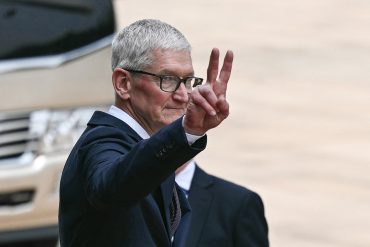
No two figures in the delegation embodied the contradictions of American commercial engagement with China more precisely than Tim Cook and Elon Musk. Their presence in Beijing was not ceremonial. It was a statement of exposure.
Cook’s appearance carried particular weight given what awaits him at home. Apple announced last month that Cook will step down as chief executive on September 1, transitioning to executive chairman, with hardware engineering chief John Ternus taking over as CEO. His final act as leader of the world’s most valuable consumer technology company was to accompany the American president to China, the country that assembles the overwhelming majority of iPhones and accounts for roughly a fifth of Apple’s global revenue. Cook spent fifteen years managing what is simultaneously Apple’s greatest manufacturing dependency and one of its largest consumer markets, navigating tariff escalations and supply chain disruptions with a patience that became the defining characteristic of his tenure. The Beijing visit was its fitting coda.
Musk’s presence carried a different valence. Tesla’s Shanghai Gigafactory produces vehicles for both the Chinese domestic market and broader Asian export, but Musk arrives in Beijing in 2026 as something considerably more than a carmaker. His proximity to the centre of American executive power makes him a figure Beijing watches with particular attentiveness. He is also the man preparing to execute what analysts are calling the most consequential market event in a generation. SpaceX is targeting as much as $75 billion in its IPO, potentially the largest listing in history, with valuation estimates ranging from $1.75 trillion to $2 trillion. The man preparing to price American innovation at a scale the world has never seen was seated, on Thursday, across from the government whose technological rise most directly tests the premise that such a premium remains justified.
Together, Cook and Musk represent the two poles of American corporate engagement with China: deep, structural, largely irreversible integration on one side, and the more volatile intersection of commerce, political proximity, and capital markets ambition on the other. Both men left Beijing with the same fundamental uncertainty they arrived with. The relationship that governs their exposure to China is more institutionalised than it was on Wednesday. It is not, in any meaningful sense, more secure.
The Geology of Leverage
No issue entering Thursday’s talks carried more structural weight than rare earths, and no issue better illustrates how thoroughly the past eighteen months have reordered the bilateral power dynamic. China controls roughly 90 percent of global rare earth refining, materials essential for semiconductors, electric vehicles, military equipment, and electronics. For decades, this dominance was treated in Washington as a theoretical vulnerability. In 2025, it became an operational one.
After Trump escalated tariffs past 140 percent, Xi reached for his most consequential economic instrument. When he threatened to restrict rare earth mineral and magnet flows in April and October 2025, Trump pulled back rather than risk further escalation. The episode was instructive not because it revealed a new fact about Chinese power, but because it demonstrated, in public, with verifiable consequences, the asymmetry that analysts had long described in the abstract. The October 2025 truce reached in Busan suspended the most punitive restrictions. Both sides arrived in Beijing inclined to extend it. Beijing’s probable willingness to purchase Boeing aircraft and American soybeans, and to announce the Board of Trade and parallel Board of Investment already sketched out in previous working-level talks, reflected this calculus.
The extension of that arrangement would represent a tactical success measured in months rather than years. One year on from China’s 2025 rare earth export restrictions, the United States still has significant ground to cover before it reaches anything resembling true supply chain resilience. Diversification programs are under way, in California, Australia, and Canada, backed by emergency financing through the Defence Production Act, but the geology of these efforts does not compress to meet a political timetable. Processing and refining capacity that took China thirty years to build cannot be replicated in three. For the industries most exposed, defence contractors dependent on dysprosium for jet engine magnets, EV manufacturers reliant on terbium for motors, semiconductor fabs requiring gallium and germanium for compound chips, the truce is not a solution. It is time purchased at a known price.
The AI Contest and the Paradox of Managed Dependency
Artificial intelligence occupied more of the summit’s formal architecture than any prior bilateral meeting. The discussions built on working-level channels established under the previous administration, addressing safety protocols, the dangers posed by non-state actors with access to frontier models, and the risk of autonomous systems acquiring proximity to nuclear command structures. These conversations are necessary. They are also, in the current climate, somewhat abstract relative to the commercial conflict playing out in real time.
What China wants is a formal H200 licensing framework for its commercial AI sector, universities, research institutes, and model developers, rather than the current case-by-case presumption of denial. What the United States wants in exchange is resumed export of gallium, germanium, antimony, and graphite under normal trade conditions. The exchange has the clean logic of a swap. The complication is that both sides have independent reasons to resist it.
China’s AI advances have closed the gap with the United States considerably, according to the Stanford Institute for Human-Centered Artificial Intelligence’s annual index. The United States holds the advantage in capital, infrastructure, and chips. China leads in patents, publications, and physical AI, including robotics. Beijing has simultaneously pressed for access to advanced chips and directed its domestic technology champions to develop substitutes, creating a situation in which accepting a chip deal could undermine the domestic industrial policy that gives the demand for chips its strategic logic in the first place. China’s State Administration for Market Regulation had already announced in September 2025 that Nvidia had violated its 2020 antitrust review terms, and Beijing had directed domestic companies to prioritise local chip alternatives, effectively blacklisting the H20. The H200 program thus exists in a diplomatic limbo that neither side has a clean incentive to resolve quickly.
Xi’s Confidence, and What It Rests Upon
The public record of Thursday’s opening exchanges offered a study in contrasting registers. Xi spoke from the posture of settled conviction. He called for partnership, invoked the danger of great-power conflict, and delivered what Chinese state media framed as a definitive statement on Taiwan: that it was “the most important issue in China-United States relations” and that its mishandling could push the relationship into a “very dangerous situation.” Trump responded warmly, calling Xi a “great leader” and expressing confidence in a relationship that would be “better than ever.”
The contrast was not accidental. Xi has long told senior officials that “the East is rising and the West is declining” and that “time and momentum” are on China’s side. His confidence strengthened measurably after 2025, when he demonstrated that rare earth leverage could produce American concessions under tariff pressure that no prior administration had tested at scale. This is not triumphalism for its own sake. It is a considered assessment of structural position that now informs every concession Beijing is willing to make and every line it will not cross. China’s aim is to buy time to consolidate its technological and industrial position while reigniting a faltering domestic economy. The United States, in this reading, seeks symbolic wins rather than meaningful structural reform of China’s economic model. The two objectives are not incompatible. They can coexist within a framework of managed competition, which is precisely the framework both sides agreed, on Thursday, to formalise.
Markets, Meaning, and the November Clock
Financial markets registered the summit as a relief event. Semiconductor stocks rose. Chinese technology shares held steady. The yuan was stable. Rare earth prices, still elevated from the disruptions of 2025, edged lower on expectations that the truce would extend. The equity reaction was not enthusiasm for a breakthrough; it was relief at the absence of a breakdown. In a bilateral relationship that has redefined itself around the management of permanent tension, that relief has become the relevant measure of success.
The clock governing every one of these assessments is November 10, 2026. The broader tariff-reduction truce extended at Busan in 2025 expires on that date, which was the deadline informing every conversation in Beijing. Agriculture purchases, Boeing orders, rare earth flows, H200 licensing: each of these agreements is time-bound in the same direction, designed to hold through America’s midterm elections and then require renegotiation. For capital allocators and supply chain planners, this is the most practically important fact about the summit. The framework agreed on Thursday is not an architecture. It is a lease.
The Long Game
There is a well-worn genre of analysis that frames each U.S.-China summit as either a harbinger of conflict or a foundation for cooperation, and then measures the outcome against one of those poles. Thursday’s meeting in Beijing did not lend itself to either framing. It was something more interesting and more difficult to characterise: a deliberate institutionalisation of rivalry, a formal agreement to compete within agreed limits, by two powers whose economies are too intertwined for separation and whose strategic interests are too divergent for genuine partnership.
The phrase Xi introduced, “constructive strategic stable relationship,” is worth examining at the level of its individual components. Constructive: the relationship will produce tangible outcomes, will not be purely adversarial. Strategic: both sides acknowledge the competition is real, structural, and long-term. Stable: the goal is predictability, not resolution. Together, the three words describe a world in which the two largest economies manage their rivalry through institutions, timetables, and rolling transactions rather than through either alliance or confrontation. It is not the world that the architects of the post-Cold War order imagined. But it is, increasingly, the world that exists.
For the business leaders who flanked Trump on Thursday, and for the senior investors and policymakers reading the summaries on Friday morning, the operational instruction from Beijing remains what it has been for the better part of three years: diversify supply chains as quickly as capital allows, price resilience into long-term planning, and operate within a bilateral relationship that is simultaneously essential and unreliable. The Great Hall of the People has hosted that kind of realism before. It is becoming practiced at it.