- Big Tech
- Executive Strategy
- Tech Leadership
Tim Cook Steps Back as Apple Names John Ternus CEO
13 minute read
Tim Cook will become executive chairman in September as hardware engineering chief John Ternus takes the helm at a company valued at $4 trillion and entering its most consequential product era.
Key Takeaways
- Tim Cook departs after 14 years having quadrupled Apple’s revenue, scaled services past $100 billion annually, and grown the active device base to 2.5 billion units across a deeply embedded global ecosystem.
- John Ternus, a 25-year Apple veteran and the architect of its hardware renaissance, takes command precisely when physical device quality will determine how effectively artificial intelligence reaches consumers.
- Apple’s board-led succession, reinforced by Cook’s continued presence as executive chairman, offers a rare and replicable model of institutional continuity in an industry better known for leadership turbulence.
The Quiet Handover
There are leadership transitions, and then there are those so deliberately constructed that the announcement itself becomes the exhibit. Apple’s disclosure on April 20 that Tim Cook would step down on September 1, moving to executive chairman while John Ternus assumed the chief executive title, belongs firmly in the second category. No rupture, no internal drama, no market convulsion. Just the orderly transfer of authority at the world’s most valuable company, executed with the same exacting care Apple applies to the tolerances inside its products.
The market’s reaction was telling in its restraint. Apple Inc. shares (NASDAQ: AAPL) closed regular trading at $273.05, off 0.61 percent, slipping roughly a further point in extended hours. For a company sitting at $4 trillion in market capitalisation, that is not anxiety. It is recognition. Investors had watched the ground being prepared for years. When the moment arrived, the predominant response was neither relief nor concern but something closer to confirmation: this is what a well-governed institution looks like when it manages its own succession.
What Cook Actually Built
To understand what Ternus inherits, and what the transition genuinely means, requires an honest accounting of the fourteen years that preceded it. When Cook took the chief executive role in August 2011, Apple’s market capitalisation was approximately $350 billion and annual revenue stood at $108 billion. The company was formidable. It was also, in the eyes of a significant portion of the investment community, dangerously dependent on the irreplaceable creative force of its founder. The animating question of Cook’s tenure was not whether Apple could grow. It was whether Apple could endure.
The answer arrived in the numbers. Revenue reached more than $416 billion in fiscal 2025. The active installed base surpassed 2.5 billion devices. Services, once marginal, scaled into a business generating more than $100 billion in annual revenue, a figure that would rank it comfortably within the Fortune 40 if measured independently. Entirely new product categories emerged: Apple Watch, AirPods, Apple Vision Pro. The transition to Apple-designed silicon upended the assumptions of the personal computing industry. Privacy, once a slogan, was engineered into the architecture of Apple’s platforms and became a genuine competitive differentiator. Carbon emissions per dollar of revenue fell more than 60 percent even as the top line nearly doubled.
Our goal has never been to make the most. It’s always been to make the best.
What distinguishes Cook’s record is not its magnitude but its method. He did not pursue transformation through dramatic pivots or headline acquisitions. He compounded what existed: deepening the supply chain, extending the ecosystem, strengthening the customer relationship, and holding the product culture to a standard that his predecessor had established but that many assumed would erode without him. In an industry that rewards the appearance of disruption, Cook built something rarer and more valuable: a machine that reliably gets better.
The Engineer in the Room
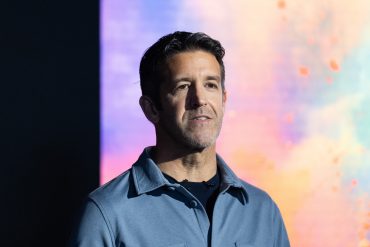
John Ternus has not been the subject of many profiles. He has spent his career building products rather than cultivating presence, and that distinction matters enormously in understanding what his appointment signals. He joined Apple in 2001, in the first months after the original iPod altered the company’s trajectory, and he advanced through the hardware organisation across more than two decades of product generations. His appointment to senior vice president of hardware engineering came in 2021. In the years since, his responsibility has encompassed the mechanical and electrical design of nearly everything Apple ships.
The scope of what his teams have produced deserves more than a passing mention. The M-series chip transition, executed in close collaboration with Johny Srouji’s silicon organisation, delivered performance and efficiency margins that no credible forecast had anticipated, and in doing so repositioned the Mac as a genuinely competitive platform. AirPods, under Ternus’s stewardship, moved well beyond their origins as wireless earbuds, earning regulatory approval as over-the-counter hearing aids and establishing a template for hardware as health infrastructure. The iPhone 17 lineup, introduced last autumn, brought the ultra-thin iPhone Air alongside refreshed Pro models, representing sustained and serious investment in materials science, thermal management, and manufacturing precision. His teams have pioneered recycled aluminium compounds, 3D-printed titanium components, and repairability standards that have simultaneously lowered Apple’s environmental footprint and extended the usable life of its devices.
The board’s decision to elevate a hardware engineer rather than a services executive, a financial strategist, or an external appointment reflects a lucid reading of where Apple’s competitive leverage actually lies. The company is entering a period in which the physical device, its sensor array, thermal envelope, battery performance, and display quality, will determine how meaningfully artificial intelligence can be experienced by the people who carry it. The intelligence is only as useful as the hardware that delivers it. Ternus understands that relationship not as a strategic framework but as a daily working reality.
Cook’s characterisation of his successor in the official release was precise: “the mind of an engineer, the soul of an innovator, and the heart to lead with integrity and honour.” Arthur Levinson, Apple’s long-serving chairman, transitioning to lead independent director, was equally unhedged: “We believe John is the best possible leader to succeed Tim.” These are not the careful formulations of a board managing a compromise candidate. They are the statements of an institution that has made a considered choice and is prepared to stand behind it fully.
Architecture of Continuity
The structural decisions surrounding the transition are as instructive as the appointment itself. Cook’s continued presence as executive chairman, with an explicit remit covering global policy engagement, is not ceremonial. Apple currently operates inside a regulatory environment of sustained intensity: antitrust proceedings in both Europe and the United States, evolving privacy frameworks across major markets, and the unresolved economics of the App Store. Cook’s institutional relationships and accumulated credibility in those arenas represent genuine organisational capital, and retaining them within the boardroom is a straightforward act of prudence.
The simultaneous creation of a chief hardware officer role for Johny Srouji carries its own significance. By formalising that layer in the organisation, Apple has ensured that the hardware and silicon functions remain tightly integrated as the company pushes further into AI-driven product experiences. It also defines the altitude at which Ternus will operate as chief executive: at the level of institutional strategy, external relationships, and long-range direction, rather than in the product details that he has spent his career mastering. The organisation is being structured so that his strengths as a leader are preserved and amplified rather than consumed.
The process itself is worth examining as a governance model. Large technology transitions have frequently been disorderly. Microsoft’s handover from Gates to Ballmer produced a strategic fog that persisted for years. Intel cycled through chief executives in search of coherence it never found. Apple’s approach, years of deliberate internal development, an unambiguous board mandate, a structured transition period, and a careful redistribution of institutional responsibilities, is categorically different. It will be studied.
The Horizon Ahead
Ternus assumes leadership with a product pipeline that is ambitious by any standard. The foldable iPhone, widely anticipated before the close of 2026 or in early 2027, will represent the first major test of the new chief executive’s product instincts in the full glare of market scrutiny. The progressive integration of Apple Intelligence across the hardware stack will determine whether the company can convert its installed base into a durable position in the AI era, or whether that base simply becomes the terrain on which others compete. Financial services, health ecosystems, and the continued scaling of subscription revenue each represent meaningful expansion surfaces within a customer relationship that is already deeply embedded.
The geopolitical dimension will demand sustained attention. Apple’s supply chain diversification, extending manufacturing capacity in India and Southeast Asia while managing the commercial weight of China, is a permanent tension rather than a solvable problem. Navigating it requires both diplomatic agility and manufacturing discipline, and neither can be compromised for the other.
On sustainability and accessibility, Ternus carries a legacy that is genuine rather than inherited in name only. His work in materials science and his teams’ advances in product repairability suggest that Cook’s commitments in these areas will be continued from conviction rather than obligation.
The Institution That Outlasts Its Leaders
Cook’s farewell letter to Apple’s community stepped deliberately outside the conventions of corporate communication. He wrote about reading user messages each morning, about devices that had changed how people worked, communicated, and understood themselves. The register was personal, even intimate, and it was clearly intentional. It was a reminder that beneath the financial architecture, the ecosystem design, and the supply-chain precision sits a company that hundreds of millions of people form genuine attachments to.
We believe that business, at its best, serves the public good, empowers people around the world, and binds us together as never before.
That attachment is, ultimately, the most consequential thing Cook leaves behind. Not the revenue multiple, not the services business, not even the silicon transition, though each of those is formidable. The deepest part of his legacy is the demonstration that Apple’s essential character, its insistence on quality, its user-centred values, its cultural self-discipline, can survive the departure of the person most identified with preserving it after the founder.
Ternus steps into an institution that has already proven it can endure. His task is not to reinvent it but to extend it, with the same clarity of purpose and the same uncompromising standard that has made Apple, across two very different leaderships, the defining technology company of its era. The baton has been passed with rare deliberateness. What matters now is the distance still to run.