- Autonomous Vehicles
- EV
- SpaceX
- Tesla Roadster
Tesla’s Flying Roadster Puts Its Engineering Ambition on Display
14 minute read
Nine years late and fitted with SpaceX thrusters, Tesla’s new Roadster arrives without a price and with a 2028 start date. It tests how much spectacle investors will accept in place of margin.
Key Takeaways
- Tesla’s next-generation Roadster comes in three versions, Performance, Thrust and Rocket. Claimed 0-60 mph times run from under 1.6 to under 0.59 seconds, with range above 300 miles.
- SpaceX-developed cold-gas thrusters power the Thrust and Rocket versions. Tesla reopened $50,000 reservations but disclosed no price, and the Rocket is not approved for public roads.
- Production begins in 2028 at a factory Tesla has yet to name. With 486,532 deliveries in the third quarter alone, Roadster volumes will be marginal next to the core Model 3 and Model Y business.
The Stage Was the Message
Tesla could have unveiled its next-generation Roadster almost anywhere. It chose a SpaceX rocket-test site in McGregor, Texas, near Waco, on the evening of October 15. That choice said more about the company’s ambitions than anything that followed on screen.
The livestream began at 7:55 p.m. Central, two weeks after the date Tesla had first announced. The October 1 event was called off on September 28. The company said it had been tracking the weather with local meteorologists and that the demonstration could only be staged outdoors. Elon Musk, characteristically, put it more simply and blamed high winds.
Turns out the future does have flying cars.
What followed was the most theatrical presentation in Tesla’s history and, by a wide margin, the least commercial. A Roadster drove up a ramp, hung inverted at its crest, then used compressed-gas thrusters to roll through the air and land. In a live acceleration run it reached 60 miles per hour in 0.81 seconds. Musk’s summary was brief: “Turns out the future does have flying cars.”
The details that matter to investors came after the cameras went dark. Tesla posted the configurations in a thread on X and on its updated Roadster page, not from the stage. It reopened reservations and confirmed that production would begin in 2028. It did not name a price for any version of the car.
Three Cars in One
The Roadster now comes in three configurations, each built on the one below it. Tesla calls the upper two “augments” to the base car rather than separate models, and the distinction is worth taking seriously.
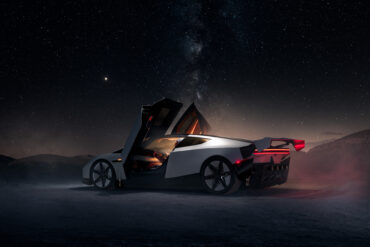
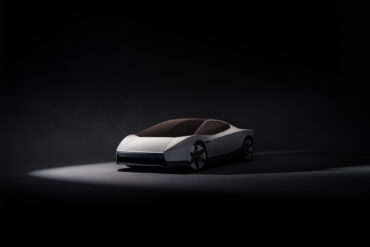
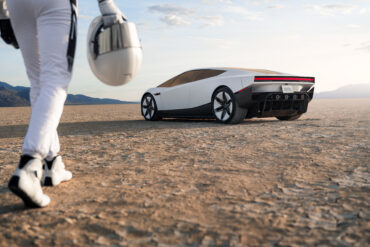
The Performance version is the road car. It seats two, carries active aerodynamics and what Tesla calls a multi-mode suction system, and claims a 0-60 mph time under 1.6 seconds. It is the only version available through ordinary reservation.
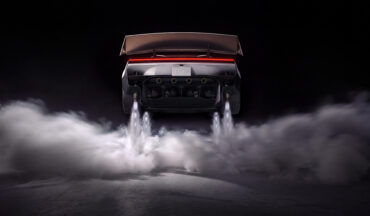
Thrust adds rear-mounted cold-gas thrusters and claims under 0.9 seconds. Tesla describes it as a limited release.
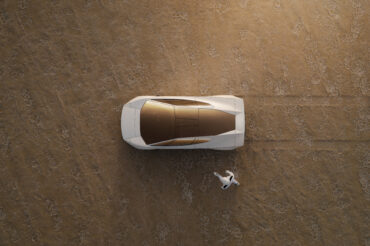
Rocket is a single-seat, invitation-only machine with thrusters around its perimeter for vertical and rotational movement. Tesla claims under 0.59 seconds to 60 mph and a top speed above 230 mph. The company’s own website states that this version is not approved for public road use. Across the range, Tesla quotes more than 300 miles of range.
We already put Roadster in a rocket. Now we put a rocket in Roadster.
The engineering is serious, and much of it is borrowed from elsewhere in Musk’s portfolio. Tesla says that adapting thrusters designed for the vacuum of space to work in atmosphere required new hardware and new control systems. Every usable cavity in the body holds carbon-fiber overwrapped pressure vessels filled with compressed gas. The company claims the thrusters produce four to five times the force the tires can transmit. That is how the car escapes the traction limit that caps every conventional vehicle’s acceleration.
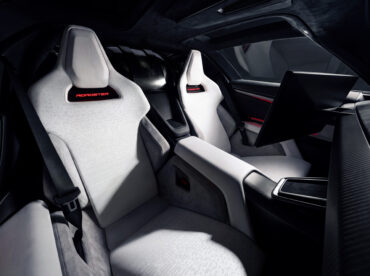
The suction fans, by Tesla’s account, can hold the car against a ceiling even when it is stationary. In Track Mode, the active wings are moved by actuators originally developed for the Optimus humanoid robot. The cabin is deliberately austere: a steer-by-wire yoke, a fixed seating position and manual controls to save weight, with magnesium, titanium and carbon fiber used throughout.
Tesla’s marketing made the lineage explicit. Its website now reads: “We already put Roadster in a rocket. Now we put a rocket in Roadster.” The line refers to the first-generation car that SpaceX sent into space aboard a Falcon Heavy in 2018. It is clever copy, and it is also a statement of strategy.
What Nine Years Changed
Any honest assessment has to begin with the car Tesla first promised. The next-generation Roadster appeared as a surprise at the Semi event in November 2017, with production pledged for 2020. That prototype promised roughly 620 miles of range, a top speed above 250 mph, 0-60 mph in 1.9 seconds and seating for four in a 2+2 layout.
The trade-offs since then are plain. Quoted range has roughly halved, to just over 300 miles. The four-seat cabin is now a two-seater at most, and a single-seater in Rocket form. The top-speed claim has fallen to above 230 mph, and only for the version that cannot legally be driven on public roads. Acceleration moved the other way. Even the base car beats the 2017 target, and the thruster versions claim figures no road car approaches.
The financial terms for customers have barely moved. Tesla is again asking $50,000 to reserve the Performance version: $5,000 at the time of ordering, described as fully refundable, and a further $45,000 within ten days or the reservation lapses. Thrust requires a $250,000 reservation payment.
Customers who committed capital on the strength of the 2017 specification are now being offered a materially different car on similar terms. That is not a trivial point for a company whose earliest buyers have long been its most vocal advocates.
The delays were not confined to the distant past. In 2026 alone, the unveiling moved from April to late April. It then slipped to roughly a month after first-quarter earnings, then to August while SpaceX refined the cold-gas system, then to October 1, and finally to October 15. Musk’s phrasing of the production date, “2028, actually,” acknowledged the credibility deficit even as it set a new target.
The Last Car for Human Hands
On the surface, a low-volume, six-figure sports car is an odd priority for a company whose investment case now rests on autonomy, robotics and AI infrastructure. Two features of the presentation explain the logic.
The first is positioning. Musk said the Roadster would be the last Tesla intended for a human driver, and the car ships without the company’s FSD driver-assistance software. The inversion is deliberate. Tesla is presenting the ultimate expression of human driving at the very moment it argues that driving is about to become obsolete. The car is meant to close one chapter and advertise the next. Notably, the demonstration vehicle performed its stunts autonomously, for safety reasons.
The second is corporate. The Roadster is the most visible product yet of engineering collaboration between Tesla and SpaceX, which has traded on Nasdaq since its initial public offering in June. Musk shared the livestream with the caption “Tesla x SpaceX.” The timing invites interpretation, because the event lands amid sustained analyst debate over whether the two companies will combine.
Wedbush has said it expects a merger in 2027. RBC Capital Markets has made the case on operational grounds. Oppenheimer has argued that keeping the companies separate better serves Musk’s longer-term aims. When the question came up on Tesla’s second-quarter earnings call, Musk said such matters would be handled through the appropriate process, not discussed on a call.
Neither company has disclosed a merger agreement, a special committee or terms of any kind. The Roadster’s SpaceX symbolism is narrative, not evidence of a transaction, and investors would be wise to price it accordingly.
Strong Volumes, Thin Margins
The Roadster arrived against a backdrop of solid volumes and compressed profitability, less than a week before Tesla reports third-quarter results.
The company’s production and deliveries report, furnished to the SEC on October 2, showed 464,391 vehicles produced and 486,532 delivered, along with 13.7 gigawatt-hours of energy storage deployed. Deliveries beat the company-compiled analyst consensus of 461,974. They rose modestly from 480,126 in the second quarter.
Deliveries did fall about 2% from the 497,099 recorded a year earlier. That earlier quarter was inflated by American buyers rushing to claim the federal EV tax credit before it expired at the end of September 2025.
Deliveries exceeded production by about 22,000 units, the second consecutive quarter in which Tesla reduced inventory. Model 3 and Model Y accounted for 478,237 deliveries. Every other model combined accounted for 8,295, a figure that shows how narrow the commercial base remains beneath the expansive product rhetoric.
The second quarter exposed the central tension in the investment case. Revenue reached $28.24 billion, up about 26% year over year, and trailing twelve-month revenue crossed $100 billion for the first time. Profitability moved sharply the other way. GAAP operating income fell 57% to $398 million, and operating margin compressed to 1.4% from 4.1% a year earlier as operating expenses rose 47%.
Capital expenditure jumped 142% to $5.79 billion. That turned free cash flow negative by roughly $1.09 billion, despite operating cash flow of $4.70 billion. In its quarterly filing, Tesla said it expects 2026 capital spending to exceed $25 billion, driven by AI compute and data centers, manufacturing and research expansion, and its growing fleet of AI-enabled assets.
The car’s value lies elsewhere. It shows engineering shared across Musk’s companies, and it lends the brand a measure of glamour. It also gives Tesla something tangible to show at a time when much of its valuation rests on capabilities still in development. Those are real assets. They are not, however, the kind that repair a 1.4% operating margin.
A Market That Has Seen This Before
Investors approached the event with visible skepticism. Tesla shares fell more than 1% on Thursday to close at $362.44, leaving the stock down about 5% for the week. Before the reveal, the shares traded roughly 25% below their 52-week high. Tesla had been the weakest performer among the Magnificent Seven this year, down by a high-teens percentage.
At around 187 times expected earnings, it also remained the most richly valued member of that group. That is a multiple with little tolerance for spectacle that arrives without substance.
History offered the relevant precedents. Tesla shares fell 6% after the 2019 Cybertruck reveal and 8.3% after the October 2024 Cybercab unveiling. They lost nearly 6% on September 4 this year after another Cybercab event left investors wanting. Each time, the complaint was the same: a striking demonstration, followed by uncertainty about when it would become revenue.
Analyst commentary was more restrained than the price action. Gene Munster of Deepwater Asset Management called the event an “engineering flex” with no commercial value beyond embarrassing established carmakers. He did read it as a signal of Musk’s intent to draw the two companies closer.
Gary Black of The Future Fund had been cautious before the reveal. He questioned enthusiasm for a stock-for-stock combination with SpaceX, arguing that such a deal would drift toward Tesla’s lower valuation multiple. Going into the event, the Wall Street consensus stood at Moderate Buy, with an average price target near $405.
The overnight move deserves restraint. A favorable open would at most interrupt the pattern of post-reveal sell-offs; it would not settle the larger argument over margins, capital intensity and the timing of returns on AI spending. That argument resumes on October 21, when Tesla reports third-quarter results after the close.
What Would Make It Real
Four questions will decide whether the Roadster is remembered as a product or as a promotional event.
The first is price and demand. Tesla has reopened reservations at the 2017 deposit levels without saying what the car will cost. How many reservations convert into binding orders, and whether Tesla ever discloses that number, will be the first meaningful test of demand.
The second is manufacturing. Tesla has not named the plant or production line that will build the car. A credible 2028 start requires decisions on tooling and suppliers well before then. A single line in a quarterly update or filing would carry more weight than any promise made from a stage.
The third is regulation and liability. Tesla itself states that the Rocket version is not road-legal and that availability depends on regional law. How the company handles certification, insurance and warranty for vehicles carrying pressurized-gas thrusters will determine how much of what was shown in Texas ever reaches a customer.
The fourth is the 2017 cohort. The original deposit holders were promised a car that no longer exists in that form. Whether Tesla offers them priority, preferential pricing or a graceful exit will reveal a good deal about how it values its earliest and most loyal customers.
None of these questions diminishes what was achieved in McGregor. Tesla’s most durable asset has always been its ability to make the improbable look inevitable. The engineering on display was real, and the overlap with SpaceX and Optimus was substantive, not cosmetic.
Yet the event also measured, with unusual precision, the distance between what Tesla can demonstrate and what it is prepared to commit to. There was no price, and production is two years away. Range and seating have retreated from the original promise. The capabilities that drew the headlines are confined to versions that are limited, invitation-only or barred from public roads.
For senior investors, the Roadster is best read as a statement of corporate identity. It argues that Tesla’s future lies where manufacturing, autonomy and aerospace meet, not in selling more conventional cars. That argument will not be settled on a ramp in Texas. It will be tested on October 21, and in the margins and cash flows that follow.