- AI Economy
- Compute Infrastructure
- Data Centers
- Hyperscalers
SoftBank’s ¥768 Billion Loss Exposes the Cost of Carrying OpenAI
9 minute read
SoftBank’s OpenAI stake held its value through September, but the debt that funds it and the data center build around it did not come cheap, driving the group to a first-half loss.
Key Takeaways
- SoftBank Group lost ¥768.0 billion in the six months to September 30, reversing a ¥2.92 trillion profit, after a ¥1.12 trillion July-September loss erased first-quarter earnings.
- A ¥597.2 billion charge on power equipment for U.S. data centers, including Ohio’s PORTS campus, and finance costs up ¥450.6 billion to ¥790.7 billion drove the reversal.
- Net asset value fell from ¥72.3 trillion in June to ¥44.7 trillion at November 9 prices, and loan-to-value rose to 15.9%, as the shares slid more than 50% from their June peak.
The Shape of the Loss
SoftBank Group has long asked to be judged by net asset value, and for two years that value has rested increasingly on artificial intelligence. Its results for the six months to September 30, released in Tokyo on November 10, show what those holdings cost to carry. The group reported a net loss attributable to owners of ¥768.0 billion, about $4.8 billion, against a profit of ¥2.92 trillion a year earlier. The damage arrived in the second quarter. A July-to-September loss of ¥1.12 trillion, roughly $7.0 billion and SoftBank’s first quarterly loss in almost two years, wiped out the ¥347.3 billion earned between April and June. Analysts had expected a quarterly profit of ¥129 billion.
What makes the result instructive is where the loss did not originate. SoftBank left the valuation of its OpenAI stake unchanged from March, so the company at the center of its strategy contributed neither gain nor loss. The reversal was assembled elsewhere: a ¥597.2 billion charge on power-generation equipment for U.S. data centers, finance costs that rose ¥450.6 billion to ¥790.7 billion, ¥433.3 billion of derivative losses and a ¥322.1 billion loss in the AI Computing segment that houses Arm, Ampere and Graphcore. The operating base held firm. Revenue rose 13.3% to ¥4.24 trillion, and second-quarter sales of ¥2.22 trillion beat the LSEG consensus of ¥2.02 trillion.
The Price of Standing Still
OpenAI is where the arithmetic turns. At September 30, SoftBank had invested $54.6 billion in the company, carried at a fair value of $99.6 billion for a cumulative gain of $45.0 billion. Over the half, Vision Fund 2 paid in a further $20.0 billion through two tranches priced at a $730 billion pre-money valuation, and a third $10 billion tranche on October 1 completed the $30 billion follow-on, lifting cumulative investment to $64.6 billion for roughly 13% ownership. A stake valued by reference to its latest funding round earns nothing when new money goes in at the same price. The cost of that money, by contrast, runs through the income statement every quarter.
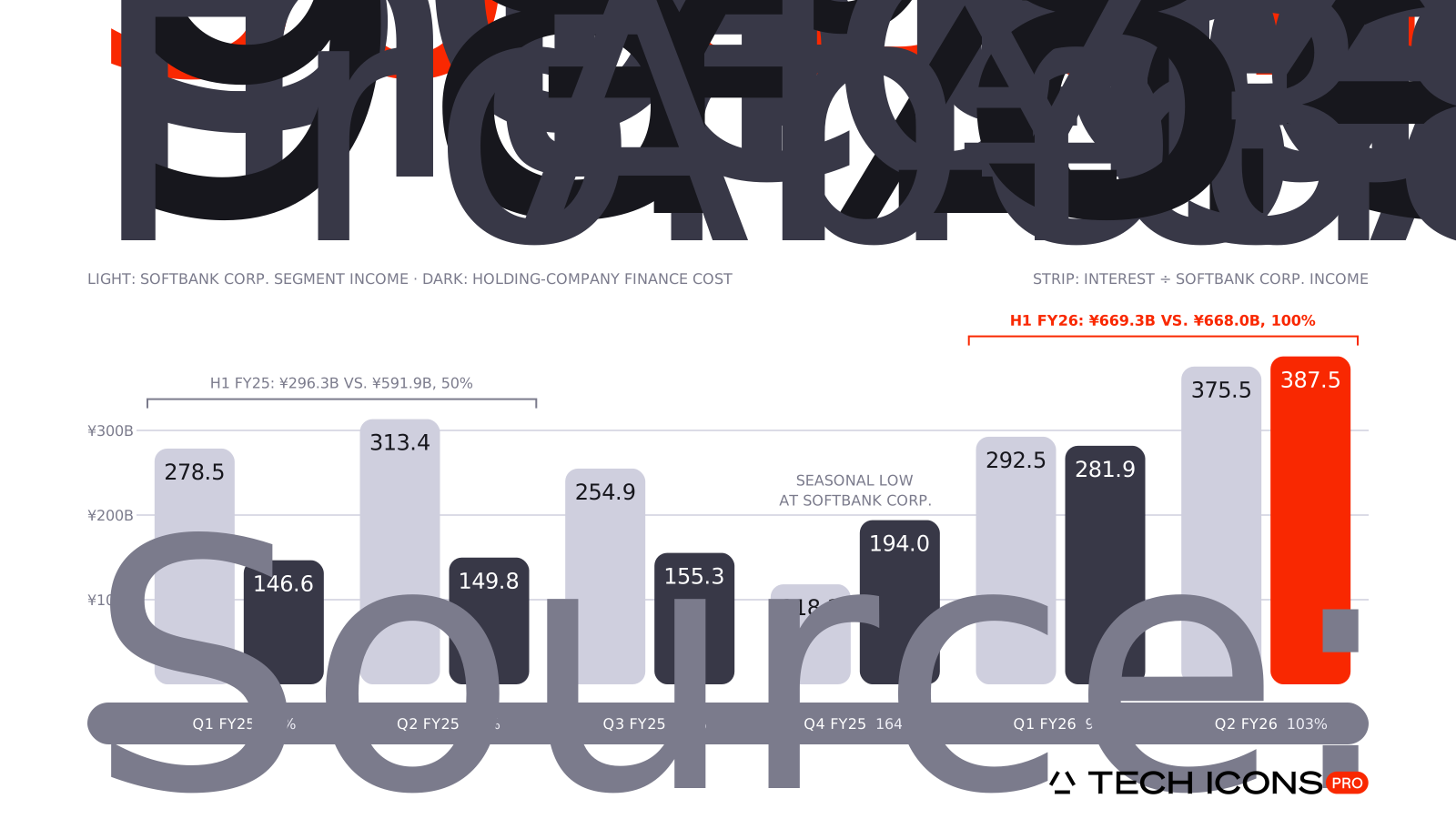
SoftBank raised it faster than at any point in its history, by its own account: $56.5 billion in July to September alone. Over the half it took on an $11.87 billion term loan, $11.5 billion of dollar notes, €2.75 billion of euro notes and ¥1.77 trillion of domestic straight and hybrid bonds, and enlarged its Arm-backed margin loan by $5 billion. The $30 billion drawn on a bridge facility was repaid by September 15 and the unused $10 billion cancelled. Consolidated interest-bearing debt still rose ¥7.9 trillion in six months to ¥32.6 trillion, and second-quarter finance costs reached ¥461.9 billion, against ¥174.7 billion a year earlier.
Ohio Sends Its Bill
The largest single charge came from Silver Bands 7, a subsidiary in which SoftBank and Vision Fund 2 have invested to secure power-generation equipment for American AI data centers, among them the PORTS-Pike Technology Campus in Pike County, Ohio. Unveiled in March as a partnership with the U.S. Department of Energy on the site of a former uranium enrichment plant, the project calls for SB Energy to build 10 gigawatts of new generation, 9.2 gigawatts of it gas-fired, to serve a 10 gigawatt data center. SB7 had paid ¥1.50 trillion, about $9.5 billion, to reserve manufacturing capacity and buy equipment. Citing the “evolving requirements” of its projects, it has revised that procurement strategy and written off ¥457.0 billion of non-refundable advances, along with ¥140.2 billion in contract modification and settlement costs.
Rebates of up to $2.1 billion over 10 years were left off the balance sheet. Chief Financial Officer Yoshimitsu Goto told the briefing that SoftBank was not discussing any downsizing of PORTS-Pike, describing the review as one of medium- to long-term data center strategy and of the equipment best suited to it. The political climate has grown less forgiving. The Democratic sweep in the U.S. midterm elections has raised expectations of tighter scrutiny of data center development, the concern behind the previous week’s technology selloff, and Goto said SoftBank is watching how that debate evolves. Even OpenAI’s role as a tenant carried a price: warrants that Energy Global, a U.S. solar and data center subsidiary, granted it as lease incentives rose in value, producing a ¥203.8 billion derivative loss.
Intel Pays, Arm Wavers
The half’s largest gain came from a position little more than a year old. SoftBank agreed in August 2025 to buy 86,956,522 Intel shares at $23 each, a $2 billion commitment. Intel’s stock rose from $44.13 at the end of March to $120.23 at the end of September, generating a ¥1.06 trillion investment gain and lifting the carrying value to ¥1.65 trillion, about $10.5 billion. SoftBank promptly turned the gain into funding, raising $7.35 billion in August through prepaid forward contracts secured on all its Intel shares, part of the package that retired the OpenAI bridge loan. The contracts are collars that cap the upside, and their revaluation cost ¥321.9 billion, the largest item in the derivative line. The best trade of the half was, in part, spent financing the biggest one.
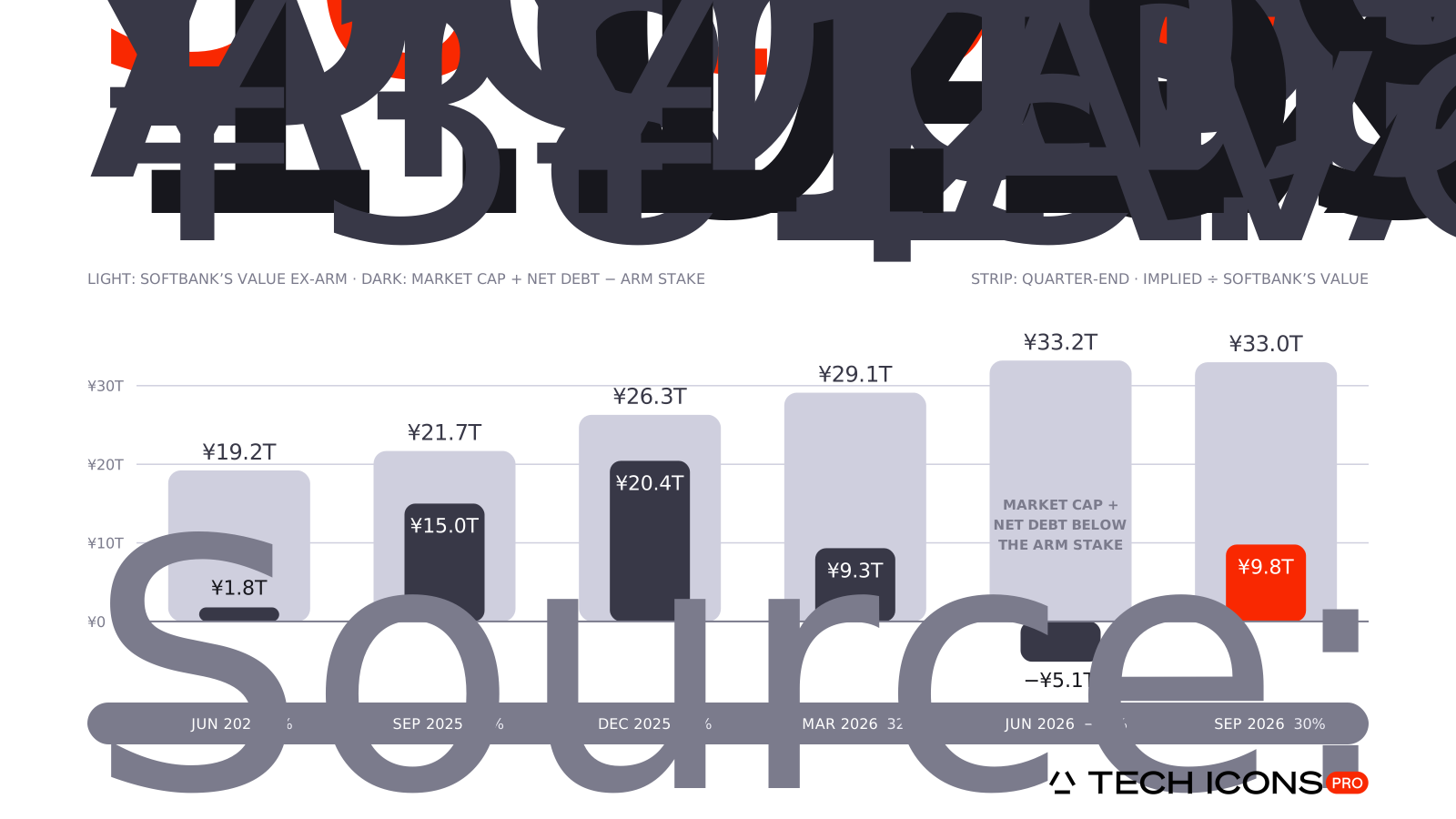
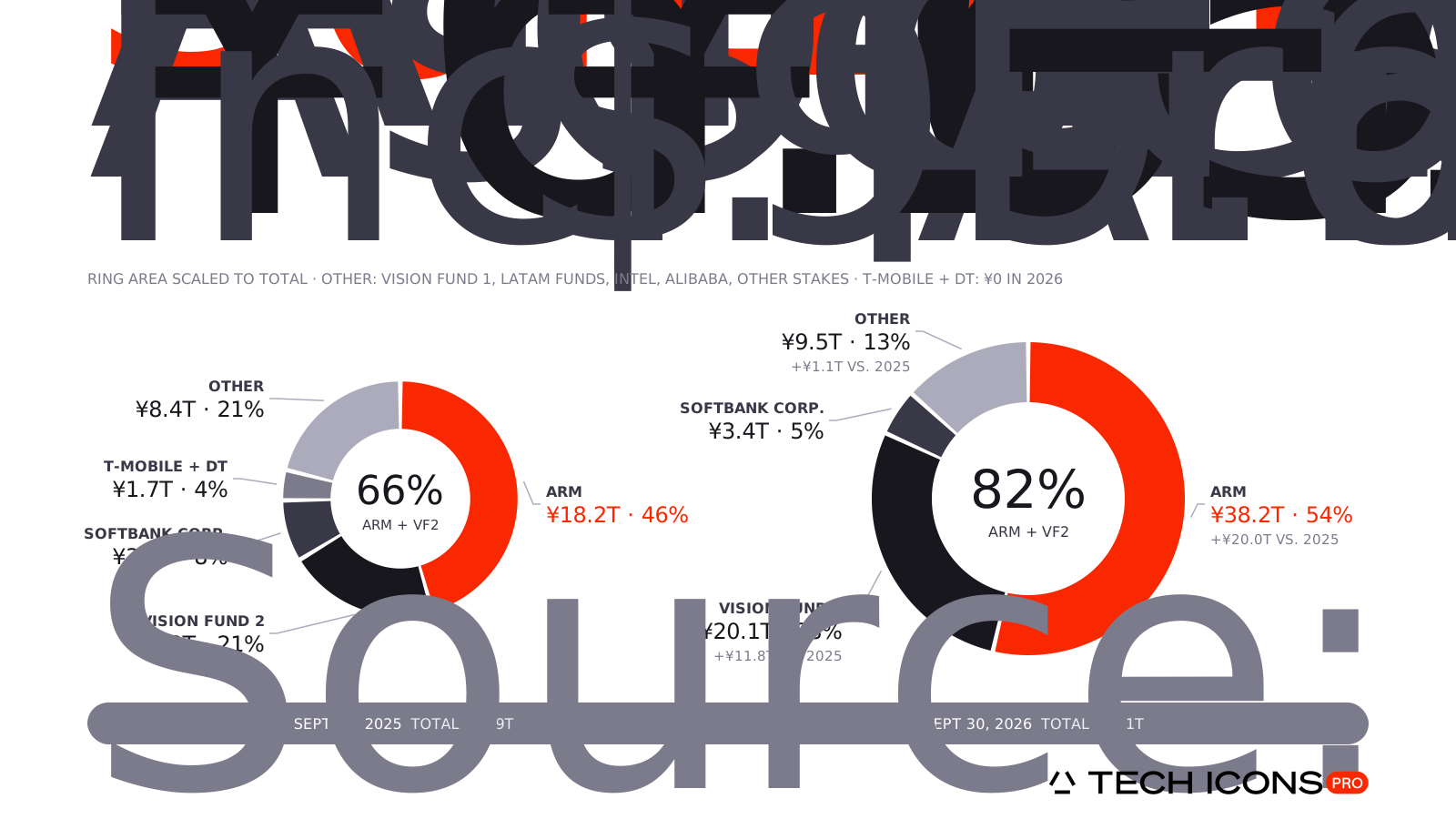
Arm, by far the largest holding, offered stronger operations than share performance. The chip designer reported record second-quarter revenue of $1.44 billion on November 4, up 27%, with licensing up 50% and data center royalties doubling. Yet SoftBank’s adjusted equity value for Arm fell from ¥49.9 trillion to ¥38.2 trillion between June and September, and the stock lost nearly 29% more in October. In the Vision Funds, a $1.3 billion second-quarter gain on ByteDance was offset by weaker share prices at listed holdings such as Coupang and Grab, leaving the segment with an ¥81.6 billion quarterly loss. SoftBank Corp., the domestic telecom unit, supplied the ballast, with record first-half revenueof ¥3.80 trillion and a raised full-year forecast.
The Market Turns to the Balance Sheet
Net asset value, the measure SoftBank asks investors to watch, fell from a record ¥72.3 trillion at the end of June to ¥59.8 trillion at September 30. The company’s pro forma at November 9 prices puts it at ¥44.7 trillion, a decline of 38% in a little over four months. Loan-to-value rose from 13.0% to 15.9%. SoftBank published no pro forma ratio, but setting September’s ¥11.3 trillion of net debt against the November valuation implies about 20% by our arithmetic, closer to the 25% ceiling its financial policy sets for normal times. Credit markets have registered the shift: the cost of insuring SoftBank debt against default reached a four-year high on November 6.
Equity investors have moved harder still. The shares fell 11% on November 6 and 4.2% on November 9, touching their lowest level in a year, then jumped 13.9% to ¥3,872 on November 10 as Asian technology stocks followed Wall Street higher. The rally came before the numbers, which were released at the close; the first session to price them is November 11 in Tokyo. Even after the rebound, the stock sits more than 50% below its June peak and trades at roughly half of the pro forma NAV per share implied by SoftBank’s own figures, against a discount of about 39% at the end of September. With Chinese regulators having blocked the China portion of the $5.4 billion ABB Robotics purchase, and an OpenAI stake whose carrying value is anchored to its last funding price, the burden of proof has shifted from valuation to cash.