Ahead of Consensus.
Intelligence across tech and capital markets, for investors, policymakers, and business leaders.
11 minute read
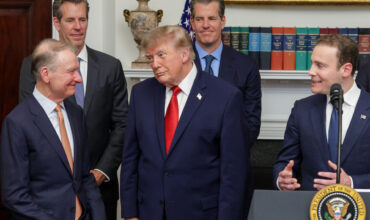
President Trump has never needed a vote to make his preferences known, and on Wednesday he made them known with unusual bluntness. Inside the White House, flanked by the executives who run Coinbase, Ripple, Robinhood, Nasdaq and Intercontinental Exchange, alongside the two officials who regulate them, Trump told the assembled industry that the moment for symbolism had passed. Congress, he said, must take “the next step” and deliver a “fair version” of the Digital Asset Market Clarity Act. It was less an announcement than a demand, aimed less at the executives in the room, who need no convincing, than at the senators watching from a distance.
The choreography mattered as much as the words. SEC Chairman Paul Atkins and CFTC Chairman Michael Selig stood beside a president who has spent eighteen months trying to convert regulatory sympathy into legislative certainty, and the distinction between the two is the story the industry cannot escape. Agencies can soften enforcement and grant exemptions, but only Congress can write a statute immune to the next election cycle. Trump’s appeal, however forceful, changed nothing about the Senate’s arithmetic. What it did was signal that the administration still treats the CLARITY Act as unfinished business, not a formality awaiting a signature.
The bill Trump wants is more technical than its name suggests, and its mechanics explain both its appeal and its difficulty. H.R. 3633, introduced by Representative French Hill in May 2025, would end a decade of jurisdictional trench warfare between the SEC and the CFTC by sorting tokens into two camps. Assets that behave like commodities, sufficiently decentralized that no single issuer controls their fate, would fall under the CFTC, which would gain new authority to register exchanges and enforce custody standards it presently lacks. Assets that still resemble securities, tied to a promoter’s ongoing efforts, would remain the SEC’s domain. A separate provision bars the Federal Reserve from offering a retail central bank digital currency, a concession to Republicans who view a state-issued digital dollar as a surveillance risk rather than an innovation.
That framework proved persuasive enough to pass the House by 294 votes to 134 in July 2025, with all 216 voting Republicans in favor and 78 Democrats crossing over to join them, a resounding bipartisan result by the standards of this Congress. But a House majority and a Senate supermajority are different currencies, and the CLARITY Act has spent the year since discovering the exchange rate. Senate Majority Leader John Thune filed cloture before the August recess, setting up a procedural vote on September 15 that requires 60 votes merely to open debate. Republicans, holding a narrow majority, need roughly six Democrats willing to cross the aisle a second time.
Finding those six votes has proven harder than the House math suggested it would be, and the reason has less to do with market structure than with the man asking for it. Trump’s own 2025 financial disclosure, released in July, reported more than $1.4 billion in crypto-related income, drawn from his memecoin’s royalties, from token sales and equity tied to World Liberty Financial, and from a scattering of altcoin and stablecoin holdings. For Senate Democrats, that figure is not incidental to the debate. It is the debate. They have made stronger conflict-of-interest provisions a precondition for their votes, and they have found unlikely allies among former administration officials uneasy with a president whose family fortune now moves in step with the legislation he is publicly demanding.
Ethics is the headline objection, but it is not the only one. Beneath it sits a set of quieter disputes that any lobbyist would recognize as the real negotiation: whether stablecoin issuers may pay yield to holders without tripping banking regulations, how closely decentralized finance protocols should be supervised, and how firmly banks can be separated from crypto custody. Each question has resurfaced inside the Senate Banking Committee’s redrafting process, and each has its own constituency willing to withhold a vote until satisfied. A bill that cleared the House on a comfortable bipartisan margin now advances, if it advances at all, one senator’s fine print at a time.
While the Senate negotiates with itself, the SEC has stopped waiting. On August 18, Chairman Atkins unveiled a proposed rule called Regulation Crypto Assets, offering token issuers two routes around standard securities registration. A “startup exemption” would permit offerings up to $5 million over four years; a broader exemption would allow up to $75 million a year, paired with disclosure obligations and a conditional safe harbor under which a sufficiently decentralized token could eventually exit the legal definition of a security entirely. The proposal opened a 60-day comment period days before the CFTC’s newly formed Innovation Advisory Committee convened for its inaugural session Thursday, a public forum bringing together the same roster of executives who had stood with Trump a day earlier.
Atkins was careful not to overstate what a rule can accomplish. Legislation, he said in the SEC’s own release, remains indispensable to producing standards durable enough to survive a future regulator inclined to unwind them. It is a rare admission from a sitting chairman that his own authority has a shelf life, and it captures the logic behind the administration’s two-track approach. Agency action buys the industry time and cover today; only a statute buys it the certainty that institutional allocators require before committing meaningful capital to an asset class still defined, in large part, by the regulator’s mood.
Markets, characteristically, did not wait for Congress either, and their enthusiasm has now stretched across two full sessions. Bitcoin surged nearly 8 percent on Wednesday and extended the advance through Thursday to trade above $71,900, its highest level since early June, as Treasury Secretary Scott Bessent’s expanded bond buyback program pushed yields lower and fed a broader appetite for risk. More than $1 billion in short positions were liquidated within the first hour of Wednesday’s move alone, and the rally spread quickly into equities: Coinbase rose roughly 10 percent, Strategy climbed 13 percent, and Circle Internet Group gained nearly as much, each stock behaving as a leveraged proxy for sentiment the underlying legislation has not yet earned.
The overlap in timing is worth sitting with rather than rushing past. Thursday’s gains coincided with the CFTC committee’s first public session, a coordinated week of regulatory theater that has done more to move prices than the Senate has managed all year. But Bessent’s influence on bond yields, not a single meeting at the White House, appears to be carrying the heavier share of the rally, a distinction that matters because it separates genuine legislative progress from a liquidity-driven advance that markets, for the moment, have chosen not to distinguish. September 15 still opens only a procedural door, and the Senate returns with barely two working weeks before midterm campaigning consumes what remains of the calendar. For the investors, custodians and exchanges now pricing in a favorable outcome, the relevant question was never whether the White House supports the industry. It plainly does. The question is whether a fractured Senate can turn that support into a statute before the political calendar, rather than the market, decides the CLARITY Act’s fate for the year.