
- Aerospace
- Aviation Markets
- Industrial Stocks
Boeing's Recovery Takes Flight as Backlog Hits $695 Billion
9 minute read
First-quarter results show Boeing narrowing losses, lifting deliveries, and posting record backlogs — the clearest evidence yet that Ortberg’s turnaround is gaining real traction.
Key Takeaways
- Boeing’s Q1 revenue rose 14% to $22.2 billion and its GAAP net loss narrowed to just $7 million, with operating cash outflow improving sharply from $1.6 billion to $179 million year on year.
- Commercial aircraft deliveries increased to 143 planes, including 114 737s and 15 787s, while the commercial backlog reached a record $576 billion, sustaining the long-term revenue conversion thesis for patient investors.
- Defense, Space and Security revenue jumped 21% to $7.6 billion, with the segment’s backlog hitting a record $86 billion, underscoring Boeing’s role as a primary beneficiary of allied defence modernisation.
A Measured But Meaningful Quarter
There is a particular kind of relief that comes not from spectacular performance but from the absence of fresh failure. Boeing’s first-quarter 2026 results, released on April 22, delivered something the company has owed its shareholders for several years: a quarter defined by steady, unambiguous operational progress. Revenue climbed 14 percent to $22.2 billion. The GAAP net loss narrowed to $7 million, or 11 cents a share. Core loss per share improved to 20 cents from 49 cents a year ago. Operating cash outflow shrank from $1.6 billion to $179 million. Free cash flow, still negative at $1.5 billion, improved from the prior year’s $2.3 billion draw.
None of these figures announces a triumphant return. Taken together, however, they confirm that the recovery underway beneath CEO Kelly Ortberg is structural rather than cosmetic. The production discipline, quality system overhaul, and regulatory repair work that have consumed Boeing’s management attention since the 737 MAX crises are beginning to manifest in the numbers. For senior investors who have held through the turbulence, the signal is clear: the trajectory has turned.
Commercial Aviation: Delivery Growth and Record Demand
The commercial segment remains the heart of the Boeing story, and Q1 provided meaningful evidence of returning momentum. The company delivered 143 commercial aircraft in the quarter, up from 130 in the same period of 2025. The mix included 114 737s, 15 787s, eight 777s, and six 767s. Revenue for the Commercial Airplanes segment rose 13 percent to $9.2 billion. The operating loss of $563 million, while still substantial, was contained relative to the prior year’s $537 million deficit, a modest improvement on a widening revenue base that reflects the drag of ongoing production investment.
Most consequentially, the commercial backlog reached a record $576 billion, contributing to a total company backlog of $695 billion. The order pipeline in the quarter included 30 787-10s for Delta Air Lines alongside a healthy spread of 737 commitments from lessors and carriers. Net orders of 140 aircraft confirm that airline demand, despite elevated financing costs and capacity discipline across the industry, remains structurally intact. Boeing is not chasing orders; the orders are already there. The challenge and the opportunity lie in converting that backlog into deliveries at pace and margin.
Production-rate management is the discipline that will determine how that conversion unfolds. The 737 line is operating at 42 aircraft per month, with the 737-10 having entered the Type Inspection Authorization 2 phase of certification flight testing. Boeing expects certification of both the 737-7 and -10 variants in 2026, with first deliveries in 2027. The 787 programme has stabilised at eight per month, and the FAA has certified increased maximum takeoff weight for the 787-9 and -10, an incremental but commercially valuable upgrade for airlines seeking to extract more performance from existing frames. Most analysts expect 737 output to reach 50 aircraft per month by late 2026, a target that will function as the primary operational benchmark for the year ahead.

Defense and Services: The Understated Pillars
While commercial aviation commands the narrative, Boeing’s Defense, Space and Security segment delivered a notably strong quarter. Revenue jumped 21 percent to $7.6 billion, operating earnings rose 50 percent to $233 million, and the margin expanded to 3.1 percent. The segment’s backlog hit a record $86 billion, with 27 percent sourced from international customers, a figure that reflects both allied defence investment and Boeing’s deepening global footprint.
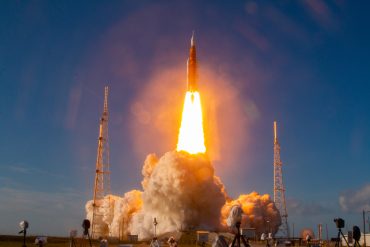
Two announcements in the quarter merit particular attention. A seven-year framework agreement to expand PAC-3 seeker production signals long-cycle procurement commitments that will anchor defence revenues well into the next decade. A partnership with Rheinmetall to pitch the MQ-28 Ghost Bat unmanned combat aircraft to Germany positions Boeing at the intersection of two defining trends in modern defence: autonomous systems and European rearmament. The successful April flight of NASA’s Artemis II mission, powered by Boeing’s Space Launch System core stage, added a high-profile reminder of the company’s institutional depth in national-priority programmes.
Global Services contributed $5.4 billion in revenue at an 18.1 percent operating margin. The unit secured its largest-ever landing-gear exchange programme with Singapore Airlines and earned initial FAA and EASA qualification for 777-9 training devices. Its backlog reached $33 billion. In a company navigating the costs of transformation, services provides the reliable cash generation that sustains the broader recovery.
Balance Sheet and the Cash Generation Test
Cash and marketable securities fell to $20.9 billion from $29.4 billion at year-end, reflecting debt repayments and capital investment at the Charleston and St. Louis facilities. Consolidated debt declined to $47.2 billion. Boeing reiterated its full-year 2026 free-cash-flow guidance of $5 billion to $7 billion, a range that implies a pronounced acceleration through the second half of the year as production stabilises and working capital dynamics shift.
That guidance remains the central commitment around which investor confidence will be built or tested. The conversion of $695 billion in backlog into profitable deliveries requires not only higher production volumes but sustained improvements in unit cost, supplier reliability, and certification timing. Supply-chain constraints in titanium and certain avionics have not been resolved. Regulatory scrutiny remains elevated, and any meaningful slippage on 737 MAX family or 777X certification would carry cash and backlog conversion consequences.
The View from Here
Markets responded with measured optimism. Shares rose more than 4 percent in early trading before settling into a more restrained gain, a reaction that reflected relief at execution rather than exuberance about what remains a long road to normalisation.
Ortberg’s prepared remarks were characteristically calibrated: “We’re building on our momentum with a strong start to the year.” The emphasis on safety, quality, and measured rate increases was deliberate. Boeing is past the acute phase of its difficulties. It is not yet operating at the standard it once set for itself and the industry.
What Q1 establishes is that the foundational work is holding. The backlog is real and expanding. The production system is stabilising. The defence portfolio is performing. For investors and policymakers with a horizon measured in years rather than quarters, Boeing’s first-quarter results offer the most credible evidence to date that the world’s pre-eminent aerospace manufacturer is reclaiming the operational ground it lost and building the base from which durable recovery becomes possible.