
- Creator Economy
- Digital Platforms
- Earnings Report
- Gaming Industry
Roblox Wins Back Players, but Wall Street Wants Payers
9 minute read
Third-quarter bookings of $1.70 billion cleared guidance and daily users rebounded to 138 million, but a softer holiday outlook and rising AI spending knocked the shares down about 17%.
Key Takeaways
- Revenue rose 16% to $1.57 billion and bookings fell 12% to $1.70 billion, above guidance, while adjusted EBITDA of $138 million more than tripled the ceiling management set in July.
- Daily users rebounded 12% sequentially to 138 million and retention was the best since 2021, yet monthly payers fell 16% and daily paying users slipped to about 1.8 million from 2.3 million.
- Guidance for a 10% to 15% fall in holiday bookings, negative adjusted EBITDA and $380 million of capex outweighed the beat, sending the shares about 17% below Thursday’s $52.46 close.
A Bar Set Low by Design
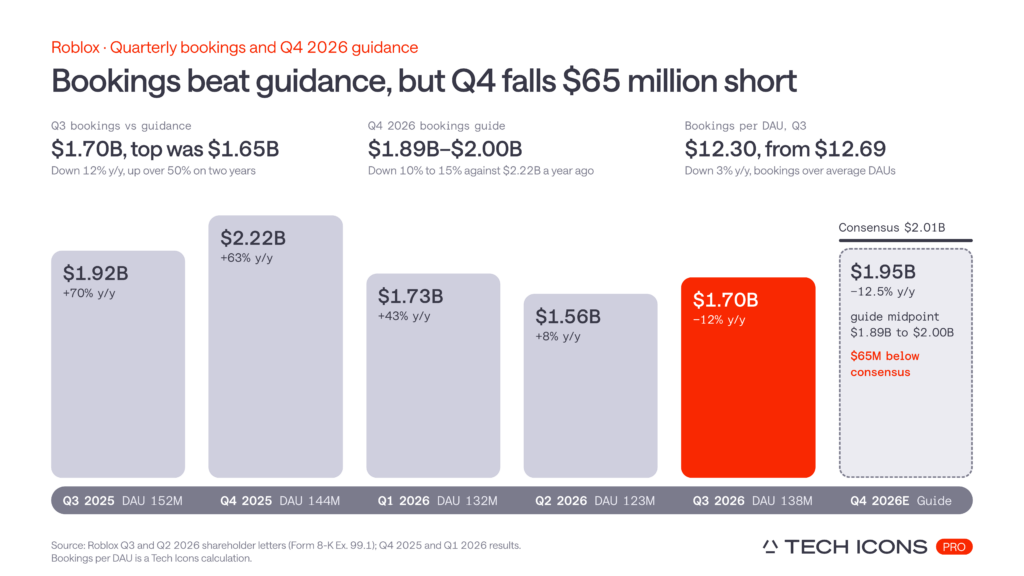
Roblox came into its third-quarter report having already told investors to expect a contraction. In July, management guided bookings to between $1.58 billion and $1.65 billion, a decline of 14% to 18% from a record quarter, and did not update its full-year outlook. Against that warning, the results released on October 29 held up better than feared. Revenue rose 16% to $1.572 billion. Bookings, the company’s preferred measure of what users spend on the platform, fell 12% to $1.697 billion, above the top of the range. On a two-year view, bookings are still up more than 50%. The annual decline therefore says less about the business today than about the summer of 2025, when a run of viral hits lifted Roblox to a peak it could not be expected to repeat on schedule.
The gains were larger further down the income statement. Adjusted EBITDA reached $138 million, more than three times the $41 million ceiling management had set and well above the $46 million of a year earlier. Free cash flow came in at $364 million against guidance that ranged from negative $60 million to positive $5 million. About $140 million of that gap is spending delayed into the fourth quarter rather than money saved. On a GAAP basis, Roblox lost $230 million, or 32 cents a share, compared with $258 million a year earlier. Revenue keeps rising while bookings fall because of how Roblox books sales. It recognizes most purchases over an estimated 27-month paying-user life. Durable items, which are spread over that period, made up 90% of virtual-item revenue against 78% a year ago. The income statement is still collecting on 2025.
The Audience Returns, the Spending Waits
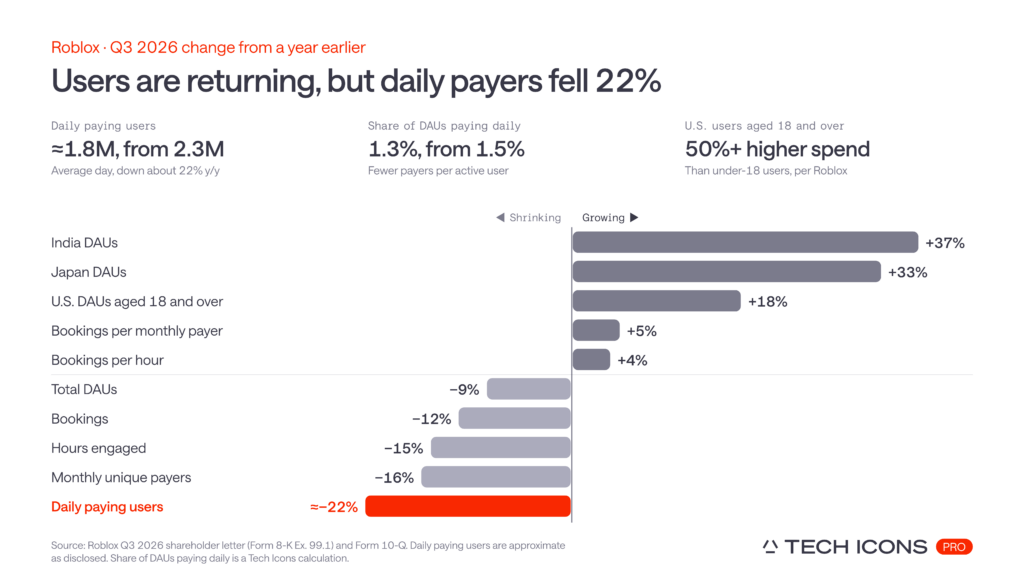
The quarter showed that users are coming back. Daily active users averaged 138 million, up 12% from the second quarter and the first sequential gain after three quarters of decline. Hours engaged rose 17% to nearly 34 billion. Management said seasonally adjusted retention reached its highest level since 2021, which the shareholder letter credits to reworked recommendation systems. The recovery is real but incomplete. Daily users remained 9% below last year, hours were 15% lower, and the user count fell short of the roughly 146 million analysts had expected.
Spending has not kept pace. Average monthly unique payers dropped 16% to 30 million. The 10-Q shows daily paying users falling to about 1.8 million from 2.3 million, barely 1.3% of the daily audience. Those who still pay are paying more, with bookings per payer up 5%. Even so, bookings per hour rose only 4% globally and 2% in the United States and Canada, the region that generates 57% of revenue. Growth is gathering where Roblox has steered it. U.S. users aged 18 and over rose 18%, and by the company’s estimate they spend more than 50% more than younger users. Daily users climbed 33% in Japan and 37% in India. The open question is whether these groups can grow fast enough to replace the spending of younger American players.
Building the Next Roblox
Management is putting the quarter’s cash toward a larger ambition: rebuilding the platform around AI-assisted creation. In the past month, more than 80% of the top 100 games by hours used AI tools, and daily asset uploads tripled from the month before. Build, the company’s prompt-driven creation tool, has drawn more than 500,000 users and 70,000 published games. The company said two of the quarter’s breakout titles, Steal an Egg and Huss Valley, were created almost entirely with AI. Roblox Reality, a photorealistic multiplayer foundation built for very large numbers of players, is scheduled for early access in the first half of 2027. The first phase of Roblox Everywhere, which will publish select games to outside app stores, is due on the same timeline. A Universal Player meant to bring console, PC and mobile games onto the platform completes a plan that reaches well beyond the children’s market.
The expense lines show what that plan costs. Infrastructure and trust and safety expenses rose 20% to $385 million. Sales and marketing climbed 66% to $111 million as Roblox pays to reach adults. Fourth-quarter guidance calls for $380 million of capital spending, adjusted EBITDA of negative $70 million to negative $10 million, and free cash flow of negative $105 million to negative $190 million. There are early offsets. Roblox Plus, the subscription introduced in April, already has millions of members, who spend seven times as much Robux as non-subscribers. More than 70% of the top 100 games by spending now run Sponsored Ads. Neither is yet large enough to change the shape of the quarter.
Safety as Strategy, and as Liability
Some of the lost growth was chosen. Since January, users in regions where chat is available must pass an age check before they can use it. Roblox’s first-quarter letter conceded that the rollout slowed new-user sign-ups and cut back conversation on the platform. By the third quarter, management said, more than 80% of daily U.S. users aged 13 to 17 had completed a check. The company’s figures on user ages now rest on these checks, and the 10-Q warns they cannot be compared with the earlier self-reported numbers. Investors are being asked to accept a smaller, cleaner user base in return for a more durable one.
The legal climate explains the choice. Roblox recorded $49 million in legal settlement expenses during the quarter and $140 million over nine months, all excluded from adjusted EBITDA. The 10-Q lists agreements with Alabama, Mississippi, Nevada, South Dakota, West Virginia and Kansas, with talks continuing elsewhere. Kansas alone secured $9.8 million over three years plus a $500,000 public-awareness campaign. Other attorneys general are still in court. Two days before the results, short seller Bleecker Street Research published a report questioning the company’s child-safety controls. For a platform whose core audience is young, trust is not a reputational nicety. It is the price of continued access to its market.
The Market Looks Past the Quarter
Investors went straight to the fourth quarter and did not like what they found. Roblox guided holiday bookings to $1.89 billion to $2.0 billion. That is a decline of 10% to 15% from $2.22 billion a year earlier and below a consensus of about $2.01 billion. Management said the outlook assumes the usual seasonal drop in users and no near-term pickup in spending per user. It also builds in a modest headwind from Grand Theft Auto VI, which Take-Two releases on November 19, though management admitted it had little data to size the effect. The stock had rallied about 21% in October and closed at $52.46 on Thursday. It fell roughly 17% after hours and traded near $43.50 early Friday. A year ago, a quarter that also beat estimates was followed by a drop of about 15%.
Analysts cut their targets without giving up on the stock. JPMorgan lowered its price target to $46 from $53. Goldman Sachs went to $55 from $60 and kept its Buy rating, and Roth MKM moved to $54 from $60. Needham and Canaccord Genuity kept Buy ratings with targets of $55 and $58. The split mirrors the quarter itself. Roblox holds $6.2 billion in cash and investments, bought back about $200 million of stock in the quarter and $580 million this year, and has won back users faster than many expected. It has not yet shown that an older, more international and more strictly verified audience will spend as freely as the younger players who powered 2025. Until spending per user rises, the market will value Roblox on its payers rather than its players.