- Data Centers
- Earnings Report
- Enterprise AI
- Semiconductors
Intel Beats on Q3 2026 but Memory Costs and PC Slump Cloud Outlook
9 minute read
Data center sales rose 78% and margins beat guidance, yet a $15 billion to $16 billion forecast, rising memory costs and an Israeli fab outage left investors repricing Intel’s recovery.
Key Takeaways
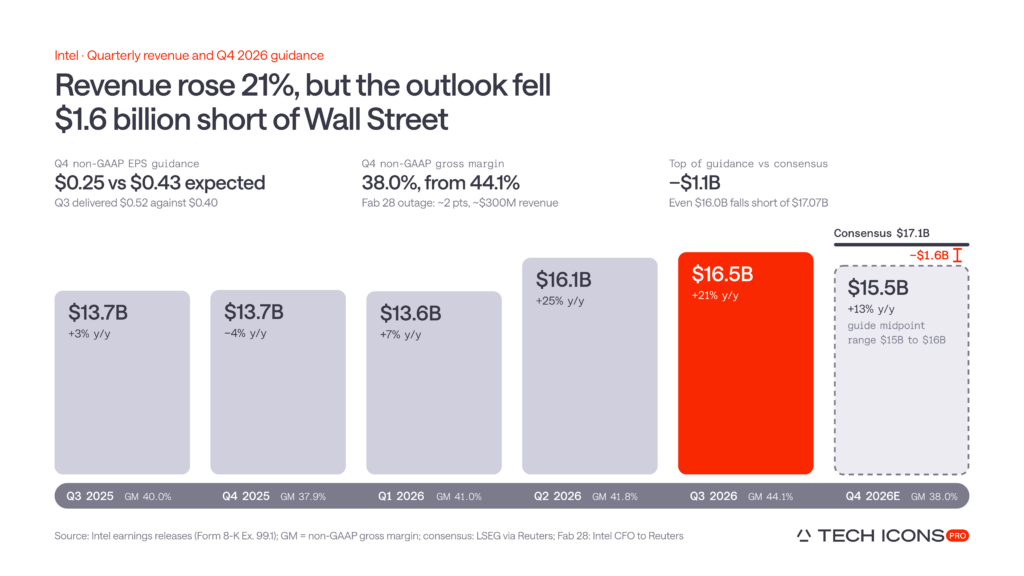
- Third-quarter revenue rose 21% to $16.5 billion and adjusted EPS of $0.52 cleared a $0.40 consensus, as Data Center and AI sales climbed 78% to $7.3 billion, the fastest in 15 years.
- Fourth-quarter guidance of $15 billion to $16 billion, adjusted EPS of $0.25 and a 38% margin trailed forecasts of about $17.1 billion and 43 cents, as PC demand weakens into 2027.
- Shares fell about 16.5% after hours to near $77, below the $95 price of August’s $23 billion share sale, leaving supply, PC exposure and 14A customer wins as the tests ahead.
The Quarter Intel Promised
For two years Intel has asked investors to believe it could execute again, and its third quarter was the proof it had promised. Revenue for the period ended September 26 rose 21% to $16.5 billion, above the midpoint of management’s own range. Adjusted earnings per share reached $0.52, more than double the $0.23 of a year earlier and well ahead of the $0.40 analysts expected. Non-GAAP gross margin widened to 44.1% from 40.0%, about two points above guidance, and adjusted operating margin rose to 19.6% from 11.2%. Taken together, the figures describe a company whose higher volumes, firmer pricing and fuller factories are finally reaching the income statement.
The reported numbers are noisier and need closer reading. GAAP net income attributable to Intel fell 18% to $3.3 billion, and diluted EPS slipped to $0.60 from $0.90, but one-off items distort both years. A year ago, Intel booked a gain of more than $5 billion on the sale of a 51% stake in Altera. This quarter included a $1.0 billion non-cash gain on shares held in escrow for the Commerce Department under the CHIPS Act Secure Enclave agreement, a line that has generated a net charge of $12.6 billion over the first nine months. That item explains why GAAP profit exceeded adjusted profit this quarter. It reveals nothing about how the business is performing.
Xeon Takes the Lead
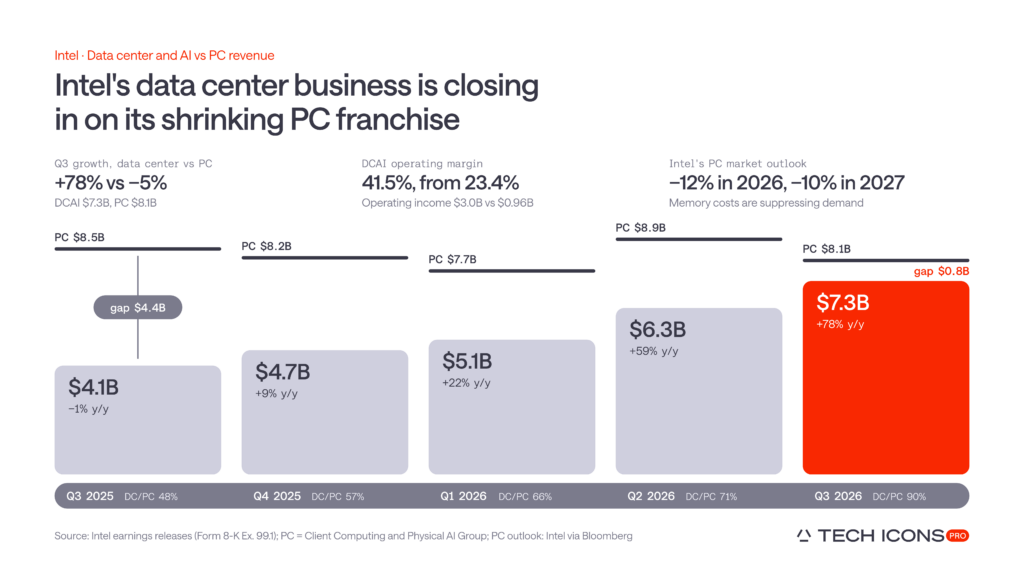
Servers carried the quarter. Data Center and AI revenue rose 78% to $7.3 billion, Intel’s fastest growth in 15 years, and segment operating income more than tripled to $3.0 billion from $964 million. The division now contributes about 44% of revenue and is roughly 90% the size of the PC business, a shift in Intel’s center of gravity that would have been hard to foresee two years ago. The constraint is no longer demand. Chief Executive Lip-Bu Tan said the immediate priority is to “unlock additional supply to meet extraordinary demand for our Xeon family.” Two days earlier, Oracle and Intel announced a planned multiyear collaboration to coordinate roadmaps and processor capacity planning, with future OCI X14 instances expected to run on Diamond Rapids. When processors are rationed, a secured allocation can be worth as much as the chip itself.
The foundry business is improving but has not yet proved itself. Intel Foundry revenue grew 58% to $6.7 billion and its operating loss narrowed to $1.85 billion from $2.32 billion. Most of that revenue still comes from Intel’s own product groups, as $6.3 billion of intersegment eliminations makes plain. In October the company released version 0.9 of its Intel 14A process design kit and announced a High-NA EUV collaboration with ASML. In April, Intel said multiple customers were evaluating 14A, and Tan has pointed to firm decisions between the second half of 2026 and the first half of 2027. No external customer was named on Thursday. Until one is, the foundry remains a cost center whose losses are shrinking, not yet a standalone business.
Where the Forecast Broke
The outlook changed the tone of the evening. Intel guided fourth-quarter revenue to $15.0 billion to $16.0 billion, a midpoint about 6% below the third quarter and roughly 9% below the $17.07 billion LSEG consensus. Adjusted EPS guidance of $0.25 compared with expectations near 43 cents. Non-GAAP gross margin is forecast to fall to 38.0% from 44.1%, with the GAAP figure at 37.1%. The midpoint still implies growth of about 13% on the $13.7 billion reported a year earlier, so the business remains materially larger than it was. Markets, however, price the direction of travel, and the direction had turned.
Most of the shortfall comes from PCs. Client Computing and Physical AI Group revenue fell 5% to $8.1 billion, short of the $8.98 billion analysts expected, and segment operating income declined to $2.29 billion from $2.69 billion. Chief Financial Officer David Zinsner told Reuters that PC revenue should fall by a percentage in the mid-20s in the fourth quarter. Intel now expects the PC market to contract 12% in 2026 and another 10% in 2027, with the slowdown lasting at least through the first half of next year. For a segment that remains Intel’s largest source of revenue and profit, that is a long stretch of weakness.
Memory Prices and the Fab 28 Shock
The PC slump has an unusual cause. The buildout of AI infrastructure has absorbed memory supply, pushing up DRAM prices and with them the cost of finished laptops and desktops. Intel’s filing lists industry-wide substrate and memory shortages among its principal risks, and Tan told Bloomberg he expects memory pricing to become “a very severe issue” for the industry in 2027. The irony is hard to miss. The same AI spending that fills Intel’s Xeon order book is draining demand from its PC franchise, leaving the company on both sides of the cycle at once.
I am a bit disappointed… we cannot fulfill the customer requirements.
A second blow came from Israel. On October 14, an explosion during the unloading of industrial gas at Fab 28 in Kiryat Gat killed two workers and seriously injured a third. The plant, which runs the Intel 7 process and mainly serves data center products, was closed for about two weeks. Zinsner told Reuters the disruption would cut fourth-quarter revenue by roughly $300 million and gross margin by about 200 basis points, with a similar revenue effect in the first quarter, and that wafers were still being assessed. That accounts for about a third of the guided 6.1-point margin decline. The outage will pass. The memory squeeze has no comparable end date.
What the Market Is Now Pricing
Intel shares closed the regular session at $92.07, down 3.6%, then fell about 16.5% in extended trading to near $77, with some quotes showing declines beyond 20%. Nvidia, Broadcom, AMD, Micron, Qualcomm and Arm slipped between 1% and 6% after hours. The pattern is familiar: in July a decisive beat was followed by a 7.9% decline the next session. The stock had more than doubled this year, and it now trades about 19% below $95, the price at which Intel sold some 242 million shares in August in a $23 billion offering that Davis Polk described as the largest U.S. common stock follow-on in history.
That capital raise gives Intel room to absorb a weaker quarter. Cash and short-term investments stood at $54.0 billion against about $50.1 billion of debt. Operating cash flow was $5.1 billion, gross capital spending $4.2 billion and adjusted free cash flow $1.6 billion, while headcount fell to 81,100 from 88,400 a year earlier. Capital spending is set at about $20 billion this year and significantly more in 2027. Demand for Intel’s server processors is no longer in question. What remains open is whether Intel can build enough of them at acceptable margins, how far the PC contraction runs, and which outside customers commit to 14A. Thursday’s selloff suggests investors want all three answered before paying for the recovery a second time.