- Digital Health
- Earnings Report
- HealthTech
Hims & Hers Sells More, Keeps Less as Branded Drugs Reset Margin
9 minute read
Revenue rose 49% to $890 million in the third quarter, yet gross margin fell to 57%, subscribers slipped by 103,000 and a reduced EBITDA outlook sharpened doubts about profitability.
Key Takeaways
- Growth accelerated for a second straight quarter as U.S. revenue rose 21% and international sales more than quadrupled to $233 million, with Eucalyptus contributing roughly $135 million.
- A heavier mix of branded weight-loss drugs cut gross margin to 57% from 74%. Leaner marketing lifted adjusted EBITDA 5% to $82.4 million, but rising overhead produced a $66 million operating loss.
- The EBITDA midpoint now sits 21% below February’s guide, while revenue guidance is 12% higher. Shares fell almost 12% before the release and slid further after hours.
The Shape of the Growth
Hims & Hers Health has spent 2026 rebuilding itself in public. Its third-quarter results, filed with the SEC on November 9, show both the speed of that rebuild and what it costs. Revenue rose 49% to $890.4 million from $599.0 million a year earlier, a second straight quarter of acceleration after 38% growth in the second quarter. U.S. revenue climbed 21% to $657.1 million. Revenue from the rest of the world more than quadrupled to $233.3 million. Management said on the earnings call that roughly $135 million of that came from Eucalyptus, the Australian telehealth group whose acquisition closed in June. Excluding Eucalyptus, the older overseas businesses still grew close to 80%.
The headline obscures how much the company beneath it has changed. A year ago, compounded medicines anchored the weight-loss business and supported a gross margin of 74%. Today Hims increasingly distributes branded drugs made by Novo Nordisk and, from this quarter, Eli Lilly, while integrating an international portfolio assembled largely through acquisition. Customers are spending more: monthly revenue per average subscriber rose 30% to $105. The company is keeping less. It reported a net loss of $33.0 million, or $0.14 a diluted share, against a consensus forecast of a $0.06 profit. Revenue also came in fractionally below the roughly $892.9 million analysts expected.
What Branded Medicine Costs
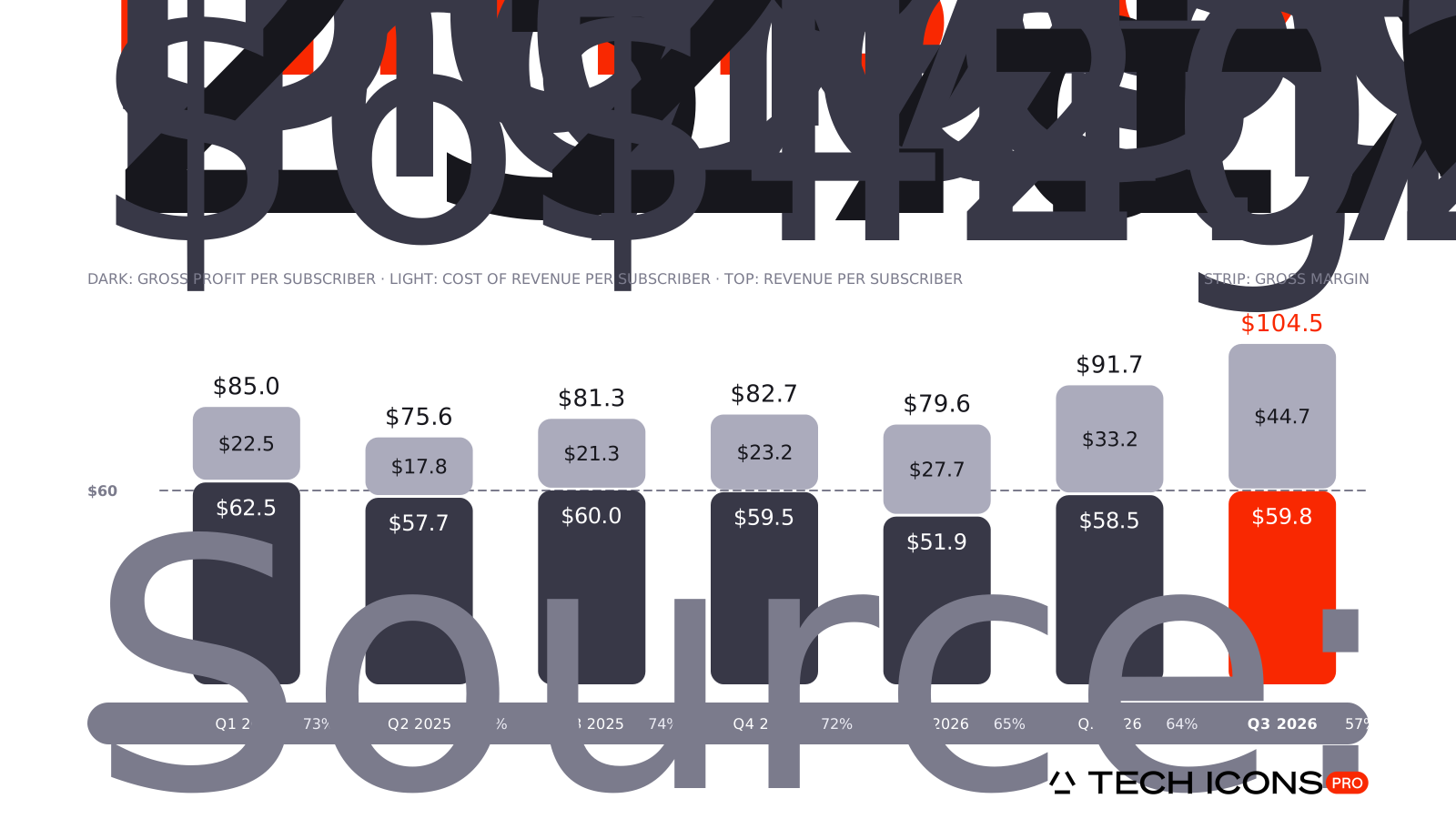
Gross margin fell to 57% from 74% a year earlier and from 64% in the second quarter. Cost of revenue more than doubled to $381.2 million, so gross profit rose only 15% while sales rose 49%, according to the company’s Form 10-Q. Management pointed to a larger share of lower-margin branded weight-loss products, especially abroad, and to the first full quarter of Eucalyptus. The U.S. shift began in March. Novo Nordisk dismissed its patent suit against Hims and agreed to supply Ozempic and Wegovy, including the Wegovy pill, through the platform. On November 6, Lilly signed its own agreement. It covers Zepbound from $299 a month and the oral drug Foundayo from $149, and Hims committed never to offer compounded copies of Lilly’s GLP-1 medicines.
The economics follow from that structure. A compounder keeps the spread between ingredient cost and subscription price. A channel for branded drugs sold at the manufacturers’ self-pay prices earns a thinner slice, increasingly through the membership and care that come with the product. Marketing absorbed the shock. Spending rose only 7% to $247.3 million, falling to 28% of revenue from 39%. That lifted adjusted EBITDA 5% to $82.4 million, and 37% from the second quarter, even as the adjusted margin slipped to 9% from 13%. Further down the income statement, the restraint fades. General and administrative expense rose 88% to $151.5 million. Technology and development spending climbed 71% to $69.4 million, and stock-based compensation reached $64.5 million from $40.2 million. The result was an operating loss of $66.1 million, against operating income of $11.8 million a year earlier.
Fewer Subscribers, Fuller Shelves
The subscriber line is where the strategy becomes visible. Hims ended September with 2.79 million subscribers, 13% more than a year earlier but about 103,000 fewer than at the end of June. Chief Financial Officer Yemi Okupe attributed the decline to “measured marketing spend in our domestic weight loss specialty.” He also cited the move of overseas brands onto the Hims & Hers name in the U.K., Germany and Australia. Management called the pullback deliberate, timed ahead of a broader weight-loss range and the January surge in demand, and cautioned that the fourth quarter could bring further subscriber pressure. The company also deferred $18 million of weight-loss membership revenue from the third quarter into the fourth.
The shelf being prepared for January is unusually full. Zepbound and Foundayo arrive on the platform this quarter, multi-month weight-loss subscriptions are planned before the new year, and Novo’s CagriSema is expected to follow once available. Injectable and oral testosterone therapy, launched October 21 as the company’s first controlled-substance offering, is on track for a $100 million annualized revenue run rate, management said. A Peptides+ line of sermorelin, glutathione and NAD+ starts this month, with no material revenue expected this quarter. An AI-native care experience reached about 70% of weight-loss subscribers by the end of September. Holding back on customer acquisition ahead of a wider range is a coherent choice. The consequence is that, for now, growth depends more on what each customer spends than on how many customers there are.
Working Capital and the Legal Ledger
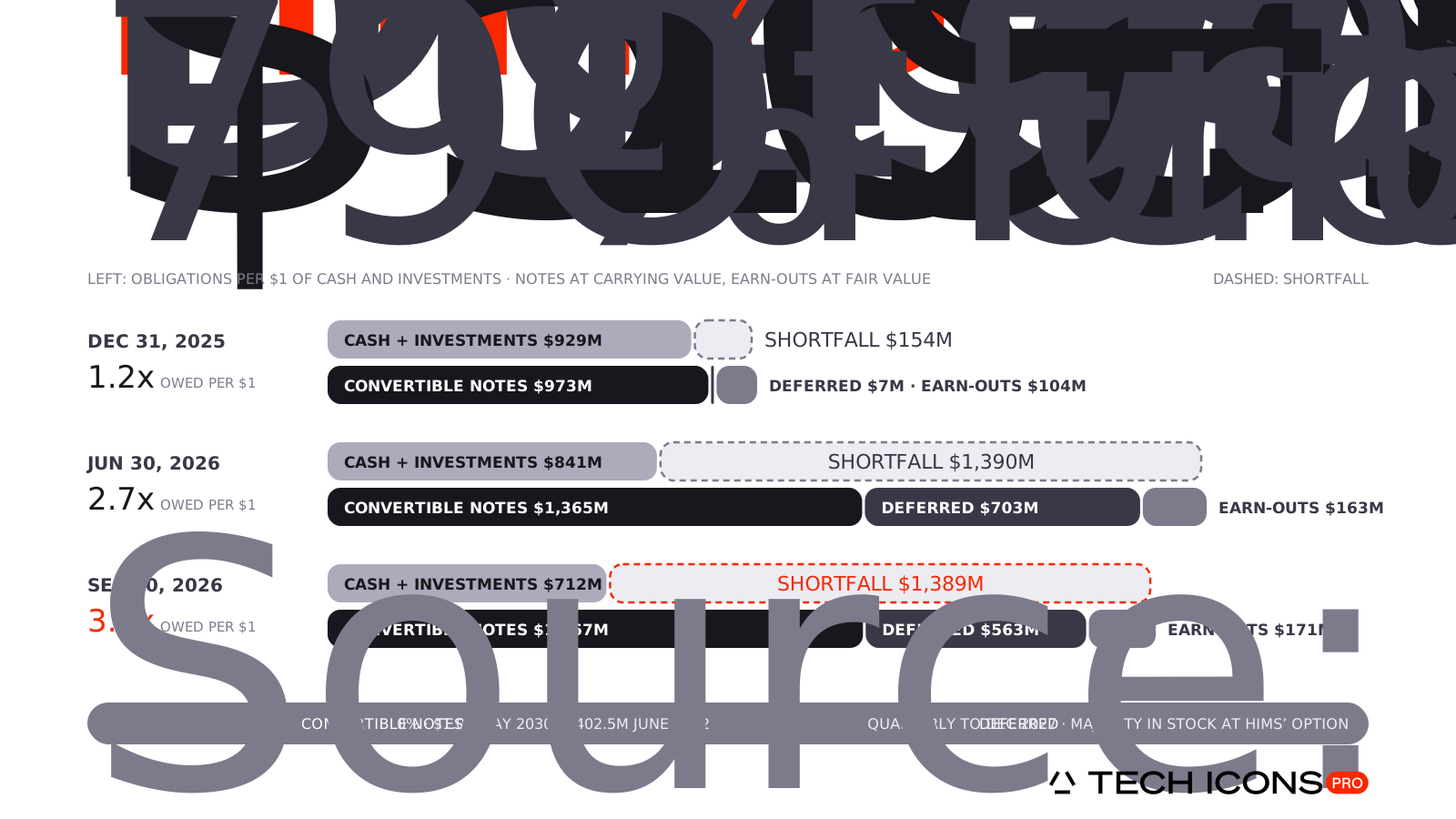
Cash flow improved sharply from the second quarter but did not regain last year’s strength. Operating cash flow was $65.4 million, down from $148.7 million a year earlier, and free cash flow was $26.0 million after a negative $68.2 million in the prior quarter. The 10-Q shows how the branded model weighs on working capital. Receivables stood at $427.8 million on September 30, against $32.1 million at the end of 2025, including $345.3 million owed as manufacturer discounts and rebates. During the quarter, Hims sold receivables carried at $434.5 million for $433.3 million under an uncommitted $400 million purchase agreement with JPMorgan Chase. The quarter’s cash conversion leaned on that facility. Convertible notes reached $1.37 billion, goodwill $1.11 billion and deferred acquisition payments $563.1 million, against cash and short-term investments of $712.2 million.
The regulatory file is thicker still. On July 29, the Federal Trade Commission, joined by Utah and Los Angeles County, sued Hims over subscription billing, cancellation practices and the sharing of health data with advertising platforms. According to the 10-Q, the company has accrued about $60 million for the case and intends to contest it. It filed a motion to dismiss on October 22, and a hearing is set for January 14, 2027. Its testosterone business depends on DEA telemedicine flexibilities that lapse on December 31, 2026, unless extended again. An 8-K filed alongside the resultsraises a governance question as well. The board added neuroscientist and podcaster Andrew Huberman, who does not qualify as independent under NYSE standards. His appointment came with a $3.5 million annual advisory contract and a $5 million annual podcast advertising agreement with his media company.
Guidance and the Market’s Verdict
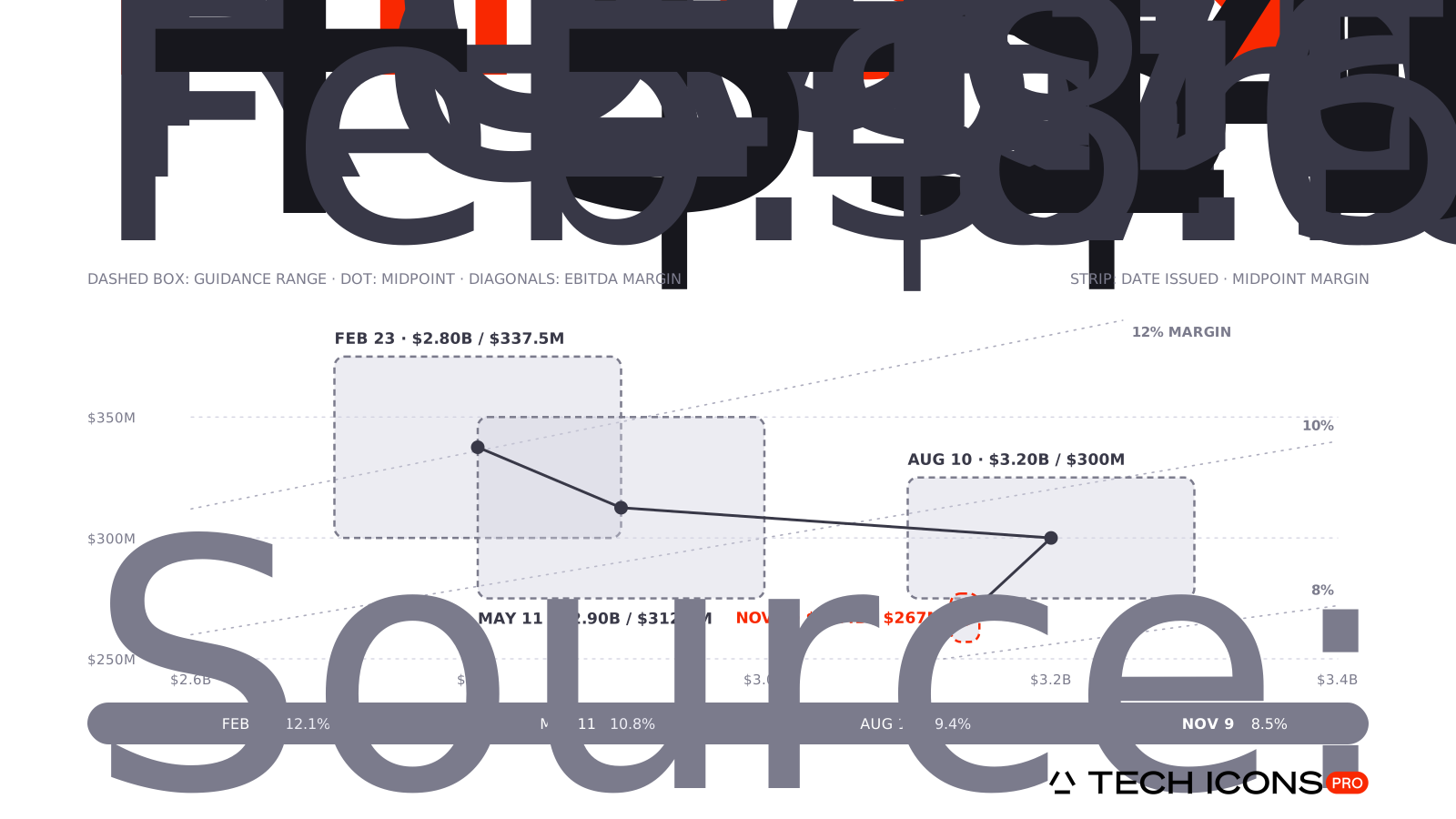
The outlook carried the most weight. Hims now expects 2026 revenue of $3.13 billion to $3.15 billion, narrowed from $3.1 billion to $3.3 billion, and adjusted EBITDA of $257 million to $277 million, cut from $275 million to $325 million. The revenue midpoint sits below the roughly $3.21 billion analysts had expected. Measured against February’s original outlook, the direction of the year is plain. That outlook called for $2.7 billion to $2.9 billion in revenue and $300 million to $375 million in EBITDA, so the revenue midpoint is now 12% higher and the EBITDA midpoint 21% lower. Fourth-quarter revenue guidance of $875 million to $895 million implies growth of 42% to 45%. That is a slowdown from 49%, despite the $18 million carried into the period. Management cited heavier pricing and marketing in the U.K. and Germany, and membership deferrals worth at least $20 million.
Investors had moved before the release. The shares fell almost 12% during Monday’s regular session to $22.94 and lost roughly 3% more after hours. That left them about 29% lower for the year. Analysts divided along familiar lines. Needham cut its price target to $32 from $42 but kept a Buy rating, Truist reiterated Hold at $32, and Canaccord Genuity held Buy at $40. Each camp can find support in the quarter. Hims is becoming larger, more international and more regulated, and it lifted its 2026 international revenue target to at least $650 million from $600 million. Its 2030 ambition of $1.3 billion in adjusted EBITDA on $6.5 billion of revenue, however, implies a 20% margin. The third quarter delivered 9%, and the path between those two figures is where the investment case now rests.