
- AI Infrastructure
- Cloud Computing
- Earnings Report
Azure Accelerates to 48% as Microsoft Pays Up for Its AI Capacity
9 minute read
Revenue rose 19% to $92.3 billion as Azure, disclosed in dollars for the first time, grew 48% to $33.2 billion, while doubled cash capex cut free cash flow 27% and backlog held flat.
Key Takeaways
- Azure grew 48% to $33.2 billion, beating guidance of 44% to 45% and accelerating six points in a single quarter. It is now Microsoft’s largest business line, ahead of Microsoft 365 cloud.
- Cash spending on property and equipment more than doubled to $39.4 billion, cutting free cash flow 27% to $18.6 billion. Operating margin still widened to 49.8% because expenses were held down.
- Commercial backlog of $677 billion was level with June, and shares rose about 4% after hours. The reaction was measured, which leaves the December-quarter outlook to drive the next move.
The Numbers Behind the Beat
Microsoft opened its 2027 fiscal year by clearing every bar it had set for itself, and several that Wall Street had set higher. Revenue for the quarter ended September 30 rose 19% to $92.28 billion. That is about $1.3 billion above the top of the company’s own forecast range and ahead of the $90.69 billion LSEG consensus. Operating income grew 21% to $45.9 billion, a margin of 49.8%, up from 48.9% a year earlier. Adjusted earnings per share exclude the swings in Microsoft’s OpenAI holding, and on that basis diluted earnings were $4.89, up 18%, while GAAP earnings reached $4.92. The reported figure was lifted by net gains from investments in OpenAI, which added $207 million to net income. A year earlier, the same line had been a $3.1 billion loss.
Strong as those totals are, they were not the most important disclosure. In September Microsoft moved from three reporting segments (Productivity and Business Processes, Intelligent Cloud, and More Personal Computing) to two: Agents and Infra, and Devices and Consumer. That ended a structure it had used for the past 11 years. Azure revenue is now published in dollars, under a narrower definition that moves GitHub cloud services, Security Copilot and healthcare cloud elsewhere. Investors can now judge Microsoft’s AI infrastructure business against an actual revenue figure rather than a growth rate, and the first reading under the new rules was emphatic.
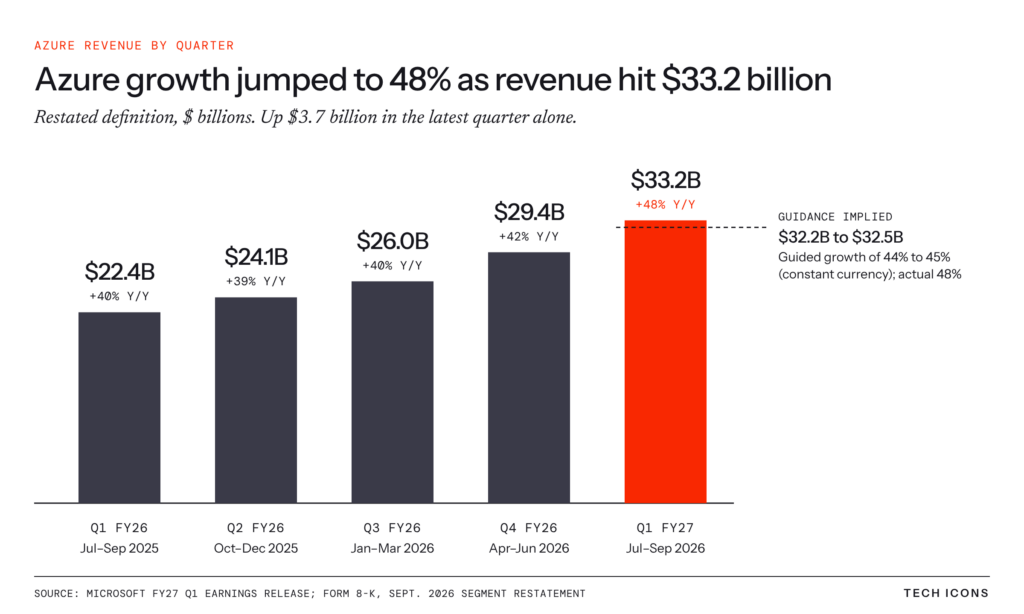
Azure Takes the Lead
Azure generated $33.17 billion, against $22.38 billion a year earlier, a gain of 48%. Management had guided to 44% to 45% in constant currency, and analysts polled by StreetAccount expected $32.32 billion. On the restated basis, growth ran between 39% and 42% through fiscal 2026. It then jumped six points in one quarter, adding roughly $3.7 billion of revenue in three months. Azure now accounts for 36% of group sales and is now Microsoft’s biggest single business, ahead of the $27.8 billion produced by Microsoft 365 cloud.
That acceleration matters because Microsoft has argued for more than a year that Azure is held back by supply rather than demand. In July, Chief Financial Officer Amy Hood said customer demand continues to exceed available capacity, and that efficiency gains get monetized quickly because of that imbalance. A six-point jump is what that claim looks like in practice when new capacity arrives and sells as soon as it is switched on. Microsoft Cloud revenue reached $63.9 billion, up 30% year over year, or 31% in constant currency, and Microsoft 365 commercial cloud grew 17%. Hood’s summary was unusually blunt: “Results exceeded expectations across revenue, operating income, and earnings per share.”
What the Capacity Costs
The cost of that growth now shows plainly in the cash flow statement. Cash spending on property and equipment came in at $39.4 billion, more than double the $19.4 billion of a year ago. Operating cash flow rose 29% to $58.0 billion, but free cash flow declined 27% to $18.63 billion. Cash and short-term investments fell to $64.5 billion from $76.8 billion in June. Capital expenditures and finance leases totaled $45.2 billion, up about 30% from a year earlier, against a StreetAccount estimate of $50.67 billion. That total also came in below the company’s own forecast of more than $50 billion. Microsoft explained the gap between cash spending and total capex as “timing differences between receipt of goods and payment and a lower mix of finance leases.”
The income statement tells a related story. In Agents and Infra, cost of revenue rose 35% while segment revenue grew 25%. Gross margin therefore narrowed to 68.9% from 71.3%, consistent with the heavier depreciation and running costs of AI infrastructure. Group margins widened anyway because overhead barely moved: research, sales and administrative costs together rose 6% while revenue rose 19%. Accounting also plays a part. From the start of fiscal 2027, Microsoft is extending the estimated useful life of datacenters and office buildings from 15 to 25 years, so more future datacenter leases will shift from finance leases, which count as capex, to operating leases, which don’t. Anyone comparing spending or margins across periods needs to adjust for both effects.
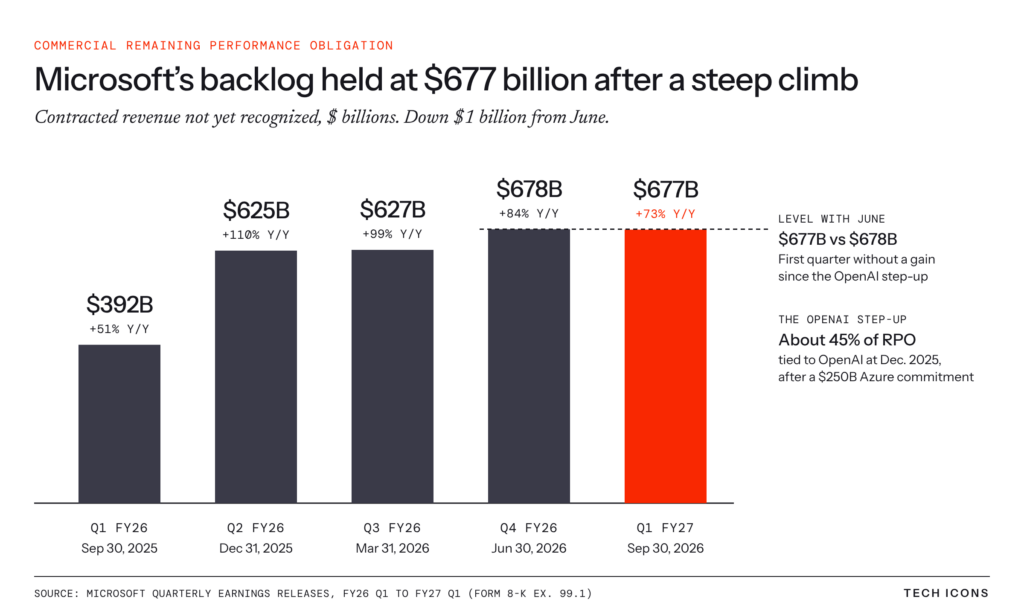
Backlog, Headcount and the Copilot Push
One figure did not advance. Commercial remaining performance obligation increased 73% to $677 billion, but it was flat against the $678 billion reported in June. The year-on-year comparison is inflated by the OpenAI commitments that more than doubled the backlog during fiscal 2026, so the flat sequential reading is the more informative one. Large contracts arrive unevenly, and one flat quarter after two years of steep gains is not a warning on its own. It is, however, the number analysts are most likely to press on.
Management is reshaping the cost base around the same priorities. In July, the company said it was cutting 4,800 jobs, about 2.1% of its global workforce. Two days before reporting, it offered voluntary buyouts to about 60,000 employees, or more than a quarter of its global workforce, in Canada, India, the United Kingdom and the United States. On the product side, Microsoft has begun to integrate its consumer and enterprise Copilot apps, starting a process that will culminate in a super app planned to feature chat, coding, and autonomous functions. The aim is to better compete with market leaders such as Anthropic and OpenAI. Microsoft 365 Copilot had reached over 30 million paid seats by the end of fiscal 2026. The consumer side moved the other way. Devices and Consumer revenue fell 3% to $15.5 billion as Windows OEM and Devices revenue decreased 22%, partly offset by a 12% increase in search and advertising revenue excluding traffic acquisition costs.
How the Market Read It
Investors approved, but they did not get carried away. Shares closed the regular session at $531.01 and traded at $552.75, up 4.09%, after hours. That was a smaller move than July’s, when the stock traded up as much as 8% in after-hours trading on 43% Azure growth. The restraint reflects how much was already priced in. The stock shed more than a third of its value, bottoming near $353 in late June, and by mid-October it was within 2% of its record close. Microsoft also benefits from comparison with its peers. It remains free cash flow positive, while Alphabet reported more than $9 billion in negative free cash flow in the quarter after Meta said its cash flow turned negative for the first time.
The next move depends on what Hood says about the December quarter, and above all on whether Azure guidance shows the acceleration can hold. The September quarter settled the question of demand. What remains open is conversion: how quickly Microsoft can bring capacity online, at what gross margin, and whether the backlog starts growing again. In July, Hood said she sees further growth in capital expenditures for fiscal 2027 and expects Microsoft to be positive free cash flow in the 2027 fiscal year. Now that Azure is reported in dollars, the market will check her on both points every quarter.