
- AI Adoption
- AI Infrastructure
- Cybersecurity
- Earnings Report
Palo Alto Networks Lifts Its Outlook and Moves Into AI Compute
9 minute read
Revenue rose 39% to $3.44 billion and full-year guidance climbed by $395 million, as a $4.5 billion all-stock deal for Applied Compute carries the security leader into AI inference.
Key Takeaways
- Revenue beat the top of guidance by about $135 million and NGS ARR rose 66% to $9.73 billion. Stripping out acquisitions, Tech Icons estimates growth of roughly 23%, not 39%.
- Fiscal 2027 revenue guidance rose $395 million, yet margin targets held and exclude Applied Compute, which could cut operating margin by up to 200 basis points in fiscal 2028.
- Diluted shares rose 18% after CyberArk, holding EPS growth to 13%. Applied Compute costs about 40 times revenue net of cash, and the 2028 cash-margin goal now excludes data centers.
A Quarter That Cleared Every Bar
Palo Alto Networks reported fiscal first-quarter results on November 18 that cleared every metric it had guided. Revenue for the quarter ended October 31 rose 39% to $3.44 billion, about $135 million above the top of the company’s range. Next-generation security annual recurring revenue, the measure management uses to track its platform business, climbed 66% to $9.73 billion against guidance of $9.54 billion to $9.56 billion, and net new ARR of $630 million was 130% higher than a year earlier. Remaining performance obligations rose 35% to $21.0 billion, and non-GAAP earnings of $1.05 a share compared with guidance of $0.96 to $0.98.
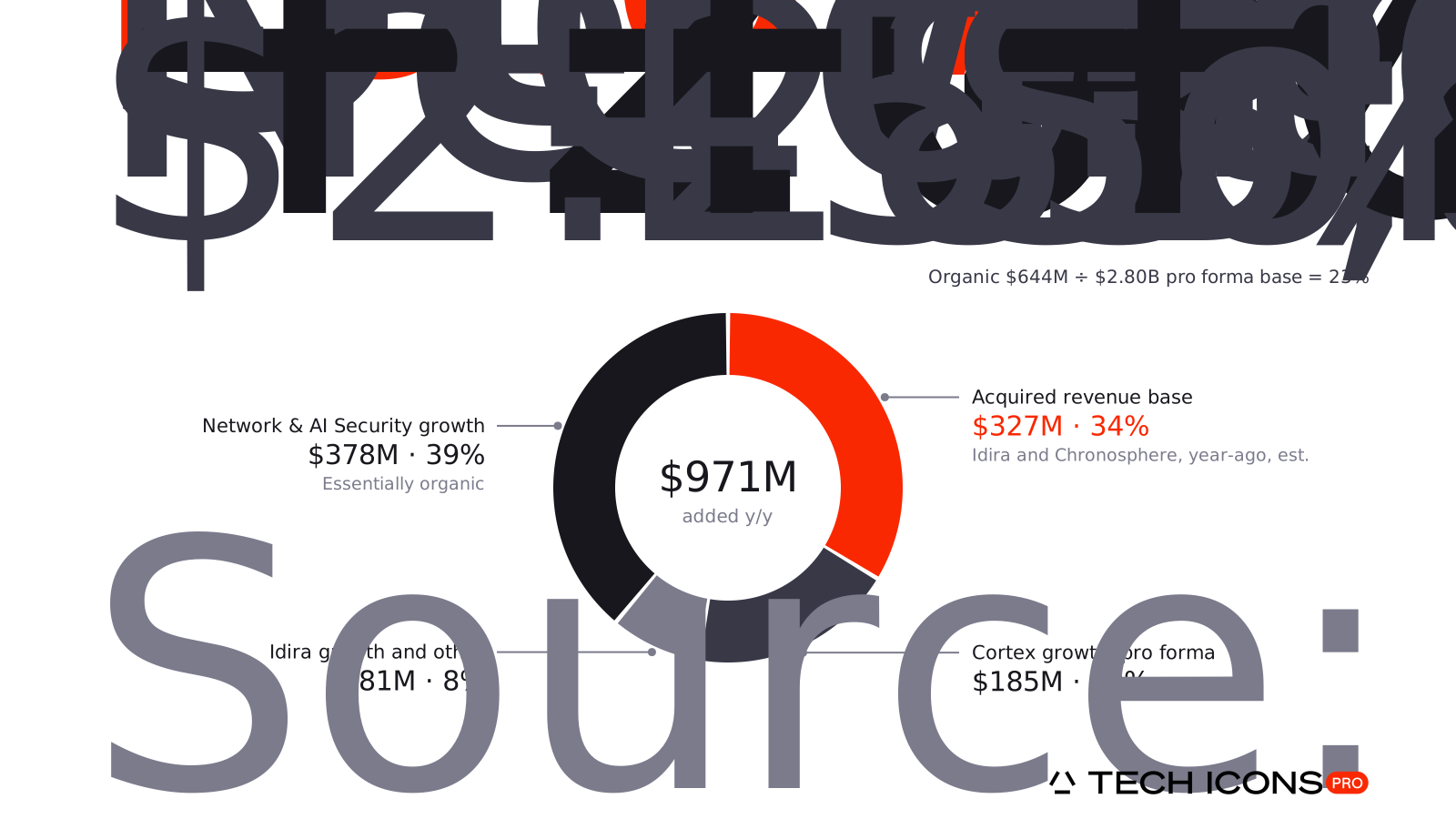
The segment detail shows where the strength sat. Network and AI Security, the firewall, SASE and AI security franchise, grew 20% to $2.28 billion with little help from acquisitions. Cortex, the security operations unit that now includes Chronosphere’s observability platform, rose 53%, or 40% on a pro forma basis. Idira, the identity business built on CyberArk, contributed $353 million and grew 23% pro forma. Prisma AIRS, the AI security product, reached about $170 million of ARR within five quarters of launch. The GAAP accounts were thinner. Operating income fell to $96 million from $309 million as amortization of acquired intangibles rose to $282 million, and net income of $482 million rested on a one-time $457 million tax benefit.
What the Raise Actually Says
The outlook carried more weight than the quarter. Management lifted fiscal 2027 revenue guidance to $14.52 billion to $14.57 billion, from $14.10 billion to $14.20 billion and ahead of the roughly $14.2 billion analysts had expected, and raised NGS ARR guidance to $11.475 billion to $11.525 billion. “Given the current threat environment and demand we see ahead of us, we are materially raising our full year guidance,” said Dipak Golechha, the chief financial officer. About $140 million of the $395 million revenue increase reflects the first-quarter beat. The remaining $255 million is a forecast about quarters still to come.
From an operating margin standpoint, we continue to offset higher COGS with improving OpEx leverage as we scale efficiency.
Profit guidance moved less. Non-GAAP earnings guidance rose about $0.10 at the midpoint, to $4.26 to $4.30 a share, barely more than the $0.08 by which the first quarter alone beat its range, and the 29.5% operating margin and 38% adjusted free cash flow margin targets were held. Costs explain part of the restraint. Non-GAAP gross margin slipped 170 basis points to 75.2%, and management expects higher component prices to weigh on it for the rest of the year. Nikesh Arora, the chief executive, also said some customers are buying hardware early to get ahead of those price increases, which helps explain why trailing firewall bookings are up 28%. Hardware is only about a tenth of revenue, and Arora expects the strength to last at least another year, but investors will want to know what follows it.
The Price of Acquired Growth
Acquisitions still account for much of the headline. Applying the company’s own pro forma growth rates for Cortex and Idira, Tech Icons estimates that about $327 million of the $971 million year-on-year revenue increase came from businesses Palo Alto Networks did not own a year ago, which puts underlying growth at roughly 23%. The guidance points the same way. With second-quarter revenue guided to $3.53 billion to $3.55 billion, the full-year midpoint implies second-half revenue of about $7.56 billion, about 18% above the prior-year period, a base that already includes CyberArk and Chronosphere, both completed in February. That is a sound rate for a company of this scale, and a more reliable guide to the trajectory than 39%.
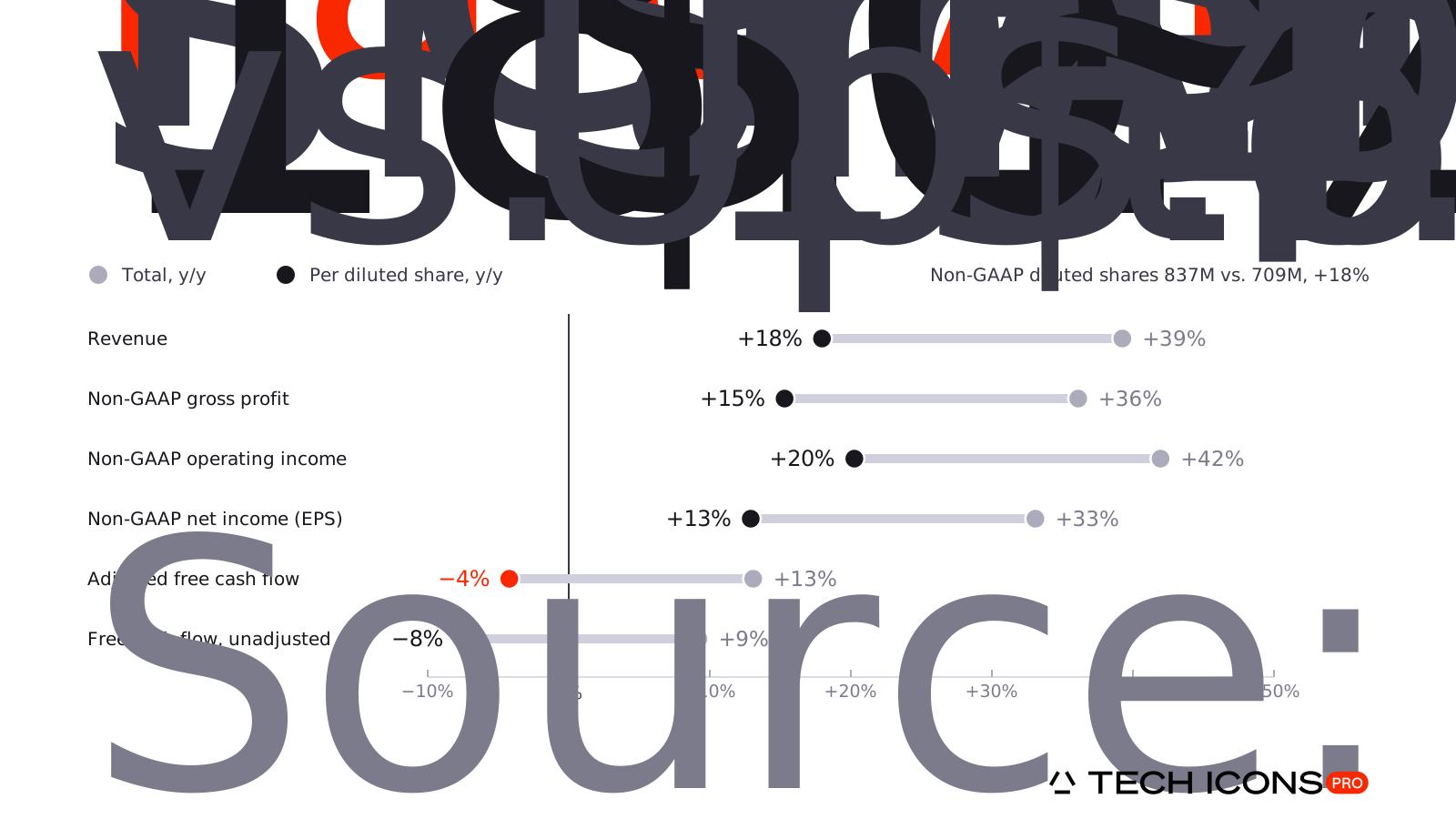
Shareholders feel the cost per share. The diluted share count rose 18% to 837 million, so a 33% increase in non-GAAP net income became a 13% gain in earnings per share. Share-based compensation charges rose to 18.1% of revenue from 15.6%, and the company repurchased no stock in the quarter, leaving up to $1 billion of authorization in place through December 2027. Applied Compute, paid entirely in stock, would add roughly 13 million shares at Wednesday’s closing price. The balance sheet, with about $9.1 billion of cash and investments, is not the constraint. The constraint is that every stock-funded deal raises the return the acquired business must earn.
From Securing Models to Running Them
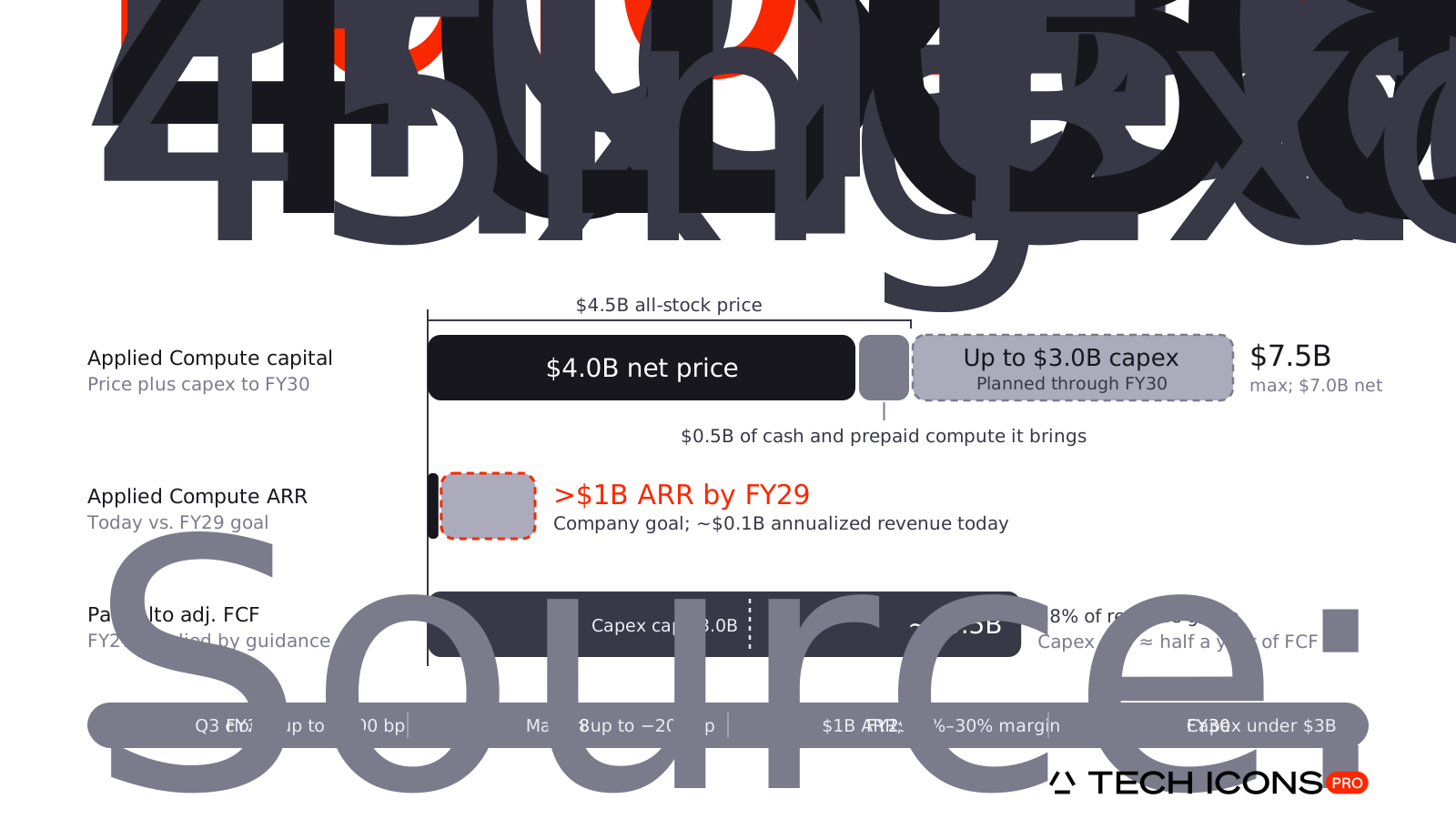
Applied Compute was the most consequential announcement of the day, and the least conventional. The company post-trains and serves open-weight AI models for enterprises, and reached about $100 million of annualized revenue within 18 months of its founding with roughly 70 employees. Palo Alto Networks is paying $4.5 billion in stock, a figure that includes about $500 million of cash and prepaid compute, or roughly 40 times revenue net of those assets. Management is targeting more than $1 billion of incremental NGS ARR from the business by fiscal 2029 and at least 100 megawatts of inference capacity within three to five years, with cumulative capital spending below $3 billion through fiscal 2030. “Every enterprise is going to run a mix of open and closed models, and every one of those models needs to be secured,” Arora said.
We have to get in the training business to be able to build a good supervision business.
The costs are spelled out. Assuming a fiscal third-quarter close, the company expects the deal to reduce operating margin by up to 100 basis points this year and up to 200 basis points in fiscal 2028, before a return to 29% to 30% in fiscal 2029; current guidance excludes it. The fiscal 2028 cash ambition has shifted as well, from the 40% adjusted free cash flow margin cited in September to 38% or more before data center capital spending. Arora grounds the case in the threat environment. Critical and high-severity vulnerabilities are being disclosed at about seven times last year’s monthly rate, and he said offensive capabilities first seen in frontier models such as Claude Mythos Preview, which Palo Alto Networks tested as a launch partner in Anthropic’s Project Glasswing, have already spread to open-source models. Running inference also brings the company onto ground held by hyperscalers and model developers, several of which are its customers.
How the Market Read It
Investors moved before the release. Cybersecurity stocks rallied across the board on November 18, with CrowdStrike up about 8% and Okta about 12%, and Palo Alto Networks rose 9.9% to close at $339.92. After the results it added roughly 9% more in extended trading, to about $369, nearly a fifth above its level two sessions earlier and enough to value the company at about $300 billion. That is a sharp recovery for a stock that traded below $170 in April. The reaction suggests the market read the report as evidence that security budgets are expanding with the AI threat, not merely holding up.
Extended-trading gains have proved fragile before. After the June report an early rally gave way to a decline the next day, and the shares fell sharply after the September release despite beating estimates. This time the guidance does more of the work, committing the company to revenue it has not yet booked. The questions for the next two quarters are concrete: whether underlying growth holds near 23% as early hardware buying runs its course, whether gross margin steadies against component inflation, and whether Applied Compute can turn a $100 million business into a billion-dollar line without eroding the cash margins that support the valuation. Arora has spent nearly three years persuading customers to consolidate on one platform. He is now asking shareholders to accept that the platform includes the compute itself.