
- AI Cloud
- Cloud Computing
- Data Centers
- Earnings Report
CoreWeave Hits Its Margins Early, but Creditors Still Set the Pace
9 minute read
Revenue rose 168% to $3.66 billion and margins hit double digits a quarter early, yet a $47 billion debt load and a $1 billion quarterly interest bill keep the focus on funding.
Key Takeaways
- Adjusted operating income of $379 million beat the top of guidance by $119 million, doubled the margin to 10% and prompted a 26% lift in full-year profit guidance at the midpoint.
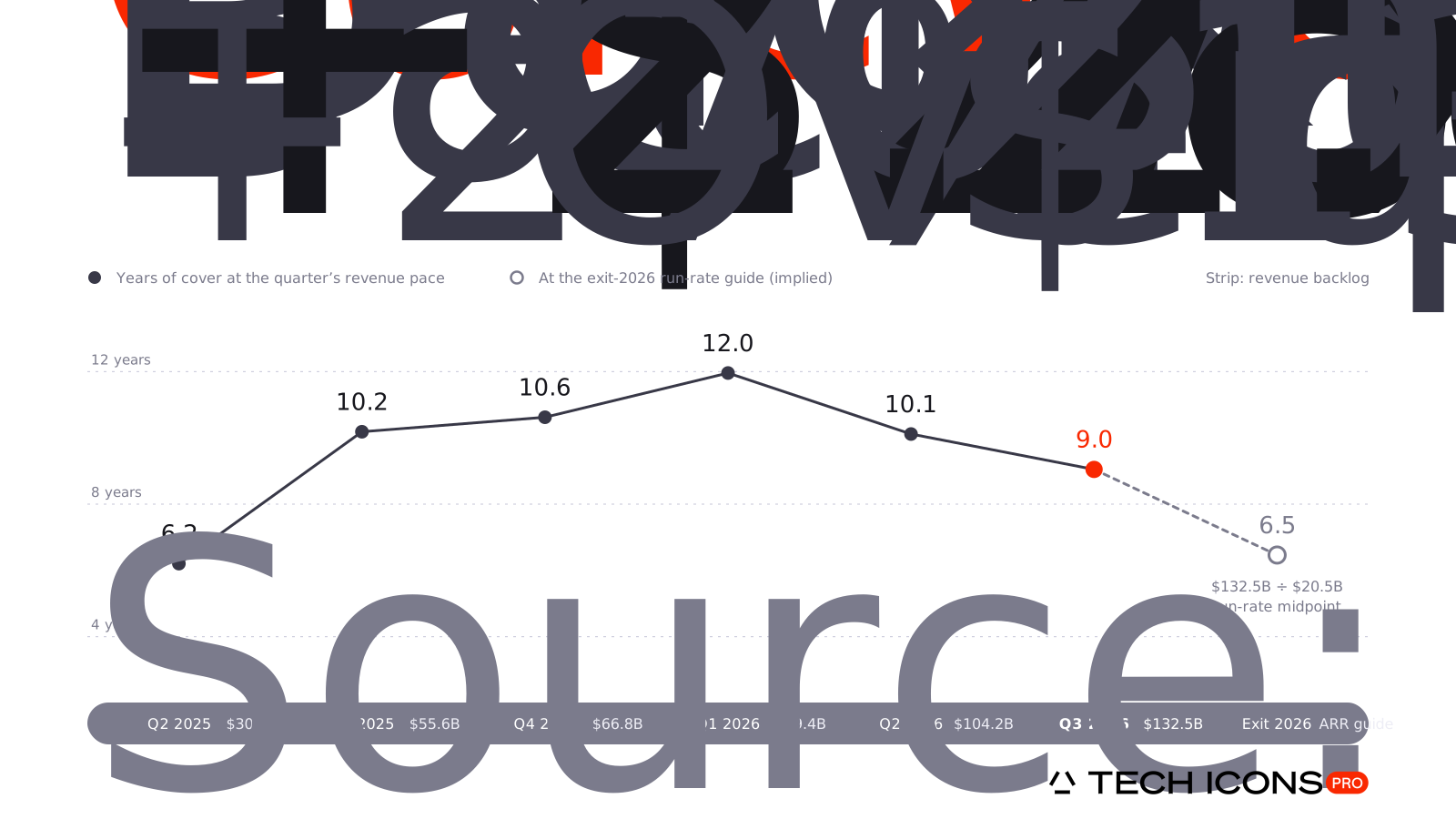
- Backlog reached $132.5 billion, but borrowings rose almost $12 billion in the quarter to $46.9 billion, and fourth-quarter interest expense is now guided to $1.05 to $1.15 billion.
- Management ruled out new parent-level unsecured bonds through 2027 at current yields, leaning on prepayments and contract-backed loans. Shares rose nearly 13% in overnight trading.
A Quarter That Arrived Ahead of Schedule
CoreWeave came into its third-quarter report as the market’s preferred proxy for everything that could go wrong with the AI build-out. Its shares had lost more than 40% in a month, some of its bonds due 2031 were yielding above 16%, and the cost of insuring its debt against default had reached levels usually associated with distress. Against that backdrop the company delivered its strongest operating quarter since listing. Revenue rose 168% from a year earlier to $3.66 billion, clearing the top of its own $3.45 billion to $3.60 billion range and the LSEG consensus of about $3.55 billion. Sequential growth exceeded $1 billion for the first time.
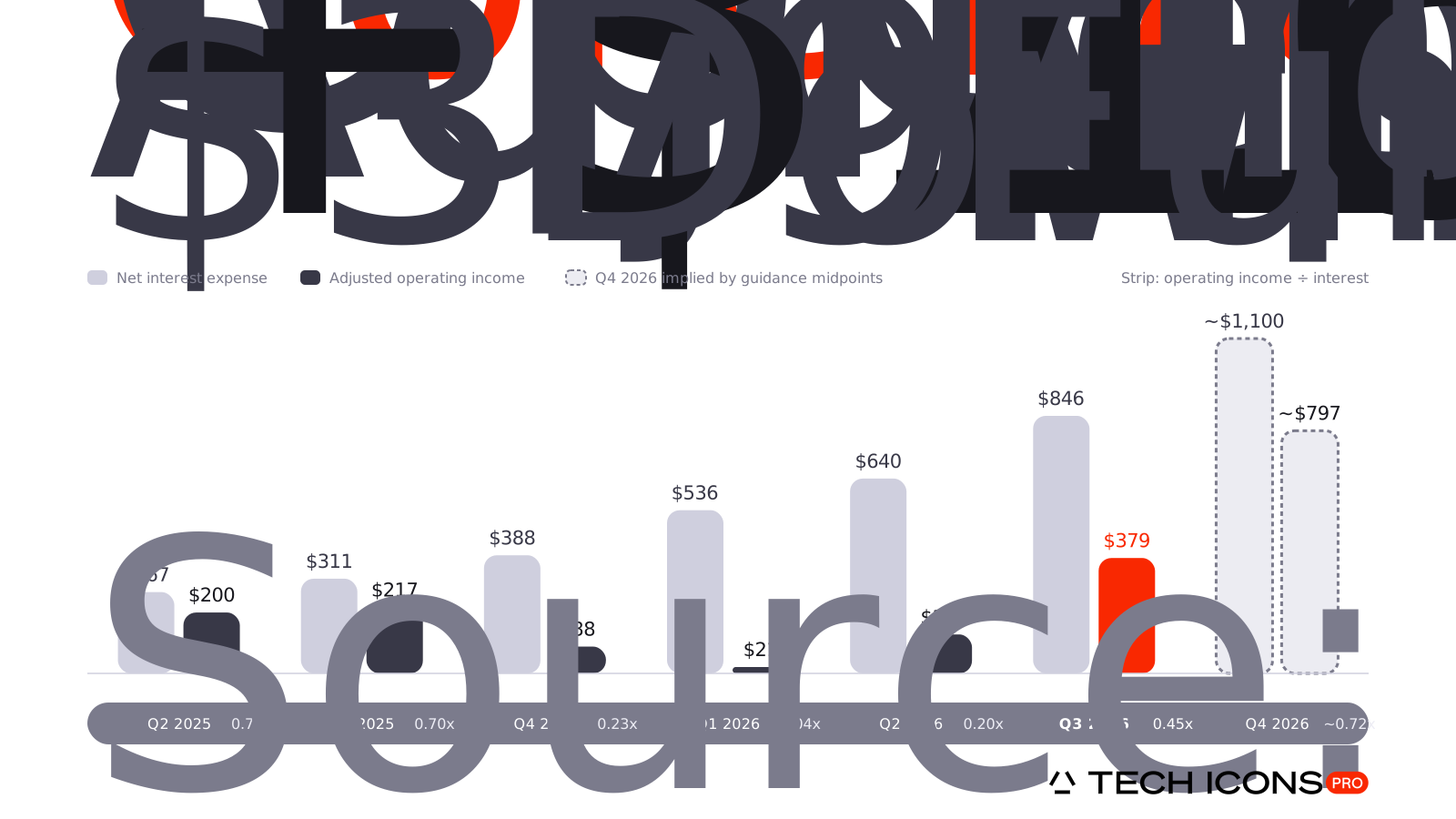
The more important number sat further down the income statement. Adjusted operating income reached $379 million, nearly three times the $128 million of the second quarter and well above the $200 million to $260 million management had guided. The adjusted operating margin moved to 10% from 5%, a level chief executive Michael Intrator said the company reached “a quarter ahead of plan.” For a business whose central question has been whether scale would ever outrun the cost of financing it, this was the first quarter that answered with evidence rather than projection.
Where the Operating Leverage Came From
The improvement reflects a capacity business beginning to work in its owner’s favor. Active power rose by more than 200 megawatts to over 1.7 gigawatts, double the footprint at the start of the year, and clusters energized late in the second quarter billed for a full three months. Depreciation and amortization reached $1.89 billion, three times the year-earlier charge, yet adjusted EBITDA climbed to $2.26 billion and its margin widened to 62%. Pricing did much of the rest. In September the company disclosed short-dated contracts signed at roughly $40 million of annualized revenue per megawatt, and on Tuesday’s call management described its capacity as largely sold out through 2027.
Guidance assumes the curve steepens from here. Full-year revenue is now expected at $13.0 billion to $13.3 billion, up from $12.4 billion to $13.2 billion and above the roughly $12.9 billion analysts had modeled. Adjusted operating income guidance rose to $1.275 billion to $1.375 billion. Subtracting the first nine months implies fourth-quarter revenue of about $4.7 billion to $5.0 billion and an adjusted operating margin in the mid-teens, ahead of the low-teens figure the finance chief had pointed to in August. CoreWeave also lifted its target for annualized run-rate revenue at the end of the year to $20 billion to $21 billion. Contracted power, the pipeline that feeds future revenue, grew by more than 900 megawatts to over 4.6 gigawatts, more than 1.3 gigawatts of it outside the United States.
The Price of Building Ahead of Revenue
Below operating income, the cost of that growth remains plain. Net interest expense rose to $846 million, slightly under the $860 million to $940 million guided but still more than twice adjusted operating income, and the fourth quarter is expected to bring $1.05 billion to $1.15 billion. The pretax loss was $626 million, and an $83 million tax provision took the net loss to $709 million, or $1.27 a share. Recourse and non-recourse borrowings together reached about $46.9 billion at the end of September, up nearly $12 billion in three months, against $4.1 billion of unrestricted cash. About 89% of that total is classified as recourse debt, meaning lenders can look beyond the specific assets that secure it.
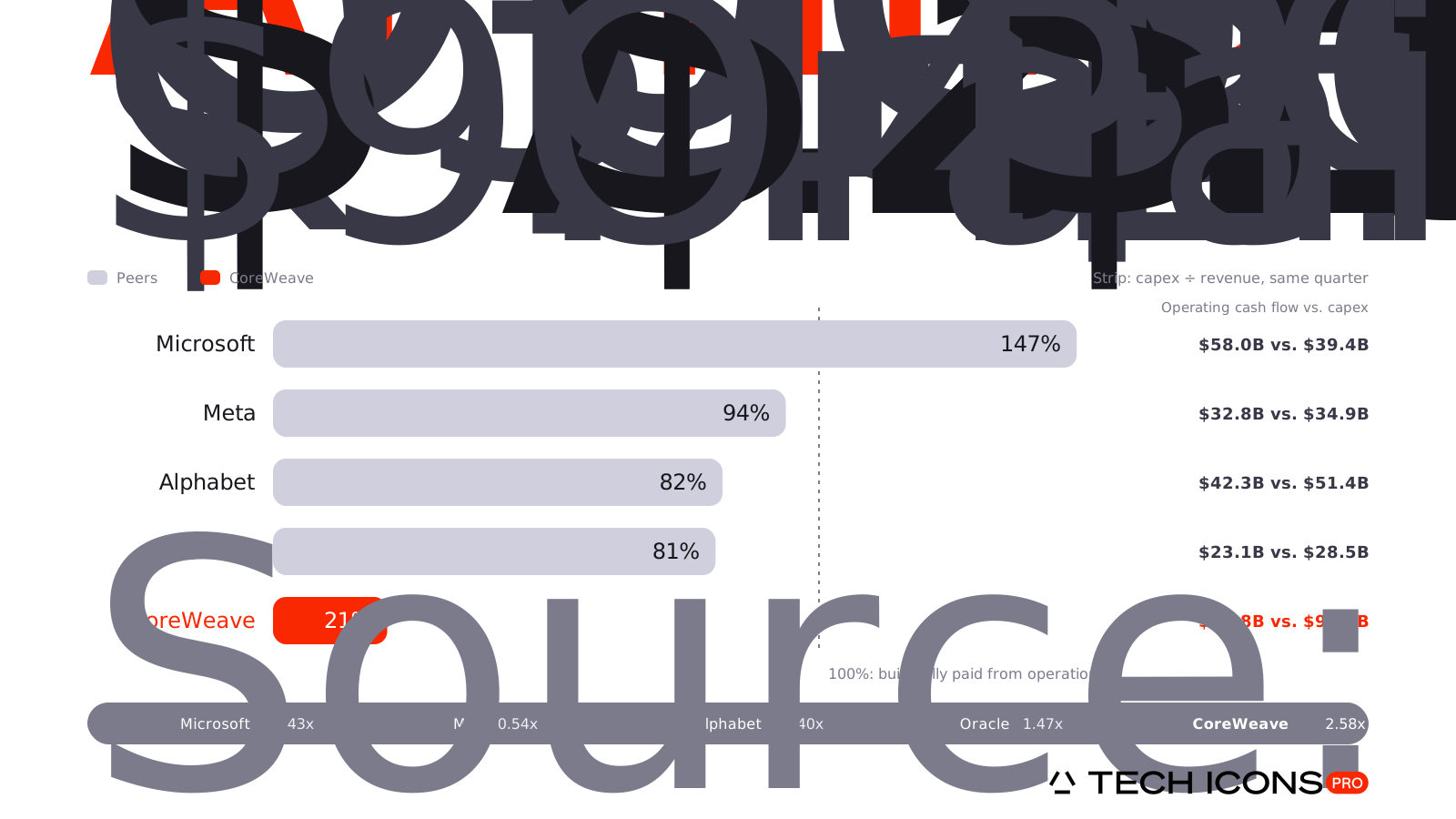
Cash flow tells the same story at a larger scale. Operations generated $1.98 billion in the quarter while purchases of property and equipment absorbed $9.44 billion, leaving a gap of roughly $7.5 billion that lenders and customers had to fill. The company raised the low end of its full-year capital spending range, now $37 billion to $39 billion, because it expects to deliver infrastructure to customers sooner than planned. That is a sign of demand, and it is also a decision to borrow earlier. What eases the strain is customer money arriving in advance: deferred revenue stands near $10 billion, and Intrator pointed to roughly $9 billion of prepayments and deposits expected over the next three months alone.
A Funding Plan Written for a Closed Market
The call was, in effect, a financing presentation. “At current yields, we do not intend to issue additional parent-level unsecured debt through 2027,” finance chief Nitin Agrawal said, adding that the company’s asset-level secured loans continue to trade around par. CoreWeave expects to raise less than $5 billion of parent-level debt through 2027, with most new capital coming from customer prepayments, hardware-partner financing and delayed-draw loans matched to individual contracts. Equity-linked capital remains part of the toolkit: in September the company raised about $4.2 billion of convertible notes and set up a program to sell up to 35 million shares, roughly 6% of its share count. Management said more than 75% of committed capital spending through 2027 is tied to investment-grade and enterprise customers, and that its contract-backed loans have priced between 225 and 550 basis points over SOFR since the listing.
The plan rests on contracts doing the work that bond investors no longer will. Management said long-dated contracts recover their hardware cost in one to two years at current pricing, and that 2027 renewals could add close to $4 billion of annualized revenue without new capital spending. Agrawal said that if CoreWeave served only its committed backlog, 2027 capital spending would stay in line with 2026 while revenue and EBITDA grew sharply. The quarter’s product work supports that case. CoreWeave Forge, launched in September, folds Weights & Biases, OpenPipe and the marimo notebook into one development environment, while Cognition’s first production workloads on Nvidia Vera Rubin systems ran at 4.8 times the throughput of the prior generation. Canva, Substack and Wayve joined as customers, and OpenAI, Jane Street and Perplexity expanded.
What the Market Is Still Waiting to See
Investors took a few hours to make up their minds. The shares closed Tuesday at $48.73, down 0.5%, slipped below that level at one point after the release, and then turned decisively higher: they traded about 6% up in the after-hours session and nearly 13% up in overnight trading. The relief spread well beyond CoreWeave. Nvidia, AMD and Micron edged higher after hours, Nebius drew a lift ahead of its own report, and in Asia SK Hynix rose 3.6%, TSMC 2.6% and Samsung Electronics 2.4% as the results eased fears that AI infrastructure demand was cracking. “The business can execute well and still face a tougher financing environment,” said Joe Tigay, portfolio manager at Equity Armor Investments, summarizing the view that operating success and credit access have become separate tests.
That separation defines the next phase. CoreWeave has shown that its clusters earn more once they are running, that customers will pay in advance, and that demand extends well into 2027. It has not yet shown that it can fund the next several gigawatts at a cost that leaves equity holders a meaningful share of the return. The contract-backed debt Agrawal expects to raise in the coming weeks, the arrival of the $9 billion in prepayments, and the pricing of CoreWeave’s bonds will now say more about the stock than any backlog figure. Rates matter too: a firmer-than-expected U.S. inflation report this week pushed Treasury yields higher, a reminder that part of CoreWeave’s cost of capital is set far from its data centers. Nebius reports on Thursday, and its results will show whether the market is judging CoreWeave alone or the entire neocloud model.