- Cloud Computing
- Data Centers
- Semiconductors
NVIDIA Posts $81.6 Billion Quarter as AI Infrastructure Scales
11 minute read
NVIDIA’s first-quarter fiscal 2027 results confirm the AI infrastructure build-out is accelerating well beyond earlier projections, with data-centre revenue reaching $75.2 billion.
Key Takeaways
- NVIDIA posted Q1 fiscal 2027 revenue of $81.6 billion, an 85% year-on-year increase, beating its own $78 billion guidance and signalling sustained structural demand for AI infrastructure at scale.
- Data-centre networking revenue nearly doubled year-on-year to $14.8 billion, reflecting a decisive shift toward full-stack AI factory procurement rather than isolated GPU acquisition by hyperscalers and sovereign buyers.
- Second-quarter guidance of $91 billion, combined with an $80 billion share-repurchase expansion and dividend increase, underscores management’s confidence in free-cash-flow durability through fiscal 2027 and beyond.
The Numbers That Set the Tone
NVIDIA reported first-quarter fiscal 2027 revenue of $81.6 billion, an 85 percent advance over the prior year and a clean beat against its own guidance of $78 billion. The company’s shares fell in after-hours trading. That reaction, jarring at first glance, has become the most reliable indicator of where NVIDIA now sits in the hierarchy of market expectations: a company so consistently extraordinary that extraordinary has become the minimum acceptable outcome, and the only question that moves the stock is whether the next quarter will be larger still.
For most technology companies, such a result would constitute a landmark. For NVIDIA, it has become something closer to a baseline. NVIDIA no longer earns credit simply for exceeding estimates; it is judged, quarter after quarter, on whether the next bar is high enough. The forward guide of $91 billion for the second quarter answered that question with considerable force.
Data Centres Drive the Architecture
Data-centre revenue of $75.2 billion was the clear centre of gravity, rising 21 percent sequentially and 92 percent year-on-year. Within that figure, compute contributed $60.4 billion while networking reached $14.8 billion, a near-doubling that deserves particular attention. Networking revenue of that magnitude is not simply a function of more GPUs being shipped; it reflects a structural transition in how large-scale AI capacity is being procured and deployed.
Hyperscalers, cloud providers, and sovereign AI programmes are no longer purchasing discrete accelerators and patching together the surrounding infrastructure from third-party vendors. They are buying complete AI factory stacks: compute, interconnect, storage, and software designed to operate as a unified system optimised for inference and training at scale. NVIDIA’s capture of both the silicon and the networking layers explains why gross margins held steady at 74.9 percent on a GAAP basis and 75.0 percent non-GAAP, precisely in line with guidance and well above the levels of a year ago when charges related to H20 export restrictions weighed on the metric.
Non-GAAP diluted earnings per share rose to $1.87; GAAP EPS reached $2.39. Net income on a GAAP basis stood at $58.3 billion. The company returned roughly $20 billion to shareholders through buybacks and dividends and announced an additional $80 billion share-repurchase authorisation alongside a dividend increase to $0.25 per share.
Jensen Huang’s Industrial Vision
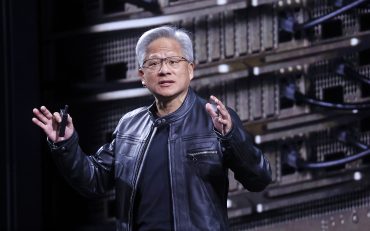
Founder and chief executive Jensen Huang framed the results in terms that are characteristically long in scope. “The buildout of AI factories, the largest infrastructure expansion in human history, is accelerating at extraordinary speed,” he said. “Agentic AI has arrived, doing productive work, generating real value and scaling rapidly across companies and industries.”
The language is deliberate. Huang has spent several years repositioning NVIDIA not as a chipmaker but as the infrastructure layer of a new industrial order, and the quarterly figures increasingly vindicate that framing. Chief financial officer Colette Kress struck a more measured register in her written commentary, highlighting the company’s ability to sustain 75.0 percent non-GAAP gross margins even after adopting a new policy that incorporates stock-based compensation into non-GAAP measures. She also pointed to the balanced contribution from compute and networking as evidence of full-stack AI factory deployments, and confirmed that second-quarter guidance is built on a conservative assumption of zero data-centre compute revenue from China.
That assumption is more than a footnote. It reflects the regulatory reality that governs NVIDIA’s most advanced products and introduces a persistent uncertainty into long-range forecasting. Yet the company has, so far, absorbed that constraint without visible damage to its top-line trajectory.
The Demand Signal and Its Depth
What distinguishes this cycle from earlier technology investment waves is the breadth of the demand base. Cloud-service providers report sold-out GPU cluster capacity. Enterprise adoption, once concentrated among a handful of hyperscale operators, has extended into financial services running real-time risk models, healthcare deploying multimodal foundation models, and automotive companies simulating autonomous fleets at scale. Sovereign governments, particularly across the Middle East and Asia, are committing tens of billions of dollars to domestic AI infrastructure, frequently in direct partnership with NVIDIA.
Each deployment reinforces a self-sustaining logic: more AI models require more compute; more compute generates more data; more data demands more sophisticated inference infrastructure. NVIDIA’s software ecosystem, anchored by CUDA and extended through enterprise offerings such as NIM, lowers the barrier for organisations that lack the in-house engineering depth of the largest cloud operators. The result is a customer base that is broadening even as the capital intensity of each deployment rises.
Competitive Pressures and the Question of Durability
Intellectual honesty requires acknowledging the constraints. Gross margins, while stable, face long-term pressure from rising silicon complexity and the gradual maturation of competing offerings. AMD’s MI300 series represents a credible alternative at the margin, and domestic Chinese AI chip development, though still far from parity, warrants monitoring. Regulatory scrutiny of NVIDIA’s market position is intensifying in Washington and Brussels. And valuations, at current levels, embed expectations of hyper-growth that leave little room for error.
The geopolitical dimension adds a layer of structural uncertainty that no quarterly result can fully resolve. Export controls are a permanent feature of the landscape for advanced semiconductors, and any escalation would compress the addressable market in ways that guidance cannot anticipate.
The Infrastructure Imperative
NVIDIA’s fiscal 2026 full-year revenue of $215.9 billion represented a 65 percent increase over an already exceptional prior year. The compound annual growth rate over three fiscal years now exceeds 80 percent, a rate of expansion that is without precedent for a company operating at this scale. The second-quarter guide of $91 billion implies that fiscal 2027 could see aggregate revenue approach or exceed $350 billion, a figure that would have been regarded as implausible speculation three years ago.
For senior investors and policymakers, the significance of these results extends beyond any single company’s balance sheet. NVIDIA’s trajectory is allocating capital at civilizational scale, redirecting trillions of dollars toward accelerated computing infrastructure and reordering global supply chains in the process. Countries and corporations that secure access to the latest generation of AI platforms gain a measurable, compounding productivity advantage. Those that fall behind in access will find the gap increasingly difficult to close.
The AI factories, as Huang describes them, are not a future aspiration. They are being built now, at speed, and NVIDIA remains the indispensable supplier at their core.