- AI Memory
- Data Centers
- Memory Chips
Micron's Record Quarter Redefines Memory's Place in AI
9 minute read
Fiscal Q3 2026 results reveal how a historically cyclical commodity has been structurally re-rated as an indispensable, high-margin bottleneck at the heart of AI infrastructure.
Key Takeaways
- Micron posted Q3 revenue of $41.46 billion, quadrupling year-over-year, with GAAP gross margin of 84.6 percent and operating cash flow of $25.39 billion, marking a historic inflection for the memory sector.
- Sixteen multi-year Strategic Customer Agreements carrying roughly $100 billion in remaining performance obligations and $18 billion in upfront cash fundamentally alter Micron’s revenue visibility and insulate it from traditional memory-cycle volatility.
- HBM4 has entered high-volume production, calendar 2026 supply is fully committed, and management sees tightness persisting through 2027-2028, positioning Micron as a primary vehicle for sustained AI infrastructure exposure.
Numbers That Reframe a Sector
There are earnings reports that beat expectations, and then there are earnings reports that change the terms on which an entire industry is understood. Micron Technology’s fiscal third quarter of 2026 belongs to the second category.
For the quarter ended May 28, Micron reported revenue of $41.46 billion, a figure that quadrupled the $9.30 billion posted in the year-earlier period and rose 74 percent sequentially from $23.86 billion. GAAP net income reached $28.24 billion, or $24.67 per diluted share. Gross margin expanded to 84.6 percent on a GAAP basis; operating margin reached 80.4 percent. Operating cash flow surged to $25.39 billion, with adjusted free cash flow of $18.3 billion after net capital expenditures of $7.1 billion.
These are not the numbers of a semiconductor company riding a cyclical upturn. They are the numbers of a business that has undergone a structural re-rating, and the mechanisms behind that transformation are more consequential than the headline figures themselves.
Demand Across the Stack
Micron’s four reporting segments each delivered both strong revenue and elevated margins, a combination that rules out narrow, AI-concentrated demand confined to a single end market.
Cloud Memory generated $13.77 billion in revenue at 83 percent gross margin and 78 percent operating margin. Core Data Center contributed $11.52 billion at 87 percent gross margin. Mobile and Client matched that revenue figure at 87 percent gross margin and 86 percent operating margin. Automotive and Embedded added $4.63 billion at 79 percent gross margin.
The two data-center-oriented units together approached $25.3 billion, roughly 61 percent of total revenue, confirming that AI training and inference infrastructure remain the primary demand vector. The more telling signal, however, is the margin uniformity across non-AI segments. Mobile, automotive, and industrial customers are absorbing premium-priced memory because the architecture of their own products has shifted. AI content gains at the device and edge level are driving meaningfully higher memory requirements throughout the technology stack, not merely at the hyperscale tier. That breadth of demand, combined with structural supply constraints, is precisely the condition that gives a memory supplier pricing power it has historically never possessed.
The Architecture of Contracted Visibility
The most consequential disclosure in the quarter was not a revenue or margin figure. It was the announcement of 16 multi-year Strategic Customer Agreements spanning data centers, consumer electronics, automotive, and industrial segments.
These contracts commit customers to minimum volumes of DRAM, including high-bandwidth memory, and NAND over multi-year horizons, with price floors or bands and substantial upfront cash deposits. Remaining performance obligations for the agreements signed through the quarter and shortly thereafter reached approximately $100 billion on a conservative basis. Upfront cash and related financial commitments across the initial 16 agreements totaled more than $22 billion, of which roughly $18 billion was cash. The SCAs already cover around 20 percent of Micron’s DRAM bit shipments and approximately one-third of NAND bits, with management expecting this framework to represent a materially larger share of revenue over time.
The significance extends beyond Micron’s income statement. Memory has historically been the most violently cyclical segment of semiconductors, a commodity business prone to oversupply, price collapse, and margin destruction whenever capacity growth outpaced demand. The SCA architecture disrupts that pattern. Customers are effectively paying for supply certainty in a chronically tight market, providing Micron with the revenue predictability to underwrite capacity investment with considerably lower downside risk than prior cycles permitted. This is not a temporary accommodation to market conditions. It is a renegotiation of the commercial relationship between supplier and customer, with lasting implications for how memory companies are valued.
Technology at the Leading Edge
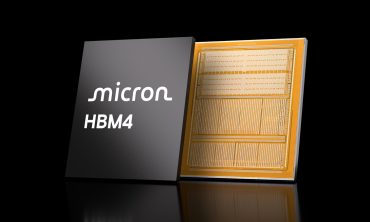
Underpinning the contractual framework is a genuine technology advantage. HBM4, built on 1-beta DRAM process technology, has entered high-volume production for a lead customer’s platform, with qualification samples shipped to additional customers. HBM4 revenue has already exceeded $1 billion, and the 12-high stack is ramping at approximately twice the pace of the prior-generation HBM3E 12-high, with faster yield maturation anticipated. Calendar 2026 HBM supply is sold out following completed volume and pricing negotiations, and management points to industry-wide tightness persisting through at least 2027-2028.
To capture share in this environment, Micron raised its fiscal 2026 capital expenditure target to approximately $27 billion, with fiscal Q4 net CapEx guided near $10 billion. Fiscal 2027 spending is expected to step up further, with more than half the incremental investment directed toward construction and clean-room capacity. CHIPS Act incentives and equivalent programs partially offset the capital intensity required to maintain process leadership. For Q4, Micron guided revenue of $50.0 billion, plus or minus $1.0 billion, gross margin of approximately 86 percent, and non-GAAP EPS of $31.00, plus or minus $1.00.
Memory Repriced
Micron shares closed the regular session on June 24 at $1,048.51 before surging 13 to 16 percent in after-hours trading, with indications reaching above $1,200. Bank of America raised its price target to $1,500 from $950, citing multi-year AI memory demand and structural constraints. The move lifted broader semiconductor names and contributed to a constructive tone in Asian equity markets, as investors read the results as confirmation that AI capital expenditure remains robust and that memory suppliers at the leading edge are converting that spend into durable, high-margin revenue.
The quarter is not the culmination of a cycle. It is the validation of a thesis. Memory, once priced as a commodity, has been repriced as infrastructure. The combination of HBM technology leadership, broad demand across every segment of the technology industry, and a contractual architecture that converts spot-market exposure into long-term visibility has produced an investment profile that bears little resemblance to the Micron of prior cycles.
Execution risks remain. Advanced-node yield ramps are difficult, Samsung and SK Hynix are not standing still, and supply tightness will eventually ease. But the contractual and technological buffers now in place are substantively different from anything the memory industry has previously constructed. For investors seeking durable, high-conviction exposure to the AI infrastructure cycle, the signal is unambiguous. Micron has not merely benefited from AI-related demand. It has built the commercial and technological architecture to capture a structural share of it.