- DUV
- EUV Lithography
- Semiconductors
ASML's Order Book Is Now Sold Out Through 2027
9 minute read
A €9.3 billion quarter and a sharply higher full-year forecast confirm that the constraint on ASML’s growth is no longer demand. It is how fast the company can build.
Key Takeaways
- ASML’s Q2 net sales reached €9.3 billion at a 54% gross margin, both above guidance, lifted by installed base revenue that outperformed by roughly €300 million as customers rushed to upgrade existing tools.
- Full-year 2026 guidance climbed to €43-45 billion, from €36-40 billion in April, with third-quarter sales guided at €11-12 billion on the back of unusually strong first-half order intake.
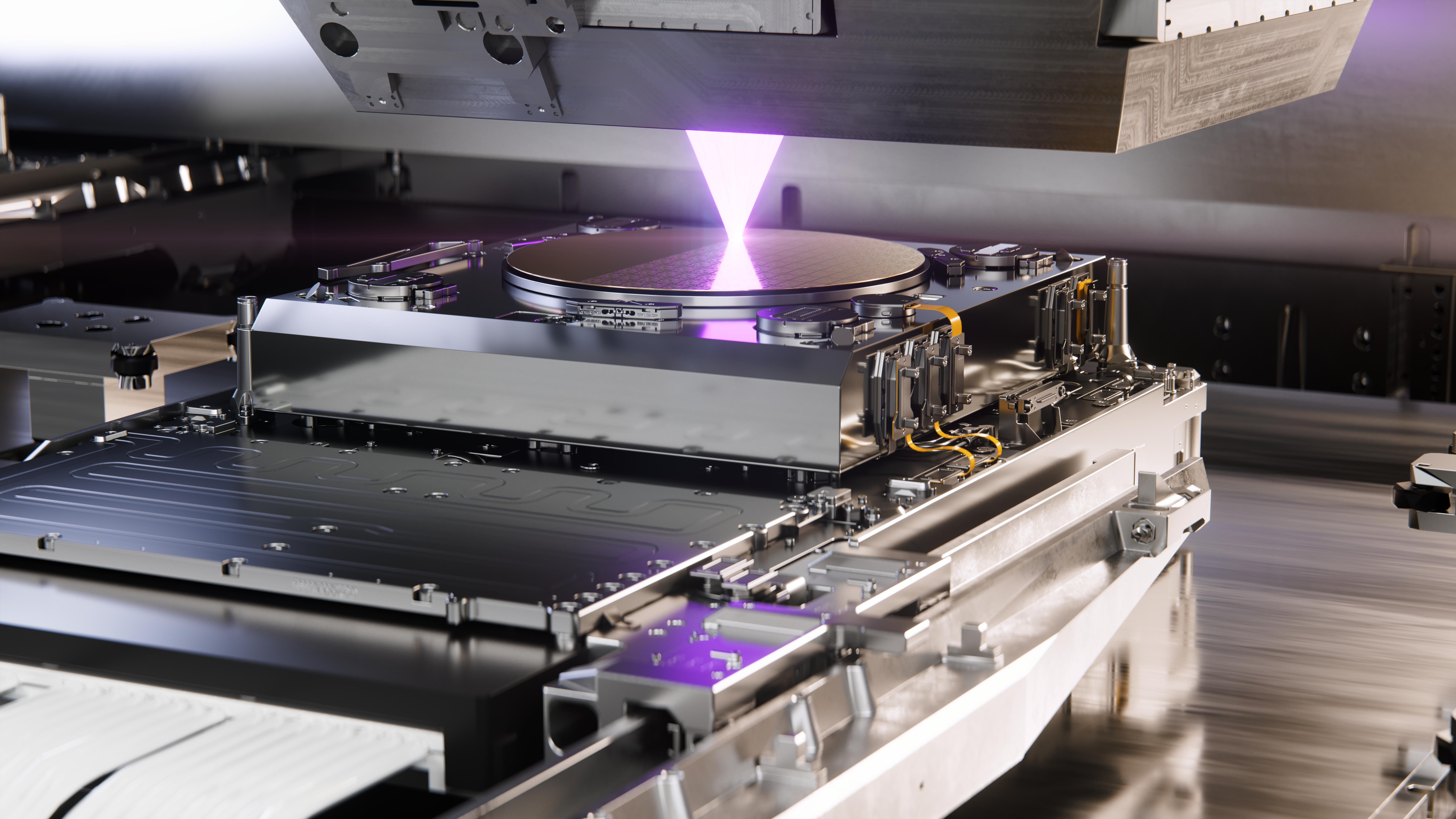
- ASML will add 30% more EUV and DUV capacity for 2027, a decision that treats the current cycle not as a peak to manage but as a floor to build against.
A Quarter That Outran Its Own Guidance
There is a particular kind of corporate result that tells you more about the world than about the company itself. ASML’s second quarter is one of them. Total net sales reached €9.326 billion, up from €8.767 billion in the first quarter, with a gross margin of 54.0% and net income of €2.918 billion, producing basic earnings per share of €7.59. Every one of those figures cleared the range the company had set for itself only three months earlier.
The source of the beat is worth dwelling on, because it was not new machines. Installed Base Management revenue, the business of servicing and upgrading systems already on customer floors, came in near €2.762 billion, roughly €300 million above expectation. Chipmakers, it turns out, were not content to wait for fresh capacity. They wanted more out of what they already had, and they wanted it now. New lithography systems sold rose to 86 units from 67 the quarter before, while used system sales fell to five from twelve, a mix shift that says something quiet but important: the secondary market for older tools is drying up because nothing idle is being left on the table.
The Guidance That Keeps Moving
If the quarter itself was strong, the outlook is the real story. ASML now expects third-quarter net sales between €11.0 billion and €12.0 billion, with gross margin climbing to 55-57%, and has raised its full-year 2026 forecast to €43-45 billion, up from the €36-40 billion range set in April, which was itself an upward revision of an earlier estimate. Two guidance raises inside a single year is not a company managing expectations. It is a company that keeps discovering it undersold its own position.
Chief Executive Christophe Fouquet framed the shift in terms of visibility rather than surprise, pointing to order intake that stayed exceptionally strong through the first half and gave management a clearer read on demand extending well past this year. The company’s response has been to expand rather than ration. ASML plans to add 30% to its roughly 65-unit 2026 low-NA EUV capacity for 2027, with another 30% increase under review for 2028, and is applying the identical math to DUV immersion capacity, currently near 130 units. Released the same day, a separate announcement describing a readiness milestone for High-NA EUV in high-volume logic production reinforces the pattern. This is a company building ahead of orders, not behind them.
Capital Discipline Inside an Expansion
What distinguishes this expansion from past semiconductor cycles is that ASML is funding it without pulling back on shareholders. The company repurchased approximately €1.1 billion in stock during the quarter under its 2026-2028 buyback program and declared an interim dividend of €1.88 per share, payable in early August. Cash and short-term investments dipped to €7.582 billion from €8.376 billion, a decline that tracks neatly with buybacks and dividends rather than any sign of balance sheet strain. For the largest company by market value in Europe, running an aggressive capacity build and an expanding capital return program at the same time is not a balancing act. It is a statement about how much confidence sits behind both decisions.
It is worth remembering how unusual this combination has historically been in capital equipment. Companies asked to double down on plant and tooling in the middle of a demand surge typically do so at the expense of the dividend, on the theory that every euro retained today buys capacity tomorrow. ASML’s willingness to do both at once suggests management sees the expansion as self-funding rather than a stretch, financed comfortably out of the same order book that is driving the guidance higher. That is a subtle but meaningful signal to institutional holders: the capital intensity of this cycle is being absorbed inside the business rather than passed on to shareholders as a temporary sacrifice.
What the Market Already Knew
Shares responded immediately, rising nearly 3% in regular trading and adding a further 3.5% after hours, extending a run that had already carried the stock up more than 60% for the year. That the reaction was measured rather than euphoric says something about how thoroughly the market had priced this in advance. ASML had actually trailed its own equipment peers for much of the year, a gap that reflected two lingering doubts: exposure to China and the slower-than-hoped ramp of its next-generation High-NA tools. Neither doubt has disappeared. China is expected to account for roughly a fifth of ASML’s 2026 revenue, concentrated now in deep ultraviolet systems and servicing rather than the already-restricted EUV segment, and legislative proposals moving through Washington, alongside the Netherlands’ recent alignment with a broader allied export framework, keep that exposure squarely in view.
The muted reaction also reflects a market that has learned to distinguish between a beat that changes the story and a beat that confirms it. Analysts heading into the print were already debating whether so-called peak-out fears, the idea that the AI infrastructure cycle might be nearing its ceiling, were overdone. ASML’s numbers did not settle that argument so much as postpone it. A result this strong buys the bull case more time, but it does not remove the underlying tension between a company whose backlog looks sold out for years and a political environment that could still reshape a fifth of its revenue base with a single piece of legislation.
The Shape of the Cycle
What this quarter actually reveals is where the growth is coming from, and it is not evenly distributed. Memory has become the dominant driver of new orders, a shift tied directly to the scale of capital that Korean and other memory manufacturers are committing to expansion. That demand has become durable enough, and visible enough, that ASML is willing to spend against it rather than simply allocate around it. The company’s capacity language, adding a third more output now and weighing another third for the year after, is not a hedge. It reads as a conclusion, quietly stated, that this build-out has years left in it rather than quarters.
The genuine test is not this result but whether the newly raised guidance holds once the market has fully absorbed both its scale and the political friction still working through two capitals. For now, the arithmetic favors ASML: a monopoly in EUV lithography, a backlog that appears sold out well into 2027, and a management team confident enough to commit capital ahead of certainty rather than behind it. The risk inherent in any single-supplier bottleneck remains the same one that has always applied. The scarcity that supports pricing power today can just as easily become the excuse tomorrow, should any link in the chain, whether components, export licensing, or customer discipline, fail to keep pace with the demand ASML itself just confirmed.