- Chip Manufacturing
- Earnings Season
- Semiconductors
ASML Raises 2026 Outlook as AI Lifts Lithography Demand
11 minute read
Strong Q1 results and an upward revision to full-year guidance confirm that hyperscaler investment is flowing directly into semiconductor equipment orders.
Key Takeaways
- ASML posted Q1 net sales of €8.8 billion and raised its 2026 revenue forecast to €36-40 billion, citing accelerating customer capacity-expansion plans driven by AI infrastructure buildout.
- Installed-base management revenue reached €2.5 billion, roughly 28% of quarterly sales, underscoring the growing importance of the aftermarket as a durable, high-margin earnings stream.
- Geopolitical uncertainty around China export controls prompted a wider guidance band, but management’s upward revision signals that demand from non-China customers is more than filling any near-term gap.
The Lithography Barometer
Every quarter, ASML’s results function as something closer to a macro instrument than a company earnings report. When the sole supplier of extreme ultraviolet lithography systems to the world’s leading chipmakers raises its annual outlook, the inference runs well beyond Veldhoven. It reaches into the capital-expenditure plans of TSMC, Samsung, and Intel, through the hyperscaler data centers those foundries ultimately serve, and across the policy offices of governments that have staked industrial strategies on semiconductor sovereignty. The numbers ASML reported on April 15 were, on their face, measured: Q1 net sales of €8.8 billion, a gross margin of 53 per cent, net income of €2.8 billion. None of it constituted a dramatic surprise. What mattered was the guidance revision that accompanied it, and what that revision implies about the durability of AI-driven demand.
That revision, lifting the full-year 2026 revenue forecast from €34-39 billion to €36-40 billion, arrived against a backdrop of persistent macro uncertainty, unresolved export-control negotiations, and a semiconductor industry still calibrating the pace at which AI infrastructure investment converts into wafer starts. The fact that ASML could raise its midpoint under those conditions, and do so with a gross-margin band left intact at 51-53 per cent, reflects something more than a strong quarter. It reflects a company whose order visibility has structurally lengthened, whose aftermarket revenue base has deepened, and whose technological position at the frontier of chip scaling remains, for the foreseeable future, uncontested.
A Quarter That Rewards Close Reading
The headline figures alone do not capture the texture of the quarter. Revenue grew roughly 13 per cent year-over-year from €7.7 billion in Q1 2025, while net income rose from €2.4 billion. The gross margin of 53 per cent landed at the upper end of ASML’s own 51-53 per cent guided range, a function of product mix rather than volume alone. ASML shipped 67 new lithography systems alongside 12 used units, a sequential decline from the fourth-quarter peak but still comfortably aligned with customer ramp timelines.
The more instructive figure was installed-base management revenue: €2.5 billion, up from €2.1 billion in Q4 2025. That segment, covering service contracts, field upgrades, and performance enhancements to systems already on customers’ floors, now accounts for approximately 28 per cent of quarterly revenue. Historically, it has been treated as a steady but unremarkable contributor. It is becoming something more consequential. As chipmakers wait for High-NA EUV tools to arrive in meaningful production volumes, they are paying premium prices to extract additional wafer output from existing EUV and DUV fleets. The installed base is, in effect, functioning as a capacity buffer, and ASML is the only party positioned to monetise it.
Management’s Signal
Chief executive Christophe Fouquet, who assumed the role following Peter Wennink’s departure last year, described the demand environment with precision rather than enthusiasm. Chip demand is outpacing supply, he observed, and customers are responding by accelerating their capacity-expansion plans for 2026 and beyond. The acceleration, he added, is underwritten by long-term agreements between chipmakers and hyperscalers building out AI training infrastructure, agreements that give both sides of the supply chain greater confidence to commit capital earlier than normal cycles would otherwise permit.
That dynamic is structurally different from prior upcycles. Traditional semiconductor investment tended to follow demand with a lag, constrained by uncertainty over the longevity of end-market growth. What has changed is the nature of the buyer at the top of the chain. Hyperscalers do not procure AI compute reactively; they plan years ahead, sign multi-year contracts, and treat capacity shortfalls as strategic liabilities. That visibility propagates down through the foundry layer and into equipment orders, giving ASML a clearer forward signal than it has historically enjoyed. Fouquet’s phrase “very strong order intake” encompasses both new system bookings and upgrade orders for the existing fleet, reflecting both dimensions of that pull.
Raising the Bar
The full-year 2026 guidance revision, from €34-39 billion to €36-40 billion, carries more weight than the numbers alone suggest. The 2025 base was €32.7 billion in revenue at a 52.8 per cent gross margin, itself a record that reflected early High-NA EUV adoption and strong foundry and logic demand. The new range implies growth of roughly 10 to 22 per cent, which would make 2026 the second consecutive year of expansion following the cyclical digestion period of 2024.
Notably, management chose to widen rather than narrow the band, explicitly citing the potential impact of ongoing export-control discussions on China shipments. China remains a material source of DUV revenue, and any further restriction would shift the mix toward more advanced tools sold in other markets. The decision to acknowledge that uncertainty transparently, while still raising the midpoint, sends a clear message: non-China demand is strong enough to carry the year regardless of how that variable resolves. For the purposes of capital allocation, that is the key read.
Second-quarter guidance of €8.4-9.0 billion in sales and a 51-52 per cent gross margin reflects typical seasonal softness in the June period while sustaining the broader trajectory. Research and development expenditure is expected to hold at approximately €1.2 billion per quarter, a level calibrated to sustain progress on the next generation of High-NA tools without sacrificing near-term profitability.
The High-NA Pivot
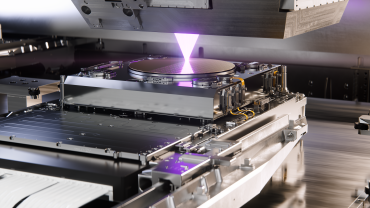
Longer-term, the NXE:3800E platform is the variable that will define ASML’s next growth phase. The tool, priced at €300-400 million per unit, is now in customer hands and progressing through production qualification. Each improvement in source power and throughput shortens the payback window for chipmakers and, in turn, expands the addressable market. ASML’s business model compounds through the full lifecycle of every tool it places: the initial sale, the multi-year service relationship, and the iterative performance upgrades that follow. The 53 per cent gross margin this quarter, at the high end of guidance, reflects that compounding in real time.
The unchanged 51-53 per cent gross-margin guidance for the full year, even at the upper revenue range, implies no material mix dilution. That is a meaningful commitment in a year where High-NA systems, with their greater complexity, are entering the revenue stream in increasing numbers. It suggests that the pricing discipline applied to legacy tools, combined with the upgraded installed-base revenue stream, is holding the margin structure intact.
What the Market Understands
Pre-market trading following the release saw ASML Holding N.V. shares (NASDAQ: ASML) rise approximately 1.7 per cent, a calibrated response that reflected a market already positioned for a solid beat. At valuations near all-time highs, the debate has moved past whether AI represents genuine lithography demand. It now centres on whether ASML can sustain its compounding rate at scale, a materially more interesting question and one this quarter does nothing to undermine.
For policymakers on both sides of the Atlantic who have deployed significant public capital in semiconductor sovereignty initiatives, ASML’s results offer concrete validation. The company’s growth is no longer anchored to any single geography; it tracks the structural expansion of AI compute wherever that build-out occurs. For institutional investors, the quarter reinforces a simpler point: when the equipment supplier at the narrowest point of the advanced-node supply chain can raise guidance under macro uncertainty and geopolitical friction, the underlying demand thesis is not cyclical. It is foundational.
That distinction, between a cycle and a structural shift, is what makes ASML’s first-quarter report worth reading carefully. The results beat. The guidance rose. The margin held. In a sector defined by long lead times and episodic visibility, that combination carries considerable weight.