Ahead of Consensus.
Intelligence across tech and capital markets, for investors, policymakers, and business leaders.
12 minute read
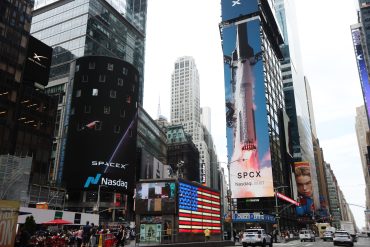
On the morning of June 12, 2026, SpaceX began trading on the Nasdaq Global Select Market under the ticker SPCX, and the market made its position clear without hesitation. Shares opened at $150, an 11 percent premium to the $135 IPO price established the previous evening, surged to an intraday high of $176.52, and closed at $161.95 on volume of approximately 495.9 million shares. The gain from IPO price to close was 19.22 percent. At its intraday peak, SpaceX’s equity value crossed $2 trillion. At the close, it held near $2.1 trillion, placing the company immediately alongside the most valuable enterprises ever listed on a public exchange.
The offering itself had no modern precedent. SpaceX sold 555,555,555 shares of Class A common stock at $135 each, raising $75 billion before any exercise of the underwriters’ greenshoe option covering an additional 83.3 million shares. Retail demand during book-building reportedly exceeded $100 billion against the reserved allocation. That figure is not a measure of retail euphoria. It is a measure of how broadly the investment community has concluded that SpaceX occupies a structural position in the global economy that no other company replicates.
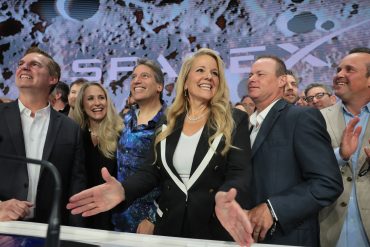
SpaceX was founded in 2002 with an explicit, unhedged mission: reduce the cost of space access enough to make human settlement of other planets viable. What followed was a sustained engineering campaign that progressively dismantled the assumptions on which the incumbent aerospace industry had been built.
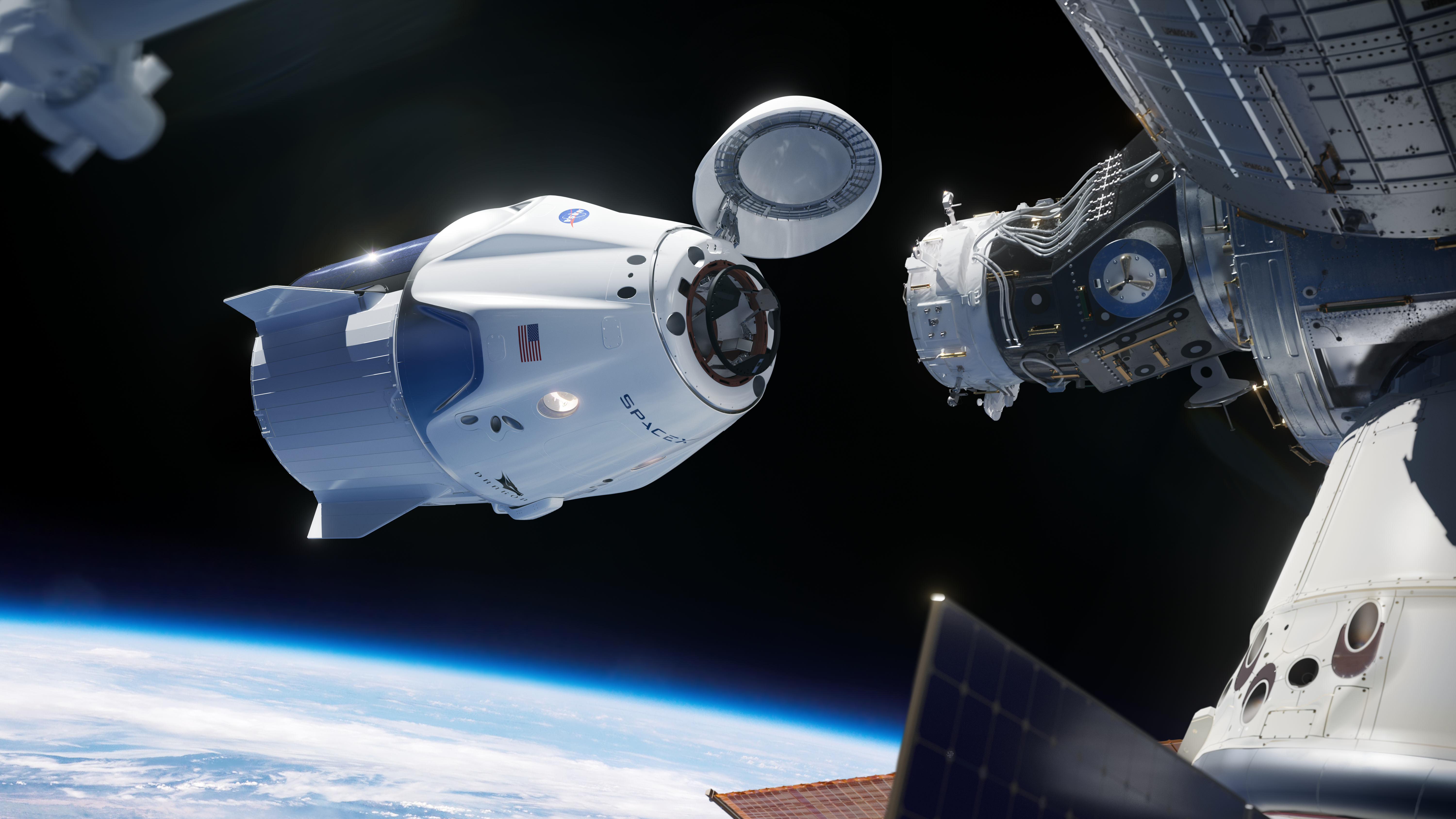
The Falcon 9 program is the foundation of everything that came after. More than 620 launches with a mission success rate above 99 percent, and first-stage boosters reflown as many as 34 times, did not merely prove reusability as a concept. They operationalised it at commercial cadence, compressing launch costs in a way that permanently altered what competitors could charge and what customers would accept. Falcon Heavy extended the heavy-lift capability. Dragon became the first privately developed spacecraft to dock with the International Space Station and, subsequently, to carry crew — achievements that shifted the institutional presumption of who builds and operates the infrastructure of human spaceflight.
The competitive separation those programs created is not primarily technical. It is economic. Lower marginal launch costs gave SpaceX the ability to deploy Starlink at a cadence no rival could match, at a unit cost no rival could approach. That structural advantage did not emerge from a single breakthrough. It compounded across two decades of iterative engineering discipline, and it now underpins the most consequential revenue engine in the company’s portfolio.

By the end of the first quarter of 2026, the Starlink constellation comprised approximately 9,600 active, maneuverable satellites, representing the overwhelming majority of operational satellites in orbit. The network served 10.3 million subscribers across 164 countries and territories. In 2025, the Connectivity segment generated $11.387 billion in revenue, up 49.8 percent year over year, with operating income of $4.423 billion and segment adjusted EBITDA of $7.168 billion.
The scale of those figures warrants direct attention. Starlink is not a promising early-stage connectivity business. It is a global broadband network already generating billions in operating income annually, growing at close to 50 percent, and doing so from a cost base that benefits structurally from the same launch infrastructure that built it. Every incremental satellite deployment costs SpaceX a fraction of what any competitor would pay. That asymmetry does not diminish as the constellation grows; it intensifies, because additional capacity accelerates subscriber acquisition while the marginal cost per satellite delivered to orbit continues to fall.
Consolidated 2025 results showed revenue of $18.674 billion and adjusted EBITDA of $6.584 billion against an operating loss of $2.589 billion. That loss is not a signal of distress. It is the direct consequence of the company funding $3.004 billion in Starship research and development through the Space segment, which generated $4.086 billion in revenue but recorded an operating loss of $657 million. Starlink’s cash generation is, in effect, subsidising the development of the vehicle that will eventually replace the cost structure it was built on. That is not a paradox. It is a deliberate sequencing of capital toward maximum long-run competitive advantage.
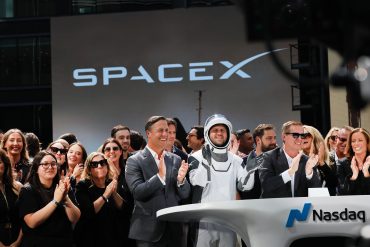
Starship is where the valuation argument either holds or fractures. The vehicle is designed for full reusability with a target payload to low Earth orbit of 100 metric tons in its V3 configuration, a specification that would make it the most capable and economical heavy-lift architecture in history by a wide margin. Eleven flight tests had been completed by early 2026, with a twelfth imminent. Booster catch had been demonstrated. Operational satellite deployment, including the substantially larger V3 Starlink spacecraft engineered to expand throughput and enable direct-to-cell coverage at meaningful scale, was scheduled for the second half of 2026.
The implications of success are layered. V3 Starlink deployment at Starship cadence would accelerate the constellation’s expansion and refresh rate well beyond what Falcon 9 can support, extending the network’s capacity advantage over every competing broadband satellite operator. Beyond Starlink, Starship enables lunar cargo missions, in-orbit refueling, and the crewed Mars architecture that constitutes SpaceX’s founding rationale. The integration of xAI in February 2026, alongside elements of X, introduced a third reporting segment covering AI infrastructure, frontier model development including Grok, and planned orbital compute capabilities. The confluence of those assets, if executed, represents something qualitatively different from any existing technology or infrastructure business.
The risks are proportionate to the ambition. Starship must achieve routine reusability and a sustained high flight rate. FAA and FCC approvals must keep pace with operational plans. Spectrum and orbital-debris frameworks must accommodate rapid constellation expansion. The AI segment must establish genuine commercial traction. None of these are trivial conditions.
A first-day close of $161.10 on a $135 offering is not noise. It is the market’s considered opening estimate of a probability distribution across futures that range from transformative to severely delayed. At 2025 revenue of $18.674 billion, the entry multiple is elevated against any conventional benchmark. Investors are not pricing the business SpaceX is today. They are pricing the business they believe it is structurally positioned to become, and they are assigning that probability with capital at scale.
The peak first-day valuation, combined with Musk’s Tesla holdings, placed his paper wealth at a level that prompted the descriptor of the world’s first trillionaire. That detail will attract commentary, but it is analytically secondary. The primary signal is institutional: the world’s largest asset allocators chose to absorb $75 billion of new equity at a valuation implying that a commercial space economy of genuine planetary scale is not a distant speculation but a financeable near-to-medium-term probability.
For policymakers, that signal carries its own weight. SpaceX’s listing concentrates unprecedented infrastructure leverage, spanning launch access, global communications, and frontier AI development, within a single controlled entity. The dual-class share structure preserves Musk’s voting authority; SpaceX qualifies as a controlled company under Nasdaq rules. Regulatory frameworks governing spectrum allocation, orbital debris, and launch licensing will be tested by the pace of ambition this capital is designed to fund. How those frameworks respond will shape not just SpaceX’s trajectory but the competitive and strategic landscape of space for every nation with interests in it.
June 12, 2026 was a beginning. The valuation assigned was a hypothesis. The quarters ahead, measured by Starship’s operational cadence, Starlink’s subscriber and revenue trajectory as V3 capacity arrives, and the AI segment’s commercial development, will determine whether the hypothesis was disciplined or merely bold. The market has placed its bet. The engineering still has to deliver.