- Quantum & Chips
Nvidia Reports $130.5 Billion Revenue with 114% Annual Growth
5 minute read
Nvidia’s record AI chip profits signal tech industry shift as global demand for artificial intelligence hardware surges
Three Key Facts
- Revenue surge of 114.2% – Nvidia reported $130.5 billion in revenue for fiscal year 2025, up from $60.92 billion the previous year, with net income jumping 144.89% to $72.88 billion.
- Stock price increases nearly tenfold – Nvidia’s shares have surged approximately 900% since ChatGPT’s launch in November 2022, driven by AI infrastructure demand.
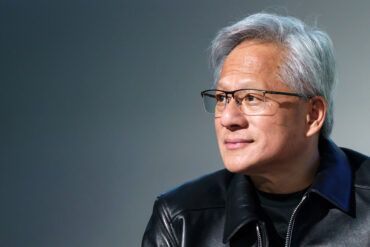
- “Legend in Leadership” award – CEO Jensen Huang receives recognition from tech leaders including Michael Dell, Marc Benioff, and Arvind Krishna for transformative industry impact.
Introduction
Nvidia CEO Jensen Huang demonstrates how strategic pivots can transform entire industries, as his company reports record-breaking financial results that underscore the AI revolution’s commercial impact. The semiconductor giant’s latest fiscal year performance reveals revenue of $130.5 billion, representing a 114.2% increase from the previous year’s $60.92 billion.
Huang’s leadership philosophy directly challenges traditional 1980s management wisdom of “stick with your knitting.” Instead, he has twice fundamentally reshaped Nvidia’s business model to capitalize on emerging technologies, following the example of his mentor Michael Dell.
Key Developments
Nvidia’s transformation began in 1993 when Huang founded the company with a focus on graphics processing units for gaming. The first major strategic shift occurred in 2010 when Huang recognized the broader potential of the company’s CUDA programming platform for deep learning applications.
Eight years later, Huang executed a second pivotal transformation by positioning AI as a force comparable to electricity’s historical impact. This vision led Nvidia to expand beyond gaming hardware into artificial intelligence infrastructure, data centers, and high-performance computing.
The company’s culture emphasizes risk-taking and rapid experimentation through what Huang calls “incremental problem-solving.” His management approach features mass leadership meetings and flat organizational structures that promote open communication across all levels.
Market Impact
Nvidia’s stock price has surged nearly tenfold since ChatGPT’s November 2022 launch, reflecting investor confidence in the company’s AI positioning. The semiconductor sector has experienced significant momentum as Nvidia’s GPUs power AI infrastructure globally, from autonomous vehicles to machine learning applications.
Net income jumped 144.89% to $72.88 billion, demonstrating the company’s ability to convert AI demand into substantial profits. Major partnerships with OpenAI, Microsoft, and other tech giants reinforce Nvidia’s dominant market position in AI hardware.
Analysts view Nvidia’s performance as validation that bold strategic pivots outperform conservative approaches in rapidly evolving technology markets. The company’s financial results contrast sharply with traditional hardware manufacturers that maintained narrow product focus.
Strategic Insights
Huang’s approach reveals how leadership adaptability creates competitive advantages in technology sectors. His willingness to abandon profitable product lines in favor of emerging opportunities enabled Nvidia to capture the AI infrastructure market before competitors.
The company’s strategic acquisitions, including Mellanox Technologies and the attempted purchase of Arm, reflect systematic efforts to expand beyond core GPU manufacturing. This diversification strategy positions Nvidia across multiple high-growth technology segments.
Traditional risk-averse management practices appear increasingly obsolete as Nvidia’s success demonstrates the rewards of embracing technological disruption. Companies that maintain rigid operational focus risk missing transformative market opportunities.
Expert Opinions and Data
Industry leaders consistently praise Huang’s vision and execution capabilities. According to Fortune, Dell, alongside other tech leaders, praised Huang for driving transformative global change during the recent CEO leadership event.
“The future ain’t what it used to be,” reflects the sentiment among industry analysts who view Nvidia’s rise as clear evidence against traditional management conservatism. IBM CEO Arvind Krishna specifically acknowledged Huang’s courage in pivoting away from established profit sources.
Philippe Dumas, EGEC Secretary-General, represents the broader technology leadership community that recognizes AI’s exponential growth potential. The consensus among tech executives emphasizes that current market conditions reward bold strategic moves over incremental improvements.
Conclusion
Nvidia’s record financial performance validates Huang’s leadership philosophy that adaptability trumps operational consistency in technology markets. The company’s transformation from gaming hardware manufacturer to AI infrastructure leader demonstrates how strategic vision creates lasting competitive advantages.
Huang’s recognition by industry peers through the “Legend in Leadership” award reflects broader acknowledgment that his approach represents effective modern business leadership. Nvidia’s dominance in AI infrastructure positions the company to benefit from continued artificial intelligence adoption across industries.