- Big Tech
- Media Industry
- Streaming
Netflix Founder Reed Hastings to Exit Board After 29 Years
14 minute read
The co-founder’s departure from Netflix’s boardroom marks the completion of a years-long succession and the full institutionalisation of one of the most consequential companies in media history.
Key Takeaways
- Hastings will not stand for re-election at Netflix’s June 2026 annual meeting, completing a succession begun in January 2023 and leaving a co-CEO structure under Ted Sarandos and Greg Peters in charge of a company generating more than $50 billion in annual revenue.
- Q1 2026 revenue came in at $12.25 billion at a 32.3 per cent operating margin, with advertising revenue on track to double to roughly $3 billion and free cash flow guidance raised to approximately $12.5 billion, aided in part by a $2.8 billion Warner Bros. break-up fee.
- Hastings leaves a platform operating in more than 190 countries, though his exit coincided with an 8 to 9 per cent after-hours share decline, reflecting investor unease about founder departures even when transitions are well-telegraphed.
The End of the Founder Era
When Netflix published its first-quarter results on April 16, the financial numbers were, by any reasonable standard, strong. Revenue of $12.25 billion, up 16 per cent year-over-year. Operating income of $3.957 billion at a 32.3 per cent margin. Membership growth ahead of forecasts. And yet the market sold the stock down roughly 8 to 9 per cent in after-hours trading. The numbers were not the story.
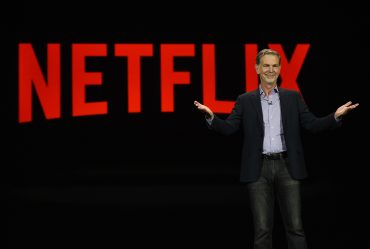
Buried in the governance section of the shareholder letter was the sentence that moved markets: Reed Hastings, co-founder and chairman, had informed the board he would not stand for re-election when his term expires at the June annual meeting. After 29 years, the architect of modern entertainment is leaving the room.
The reaction was reflexive rather than rational, but it was not without meaning. Markets understand something about founder departures that spreadsheets cannot easily quantify. Even when succession is orderly, even when the operating structure is mature, even when the outgoing figure has already stepped back from day-to-day management, the final exit carries weight that no transition memo fully absorbs. Hastings co-founded Netflix in 1997 with Marc Randolph in Scotts Valley, California, as a DVD-by-mail service at a time when the internet ran at dial-up speeds and physical media was still king. What he leaves behind is a platform operating in more than 190 countries and 50 languages, producing content in dozens of them, generating more than $50 billion in annual revenue. The distance between those two points is one of the more remarkable journeys in the history of modern business.
From Red Envelopes to Global Infrastructure
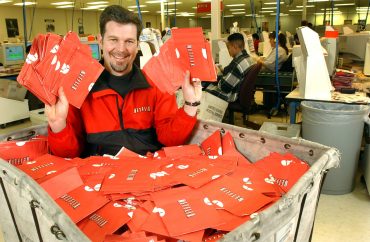
The founding insight was elegant in its simplicity: eliminate late fees, offer unlimited rentals for a flat monthly subscription, and let customers manage their own queues online. By 1999 the subscription model was operational. By 2002 the company had gone public. The near-miss with Blockbuster, which reportedly declined an offer to acquire Netflix for $50 million in 2000, has passed into Silicon Valley mythology, though Randolph has noted that the late-fee anecdote most commonly attributed to Hastings was more marketing than memoir. What mattered was the underlying discipline: a willingness to ride one platform hard and then abandon it before it peaked.
Companies rarely die from moving too fast, and they frequently die from moving too slowly.
The streaming launch in January 2007 was the first genuine pivot. But it was the 2013 decision to commission original programming that defined the company’s second act. House of Cards was a calculated wager on data-driven creative development. It paid off not merely as a hit but as a proof of concept, demonstrating that a technology platform could originate premium content without the institutional DNA of a traditional Hollywood studio. What followed was a decade of global storytelling at a scale no single media company had previously achieved: Stranger Things, The Crown, Bridgerton, Squid Game. That last title, a Korean thriller released in 2021, drew 265 million views and became the platform’s most-watched series ever. Stranger Things’ fourth season exceeded 140 million views; Bridgerton’s fourth season, released in early 2026, already stands at 94 million. These are not simply viewing statistics. They are evidence of something structural: Netflix’s capacity to originate global franchises across languages, cultures, and genres from a single platform, without a studio lot, a legacy library, or a century of accumulated industry relationships.
Maturation Without Stagnation
By the mid-2020s, Netflix faced the pressures common to any dominant platform approaching saturation in its core territories. Subscriber growth in North America and Western Europe had slowed. Content costs were rising. Competitors, belatedly recognising what Netflix had built, had constructed their own streaming services with access to deep libraries and established intellectual property. Netflix’s response was methodical. A crackdown on password sharing, rolled out with more precision than most analysts had expected, drove a new wave of paying subscribers. An ad-supported tier, aggressively priced in key markets, opened the platform to price-sensitive audiences while creating an entirely new revenue stream. Advertising revenue is now projected to double to roughly $3 billion in 2026, and the ad-supported plan accounts for more than 60 per cent of sign-ups in markets where it is available.
The company extended its reach into adjacent verticals. Gaming took a more concrete form in April 2026 with the launch of Netflix Playground, a standalone application for children. Live events, including the World Baseball Classic, which drew 31.4 million viewers in Japan, and BTS concerts, represent an effort to hold real-time attention in a landscape where appointment viewing had otherwise migrated almost entirely to sports and news. These are not core revenue lines yet. They are, more precisely, options on future audience pools that no serious competitor can comfortably ignore.
The most revealing episode of the recent period was Netflix’s decision to walk away from its proposed acquisition of Warner Bros. studios, HBO, and associated assets. Initially announced in December 2025 at an enterprise value of $82.7 billion, the deal was abandoned when a superior bid materialised elsewhere. Netflix collected a $2.8 billion termination fee, resumed share repurchases immediately, and returned to its organic growth strategy. The sequence illustrated a discipline that is rarer than it sounds: the willingness to pursue a transformative transaction, examine it seriously, and then decline to escalate when the numbers no longer justified it. Restraint, in this instance, became a financial asset. The break-up fee lifted full-year free cash flow guidance to approximately $12.5 billion.
The Architecture of Succession
Hastings’ departure did not arrive without preparation. The succession was staged across several years with a clarity of intent that many founder-led companies fail to achieve and most institutional investors never fully witness. In January 2023 he relinquished the co-chief executive title, installing Ted Sarandos and Greg Peters in a co-CEO structure that divided creative and commercial responsibility between two executives who had spent their careers inside the company. In 2025 he transitioned from executive to non-executive chairman, removing himself from operational matters while retaining board-level oversight. The June 2026 annual meeting will complete the sequence. Three years, three deliberate steps, no drama.
The board’s statement was characteristically measured: “Reed built a culture of innovation, integrity and high performance that defines who we are today.” Hastings, in an equally understated response, identified January 2016, the month Netflix went global, as his most significant memory, and suggested his real contribution had been building a culture that others could inherit and improve. Sarandos and Peters described him as a history maker and part of the company’s DNA. The language was warm, the message plain: the institution is ready to stand without its founder. That is a harder thing to engineer than any product launch or balance sheet optimisation, and Netflix appears to have done it cleanly.
What Remains
Full-year 2026 revenue guidance of $50.7 to $51.7 billion, operating margin targeted at 31.5 per cent, and free cash flow of approximately $12.5 billion represent the financial inheritance Hastings is leaving to his successors. The platform itself, its recommendation engine, its global production infrastructure, its first-mover scale in original programming across dozens of languages, constitutes a competitive position that is genuinely difficult to replicate from a standing start.
The challenges ahead are real. The entertainment landscape continues to fragment. Regulatory scrutiny of large technology-adjacent platforms is intensifying across the United States, Europe, and key Asian markets. Generative artificial intelligence is altering the economics of content creation and personalised discovery in ways that are still only partially understood. Netflix, with its data infrastructure and global scale, is better positioned than most to absorb these pressures. But absorbing them will demand exactly the quality of long-term thinking that Hastings spent nearly three decades embedding into the company’s operating culture.
My real contribution at Netflix wasn’t a single decision; it was a focus on member joy, building a culture that others could inherit and improve, and building a company that could be both beloved by members and wildly successful for generations to come.
What he built was not primarily a streaming service. It was a management philosophy rendered operational: the conviction that rigorous measurement and genuine creative ambition are not in conflict, that a company can be analytically disciplined and culturally serious at the same time. Pure Software, his first company, gave him the engineer’s instinct for systems. Netflix gave him 29 years to test the hypothesis at global scale. The verdict is unambiguous.
He leaves the boardroom with a succession structure as clean as any in recent corporate history, a platform that altered how the world watches television, and a philanthropy agenda centred on education reform that will absorb whatever comes next. The market’s after-hours sell-off will likely prove transient. The more durable story is about institutional maturity: a founder who built something disciplined enough, and large enough, to outlast him. That is not a common achievement. It is, in the end, the most demanding one.