- Electric Mobility
- EV
- Luxury Automotive
Ferrari's Luce Signals a Quiet Revolution in Luxury EVs
12 minute read
Ferrari bets its eight-decade legacy on a 1,050-horsepower electric grand tourer, as rivals retreat from the segment and the luxury EV market enters a critical stress test.
Key Takeaways
- Ferrari’s Luce delivers 1,050 cv, a 530-km WLTP range, and 60-plus new patents, with in-house motors and battery systems built at Maranello, signaling a serious long-term commitment to electric propulsion.
- Despite a robust order book stretching to end-2027 and Q1 2026 revenues of €1.848 billion, Ferrari shares fell roughly 3-4 percent on debut day, reflecting investor anxiety over the car’s polarizing design rather than its engineering.
- By pricing the Luce near €550,000 and rationing deliveries tightly, Ferrari is using scarcity and brand equity to navigate a luxury EV market where demand has cooled faster than almost any analyst anticipated.
A Stage Set for History
Rome does not easily yield to spectacle. Yet on the evening of May 25, 2026, Ferrari managed it. Beneath the sweeping concrete arches of the Vela di Calatrava, the company unveiled the Luce, its first series-production electric vehicle, before an audience of clients, collectors and journalists who understood, even in the moment, that something significant had shifted. The venue was not chosen for convenience. A modernist masterpiece of Italian engineering ambition, framed by two millennia of Roman permanence, it was a precise visual argument: that what is ancient and what is new need not be in conflict.
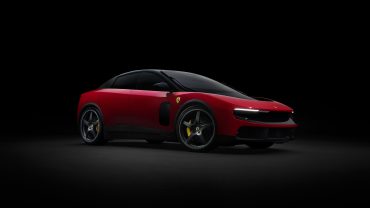
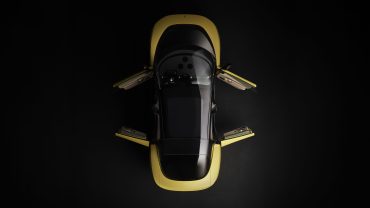
The Luce is a four-door, five-seat liftback. It produces 1,050 cv from four electric motors, one at each wheel. It reaches 100 km/h from rest in 2.5 seconds and exceeds 310 km/h. Its 122 kWh battery operates on an 800-volt architecture and delivers a WLTP range above 530 km. Kerb weight is 2,260 kg; weight distribution is 47:53. These are exceptional numbers. But the Luce is not primarily a numbers story, and Ferrari knows it. The numbers are the floor. The question the company has really set out to answer is altogether harder: whether a silent machine can carry the emotional freight of a brand built entirely on sound, sensation, and speed.
Engineering on Its Own Terms
Ferrari’s technical approach to the Luce reflects the same institutional self-reliance that has defined the company since Enzo Ferrari refused to let suppliers dictate his racing program. The motors, power electronics, and battery integration were all developed at Maranello. The vehicle control unit processes inputs and updates targets 200 times per second. More than 60 patents cover the chassis, the active suspension, the torque-vectoring systems, and a “torque shift” function designed to replicate the progressive power delivery of Ferrari’s finest manual transmissions through corners. Regenerative braking is blended seamlessly with carbon-ceramic discs, preserving pedal feel without compromise.
The 800-volt architecture enables rapid charging. Thermal management, widely regarded as the decisive engineering variable in high-performance electric vehicles, received particular attention. Ferrari engineers also developed a synthetic sound signature derived from real axle and drivetrain vibrations, equalised and amplified into the cabin. This is a careful distinction: not artificial noise layered over silence, but the acoustic residue of actual mechanical forces, shaped into something a driver can feel and interpret. It is the kind of engineering subtlety that separates a marque genuinely serious about the problem from one merely managing perception.
Design as Risk
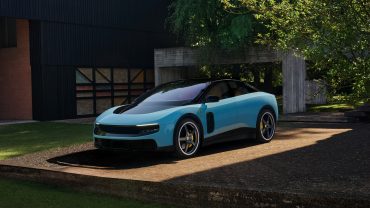
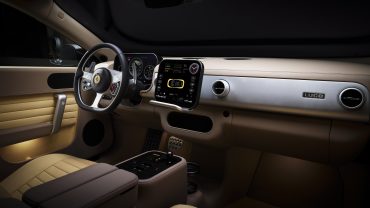
The most contentious aspect of the Luce is the one most immediately visible. Ferrari engaged LoveFrom, the San Francisco-based creative collective led by Sir Jony Ive and Marc Newson, to shape both exterior and interior. The result is a clean, almost monolithic form: a cab-forward silhouette, rear-hinged doors, flush surfaces, and a drag coefficient that Ferrari describes as the lowest in its history. The interior pairs tactile physical controls with E-ink displays, recycled aluminium, and Corning Gorilla Glass in a cabin conceived around human proportion rather than technological demonstration.
The aesthetic is confident. It is also a clear departure from the menacing, low-slung visual grammar Ferrari has cultivated for decades. Social media delivered its verdict within hours, reaching for comparisons that were not flattering. The reaction was not confined to enthusiast forums. Ferrari shares opened lower on May 26 and closed the day down approximately 3 to 4 percent. Analysts were broadly satisfied with the specification; the visual direction drew more cautious commentary. For a brand whose emotional contract with its clients is as much visual as mechanical, this was a meaningful signal, even if it reflected the discomfort of the unfamiliar rather than a genuine commercial failing.
Chairman John Elkann’s relationship with Ive and Newson is longstanding. The collaboration was years in development. Ferrari Design under Flavio Manzoni retained final authority. The decision to bring in an external perspective was deliberate, not expedient, intended to inject a design vocabulary that combustion-era thinking could not produce. Whether the market agrees with that reasoning will be answered not in comment sections but in order books, and those, by Ferrari’s own account, are already full through the end of 2027.
The Financial Architecture
Ferrari announced the Luce from a position of demonstrable financial health. First-quarter 2026 net revenues reached €1.848 billion, up 3 percent year-on-year, with an EBITDA margin of 39.1 percent. Full-year guidance was maintained despite currency pressure and tariff uncertainty. The order book remains over-subscribed across the range. Pricing for the Luce has not been formally disclosed, but market estimates converge around €550,000 before options, placing it squarely alongside the company’s halo models. Production will begin in Ferrari’s new dedicated E-Building at Maranello later this year, with customer deliveries beginning in the fourth quarter of 2026 and continuing into 2027.
The pricing and allocation strategy is not incidental. It is the core of Ferrari’s commercial logic. By keeping supply below demand, the company preserves residual values, protects exclusivity, and insulates itself from the demand volatility that has destabilised rivals offering electric vehicles at scale. This is not a volume play. It is a deliberate extension of a model that has worked with remarkable consistency: build less than the market wants, charge more than the market expects, and let the brand do the rest.
The Test That Remains
The luxury EV market has, by any honest assessment, underperformed its earlier projections. Battery costs have declined more slowly than anticipated. Charging infrastructure remains uneven in precisely the markets where Ferrari’s clients travel most. The emotional argument for electric vehicles at the highest price points is still being negotiated between manufacturers and buyers. Several European premium manufacturers have quietly retreated from ambitious electrification timelines, absorbing the reputational cost rather than the financial one.
Ferrari’s position differs in one structural respect: it is not abandoning combustion. Its stated multi-energy strategy preserves internal combustion, hybrid, and electric in parallel, giving clients and regulators alike what they need without forcing a binary choice on the brand. The Luce expands the addressable market. A five-seat grand tourer with a practical hatchback appeals to buyers who admire Ferrari without previously having a place for it in their lives.
CEO Benedetto Vigna framed the launch plainly: “We are convinced that a company demonstrates its leadership when it has the courage to dare and to take on the challenge of new technologies.” That framing is appropriate. Leadership, in this context, means accepting that the proof of the Luce’s success will arrive slowly, in the form of client testimony, secondary market pricing, and the quiet multiplication of pre-orders that Ferrari has never once publicly needed to chase. The Prancing Horse has always moved on its own terms. The Luce is no different.