- Aerospace
- Aviation Markets
- Earnings Report
- Industrial Stocks
Boeing’s Third Quarter: Defense Pays the Bills While the 737 Waits
9 minute read
A record $745 billion backlog and better-than-expected cash flow mask a commercial unit losing ground. Boeing’s value now depends on how fast it can build airplanes, not sell them.
Key Takeaways
- Revenue rose 4% to $24.19 billion and free cash flow of $464 million beat forecasts, but a core loss of $0.34 a share missed consensus as Commercial Airplanes fell deeper into the red.
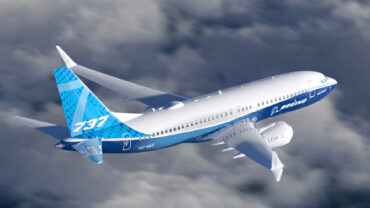
- The jetliner unit’s margin slid to negative 6.5% from negative 2.7% in the second quarter. Its 124 deliveries of the 737 imply a monthly pace near 41, still short of the 47 target.
- Defense revenue climbed 15%, and the F/A-XX award hands Boeing both crewed sixth-generation fighter programs, though a $252 million asset sale gain inflated the segment’s 6.2% margin.
The Shape of the Quarter
Boeing’s third quarter reads as the results of two companies sharing one balance sheet. The first builds fighters, tankers and missile seekers and maintains the aircraft of airlines and armed forces around the world. It is growing and earning money. The second builds commercial jetliners and is still losing money, more of it in the three months to September than in the three months before.
Group revenue rose 4% to $24.19 billion. The net loss narrowed to $116 million, or $0.26 a share, from $5.34 billion a year earlier. The core loss, which excludes certain pension costs, came to $0.34 a share. Backlog climbed to a record $745.4 billion.
Most of the year-over-year improvement comes from a weak comparison. The third quarter of 2025 absorbed a 777X charge of nearly $5 billion that drove the commercial division to a negative 48.3% margin. The more telling signal is the sequential trend. Commercial Airplanes posted a negative 2.7% margin in the second quarter and a negative 6.5% margin in the third. Over the same quarter, Defense, Space & Security and Global Services together earned $1.51 billion. Chief executive Kelly Ortberg pointed to aircraft certifications and the Navy fighter award as evidence of progress, then added the sentence that set the tone of the release: “But we are not done.”
A Production Line Short of Its Target
Commercial revenue fell 3% to $10.72 billion. Deliveries reached 161, one more than a year earlier but ten fewer than in the second quarter. The 737 accounted for 124 of those aircraft, down from 129. That works out to roughly 41 a month against a planned rate of 47, and Boeing described the program as still moving toward stable output at that level. Reuters reported that the company had hoped to get there over the summer, and that Ortberg named wing production as the bottleneck at an industry conference in September. Elsewhere, the 787 held at eight a month with 22 deliveries. Deliveries of the 777 fell to five from nine as the program gives way to the 777X, which remains scheduled for first delivery in 2027.
The causes Boeing gave for the commercial loss say more than the loss itself. It cited a less favorable delivery mix, higher estimated supply chain costs and higher projected costs tied to future production rate adjustments. That last item means the company is already recording the expense of rate increases it has not yet made. Among them is the step to 52 a month that the new 737 North Line in Everett is designed to support.
The regulatory news was better. The 737-7 won amended type certification from the Federal Aviation Administration during the quarter, and the 737-10 followed in October. That ends years of delay on two variants that make up a substantial share of the narrowbody order book.
Defense Recovers, With Help
Defense, Space & Security grew revenue 15% to $7.94 billion and earned $492 million. That is a 6.2% margin, against 1.7% a year earlier and a modest loss in the second quarter, when the VC-25B presidential aircraft program cost $280 million. The improvement is real but smaller than it looks. The quarter included a $252 million gain from the sale of HRL Laboratories. Excluding it, the segment earned about $240 million, a margin close to 3%. The unit has spent several years absorbing overruns on fixed-price development contracts, so that is a credible step forward. It is not yet the performance its new commitments will demand.
Those commitments grew materially in the quarter. On September 29 the U.S. Navy selected Boeing to design, build and deliver the F/A-XX, its sixth-generation carrier-based fighter. The Air Force had already chosen Boeing for the F-47 in 2025, so the company now holds both crewed sixth-generation fighter programs in the American inventory. Bank of America analyst Ronald Epstein summed up the position before the results, writing that Boeing “now holds the keys to the future of U.S. tactical aircraft.”
The Navy award sits outside backlog until the source selection review is complete. Defense backlog still reached a record $101 billion, helped by a seven-year contract to expand PAC-3 seeker production. Quarterly capital spending rose to $1.03 billion as Boeing invested in its Charleston and St. Louis sites.
What the Cash Flow Conceals
Operating cash flow was $1.50 billion and free cash flow $464 million, comfortably ahead of a Bloomberg consensus near $325 million. Boeing reached that despite roughly $0.7 billion in Department of Justice settlement payments. Global Services again did its quiet work, contributing revenue of $5.57 billion at an 18.3% margin. Yet free cash flow for the first nine months remains negative at $359 million. In July, management reaffirmed a full-year range of $1 billion to $3 billion. If it holds to that, the fourth quarter alone must generate between about $1.4 billion and $3.4 billion.
Where the cash comes from matters as much as how much there is. Over nine months, advances and progress billings added $8.1 billion to operating cash, while inventories absorbed $6.7 billion. In practice, customers are funding the aircraft piling up on Boeing’s books. That is ordinary for a manufacturer with more than 6,300 commercial jets on order. But it ties the quality of cash flow to delivery tempo, since deposits become revenue only when finished aircraft leave the factory.
The balance sheet gives Boeing time. Cash and marketable securities totaled $20.7 billion against debt of $45.9 billion, which is down from $54.1 billion at the end of 2025. A $10 billion credit facility remains undrawn.
A Market That Had Already Priced the Gap
Whether the quarter beat or missed depended on which consensus one used. Against LSEG estimates, revenue exceeded the $23.84 billion forecast, while the core loss was wider than the $0.21 expected. FactSet’s consensus had pointed to a $0.25 loss. The shares rose close to 1% before the open, a muted response given that options traders had positioned for a move of nearly 6% in either direction.
The stock entered the report at $188.31, closer to its 52-week low of $176.77 than to its high of $254.35. It had fallen almost 7% on September 28, when the FAA held back the 737-10. By the time the numbers arrived, investors had largely priced in the commercial weakness and were looking for evidence on cash.
The investment case now rests on one variable: how fast Boeing can build airplanes. “Expectations are rising, and they should,” Ortberg wrote to employees after the release. Demand is not the problem. The commercial unit booked 300 net orders in the quarter, from carriers including Turkish Airlines, Ethiopian Airlines and Lufthansa. The limits are wing assembly, a supplier base still recovering, and the discipline to raise output without a repeat of the quality lapses of 2024. The fourth quarter will show whether newly certified aircraft, a larger defense franchise and a patient balance sheet can produce the cash the share price already assumes.