
Ahead of Consensus.
Intelligence across tech and capital markets, for investors, policymakers, and business leaders.
15 minute read
The rise of prediction markets can be seen through a bunch of different lenses. There’s the public perception, with platforms like Kalshi and Polymarket muscling into the headlines with increasing alacrity. Then there’s the hard numbers — of how much is being wagered on the platforms themselves, and by how many people.
In early 2025, monthly prediction-market volume on crypto rails sat at about $1.2 billion. By January 2026, it had climbed to more than $20 billion, with more than 800,000 unique wallets now using these markets each month, according to TRM Labs. What had once looked like a niche pastime for election obsessives and crypto traders had become something far larger: part exchange, part sportsbook, part media product, and part internet spectacle.
Just days before this piece went to press, Kalshi raised $1 billion in a funding round led by Coatue Management, with participation from Sequoia Capital, Andreessen Horowitz, IVP, Paradigm, Morgan Stanley and ARK Invest — valuing the company at $22 billion, double its valuation from five months earlier.
The speed of prediction markets’ rise in popularity also explains why the sector is now being dragged into a much harder regulatory fight. The larger prediction markets have become, the less plausible it is to treat them as a quirky experiment in information aggregation. They’re attracting court fights, state bans, federal lawsuits, congressional scrutiny and concerns from sports leagues about their integrity. “They’re in a weird time where they’re growing under regulatory uncertainty,” says John Holden, associate professor in the Department of Business Law and Ethics at Indiana University’s Kelley School of Business.
It’s not all bad news, though. Alongside all the attention from regulators, they’re increasingly making mainstream commercial partnerships that bring them big cash — one of the latest being a deal that sees Kalshi data being shown on Fox News. “It feels like it was not a thing, not a thing, and not a thing — then all of a sudden, it just exploded,” says Karl Lockhart, assistant professor of law at DePaul University.
It can be hard to remember, but in little more than a year, prediction markets have gone from a curiosity to a mainstream cultural phenomenon — and alongside that, a governance problem.
Supporters say platforms such as Kalshi, Polymarket and, in a slightly different way, Robinhood, are simply better forecasting tools — a way of turning dispersed information into a live probability. But their critics look at the same products and see something much more familiar: gambling, repackaged as finance, liquidity and truth-seeking. Which of those two definitions regulators decide prediction markets actually fall into could dictate their future.
Markets for forecasting future events have been around for decades, whether as academic projects, internal corporate information markets or offshore exchanges. Holden says the US arrived at the current moment “fairly rapidly”, even though versions of these markets had existed in Europe and the UK for years and private companies had long used internal markets for product decision-making. What’s new about prediction markets is they’ve suddenly been pushed into the consumer mainstream.
And that muscling into the mainstream has happened in stages, but started with politics. In the US, election markets helped drag the category into the public perception, particularly after Kalshi won a court fight over whether Americans could trade on the 2024 presidential election. Then came sport, which turned a niche product into a mass-market one.
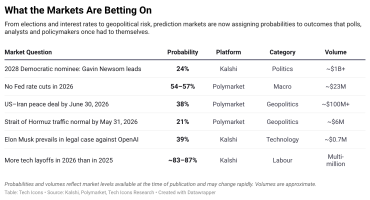
Dustin Gouker, a longtime gambling-industry analyst, says prediction markets were “very small” in the US until the election moment, before “really” blowing up in early 2025 when sports contracts arrived on regulated platforms. He estimates that roughly 85% of activity on regulated US prediction markets has been tied to sports and sports-event parlays.
The adoption of prediction markets into sports was what really changed the game for the industry. Americans were already used to betting on games; they just hadn’t previously done so through a federally regulated event-contract venue. “People like to bet on sports,” says Gouker. “That’s not a shock.” And because sports betting in the US still operates on a patchwork state-by-state basis, event contracts also appeared to open access in places where conventional sportsbooks were not legal.
Robinhood helped make that shift feel normal. In March 2025, the trading app launched a prediction markets hub inside its platform, allowing customers to trade on event outcomes such as interest-rate decisions and college basketball. A month earlier it had already shown how unstable the category still was, after rolling back Super Bowl contracts at the Commodity Futures Trading Commission’s (CFTC) request.
Simultaneously Polymarket became famous for putting prices on everything from elections to wars to the papal succession. That made it culturally resonant to the United States, where Gouker notes the international site remained widely used via crypto rails and VPNs even when it was not formally available to Americans.
The sector still benefits from its success in the 2024 US election. Many public polls suggested a coin-flip contest between Kamala Harris and Donald Trump, whereas prediction markets priced Trump as the likelier winner. When he won, prediction-market advocates took a victory lap, arguing that markets had proved a better tool than traditional polling. Gouker says that success then helped the category seep into broader culture, from papal succession markets to trades on the New York City mayoral race and federal government shutdowns. Once people could put a probability on an outcome, he says, it became interesting in its own right.
But whether something is interesting and something is integral to the way we live are two different questions. Holden says prediction market operators have long argued giving access to retail investors increases both demand and utility, but he is not convinced the utility case has been demonstrated in practice. “Are these more than a novelty?” he asks. “Are these platforms able to translate this utility that they purport to have? Can they show that this is useful to people as some sort of forecasting tool?” Right now, he adds, many of the stories around the sector concern suspected insiders “front running these major events and making hundreds of thousands of dollars”, which is far from the sort of use case that inspires trust and brings in more users.
That problem has become especially clear in recent months as platforms have pushed markets linked to war and political violence. Last month, scrutiny of bets tied to possible strikes on Iran and the fate of Ayatollah Ali Khamenei suggested some traders with privileged knowledge could profit from military developments.
Lawmakers were particularly alarmed by the possibility that people close to sensitive government information could effectively monetise it. California has since barred state officials from using insider knowledge to bet on prediction markets, while Democratic lawmakers have introduced legislation aimed at curbing contracts tied to military operations and other sensitive state actions.
Those recent bets, which have seen some people make significant sums — nearly $530 million was bet on Iranian markets alone on Polymarket — are raising suspicions. The very thing that makes prediction markets seem efficient, their sensitivity to new information, also makes them vulnerable to abuse when that information is not public. In a normal financial market, insider trading rules are a core part of the architecture that ensures things don’t go awry. But that’s not necessarily the case in prediction markets. “What we’ve seen implies government officials or employees are trading on information that they’re supposed to be keeping confidential,” says Lockhart.
While people are focused on the political and military betting, sports is where regulators are starting to chop down on prediction markets. Because so much recent growth has come from sports event contracts, regulators and state gambling authorities have increasingly asked why these products should be treated differently from conventional sportsbooks.
What we’ve seen implies government officials or employees are trading on information that they’re supposed to be keeping confidential.
Holden says the controversy stems in large part from the fact that they look extremely similar to what someone might do on FanDuel or DraftKings, except without the same taxes, licensing regimes or sports-specific compliance frameworks. That resemblance has been the spark for a growing legal war over whether these markets are really derivatives under federal law or simply gambling by another name.
That war is fully under way. Earlier this month, a court ruled that New Jersey could not block Kalshi’s sports-event contracts because the CFTC has exclusive authority over such products. But just days earlier, a Nevada judge extended a ban preventing Kalshi from operating in the state without a gaming licence, accepting the argument that its contracts amounted to gambling under Nevada law. Kalshi has now faced parallel disputes across multiple states, while the CFTC has itself sued several states to stop them interfering with federally regulated event contracts.
“We’re on the collision course to the Supreme Court,” says Holden, arguing that the growing split between courts and states makes it increasingly likely that America’s highest court will eventually have to decide where federal financial regulation ends and state gambling authority begins. Holden is careful not to predict how such a case would turn out. But he says the question matters, because sports betting has historically been regulated at state level, while event contracts are usually judged through the federal derivatives framework. And that Supreme Court decision is “ultimately what’s going to decide the status of these markets,” reckons Lockhart.
For its part, the CFTC has stopped pretending this can be handled case by case. In January, the agency said it would draft new regulations for event contracts rather than try to ban them outright. In March, it opened an advance notice of proposed rulemaking on prediction markets, with public comments due by the end of April, and on the same day it issued a staff advisory setting out how exchanges should think about surveillance, market integrity and event-contract risks.
The Van Dyke case made that risk concrete. Master Sgt. Gannon Ken Van Dyke, a U.S. Army Special Forces communications specialist, has been charged with using classified information from the January 2026 operation to capture Nicolás Maduro to place a series of wagers on Polymarket, generating more than $400,000 in profits. Prosecutors allege that Van Dyke, who was directly involved in planning the mission, used non-public operational details to position his trades in advance, routing activity through anonymising tools before attempting to obscure the proceeds. He has pleaded not guilty and was released on bond. It is the first case of its kind involving a prediction market, and it has given regulators something they previously lacked: a concrete example of privileged information being monetised on a platform that, until recently, operated largely outside traditional enforcement frameworks.
Congress and the White House have since moved to draw clearer lines. On April 30, the U.S. Senate unanimously approved a resolution prohibiting senators, officers and staff from participating in prediction markets, taking immediate effect. The measure was led by Sen. Bernie Moreno with a broadening amendment from Sen. Alex Padilla, and passed amid heightened concern over the potential misuse of nonpublic information by those with access to sensitive government deliberations. Weeks earlier, the White House had issued a staff-wide memorandum reminding employees that using confidential information for personal financial gain on platforms such as Polymarket and Kalshi constitutes a serious ethics violation — sent, pointedly, amid unusual market activity tied to Iran-related developments.
Together, those actions represent something the sector had not previously faced: coordinated institutional pressure from both ends of Pennsylvania Avenue. Full legislative bans on insider participation remain under discussion, but the Senate’s rule change and White House guidance have established a new baseline — one that reflects how seriously Washington now takes the capacity of these platforms to move on information that was never meant to be public.
Some of that framework is already being shaped by sport. The CFTC’s March advisory specifically flagged heightened risks of manipulation and insider information being used in sports event contracts. Everything from injury news and officiating decisions to access to non-public data could be at risk from sports starts. Soon after, Kalshi said it would block politicians and athletes from trading in their own markets. But it’s not all bad news for the sports industry: Major League Baseball has signed a multi-year partnership with Polymarket, coupled with integrity provisions and a memorandum of understanding between MLB and the CFTC on information-sharing.
All of those are signs of an industry being normalised, albeit under pressure. And beyond being a place to bet, they’re also rebranding as information providers — where journalists, viewers and investors go to see what ‘the market’ thinks is likely. “The prediction markets evangelist will tell you this is good for society, that it helps us price reality, that it helps us interpret the news,” says Gouker.
That may prove to be their strongest strategic position for the future of prediction markets. But it also invites further scrutiny: the more their probabilities are presented as objective signals, the more important it becomes to ask who is trading, what information they have, what safeguards exist, and whether the market is liquid enough to mean much.
One thing’s for sure, though: prediction markets aren’t going away. “It’s hard to believe that the genie goes back in the bottle,” says Gouker. He argues that what happened in the US was less the result of a serious public-policy debate than of “regulatory arbitrage” and self-certification. Event contracts were allowed to proliferate before policymakers had really decided what they thought about them. Under the Biden administration, where company owners were being investigated, he suggests, much of this would never have happened in the same way. “The change in presidential administrations in the US is what enabled this to happen,” agrees Lockhart.
Prediction markets exploded because several trends collided at once: public distrust of polling, the normalisation of online sports betting, the retail-finance boom, crypto’s growth, and regulators’ willingness — or inability — to let event contracts spread faster than the rules around them.
Prediction markets offer something older institutions have often struggled to provide: a live, legible estimate of what could happen next. That is also why they’re firmly in regulators’ crosshairs. At their best prediction markets can aggregate truth — but they can also reward rumour, privilege speed over care, and turn war, elections and sport into tradeable entertainment.
However despite all their foibles, prediction markets have ensconced themselves into our society, and they’re not moving. “It’s all going to stay,” says Gouker. “It’s just a matter of how big it gets.”


