- AI & Regulation
- AI Compute
- AI Policy
Trump Halts AI Oversight Order to Protect U.S. Lead
8 minute read
The White House pulled a voluntary AI review framework at the last minute, signaling that Washington will pursue technological supremacy over pre-market safety checks.
Key Takeaways
- President Trump canceled a planned executive order that would have established voluntary pre-release federal review of frontier AI models, citing concern that even light oversight could hinder America’s competitive edge over China.
- The decision is consistent with a broader deregulatory posture toward AI established since January 2025, prioritizing speed and innovation while shifting responsibility for risk management squarely onto private developers.
- Capital markets registered quiet approval, with tech indices steady or higher after the cancellation, reflecting investor confidence that Washington will continue to treat AI development as a strategic national asset rather than a regulated industry.
A Ceremony That Never Happened
On the morning of May 21, some of the most powerful executives in American technology were already airborne. Their destination was the Oval Office, where President Donald J. Trump was scheduled to sign an executive order establishing a voluntary framework under which developers of the most advanced AI systems would submit their models to federal agencies for pre-release review. The focus was to be national security and cybersecurity risk. Hours before the ceremony, it was canceled.
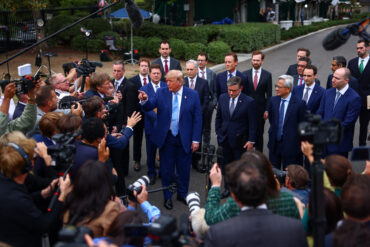
Trump told reporters he had postponed the signing because he “didn’t like certain aspects of it,” adding that the measure risked getting “in the way” of America’s commanding lead in the technology. “We’re leading China, we’re leading everybody,” he said, “and I don’t want to do anything that’s going to get in the way of that lead.”
The bluntness was characteristic. The substance was clarifying. In a single decision, the administration had drawn a sharp line: even a voluntary oversight mechanism, framed as prudent risk management, was too much friction for a White House that views artificial intelligence as the defining strategic competition of this era.
The Deregulatory Architecture
The cancellation did not emerge from a vacuum. Since taking office, the Trump administration has moved with deliberate intent to dismantle what it characterized as the regulatory drag left by its predecessor. On January 23, 2025, the president signed Executive Order 14179, “Removing Barriers to American Leadership in Artificial Intelligence,” which revoked key provisions of President Biden’s October 2023 directive and called for a comprehensive review of any policies deemed to constrain innovation.
A second structural measure followed on December 11, 2025, establishing a policy of federal preemption over state-level AI regulations, creating a litigation task force to challenge conflicting rules, and enshrining a preference for a minimally burdensome national framework. The architecture was coherent and purposeful: clear the field, eliminate friction, and let the private sector move.
Against that background, the proposed pre-release review mechanism represented a modest but symbolically significant departure. It would have formalized engagement between government agencies, notably the Department of Commerce and the National Institute of Standards and Technology, and AI developers before public deployment. Senior advisers, including David Sacks in his role as the administration’s technology policy voice, reportedly urged caution on the morning of the planned signing. The result was a last-minute reversal that left the policy process in limbo and the executives who had flown to Washington turning back without a ceremony.
Market Signals and Strategic Logic
Capital markets offered a quiet endorsement of the administration’s posture. Tech indices held steady or edged higher in the immediate aftermath of the cancellation, reflecting investor relief that a potential regulatory overhang had been lifted. Shares of companies central to the AI supply chain, including Nvidia and Microsoft, showed no distress. The message to investors was continuity: Washington will let the technology race forward rather than interrupt it for review.
That posture has a coherent strategic logic. Frontier AI development is moving at a pace that compressed timelines barely capture. OpenAI’s iterative releases of reasoning-focused models, Google’s continued scaling of Gemini, and Anthropic’s successive capability advances have all arrived in cycles that would be difficult to reconcile with any formal pre-approval window. Mandatory or semi-mandatory review mechanisms, however narrowly drawn, carry the risk of introducing delays at precisely the moment when competitive advantage is being established.
The administration has instead directed its national security instincts toward export controls, talent attraction, and compute dominance. Physical infrastructure supporting the AI buildout has benefited from parallel deregulatory efforts, including streamlined permitting for energy projects and favorable federal land use. Capital expenditure guidance from leading hyperscalers remains elevated, with several firms explicitly citing policy predictability as a tailwind.
The Responsibility That Remains
The decision carries genuine weight for the private sector. Frontier AI systems are no longer confined to research environments; they are embedded in defense planning, financial markets, and critical infrastructure. Without structured federal evaluation, the responsibility for identifying vulnerabilities in model behavior, training data, or emergent capabilities falls entirely on the developers themselves. That is a substantial burden, and not every organization carries it equally.
China, despite trailing on raw compute power and talent concentration, has demonstrated the capacity to accelerate with state-directed focus once it identifies priorities. A hands-off American posture may yield faster breakthroughs, but it also narrows the margin for error.
What Washington Has Decided
The episode leaves several questions open. A revised framework may yet emerge, narrower in scope and more carefully constructed to avoid the perception of regulatory interference. Or the administration may have signaled that even well-intentioned mechanisms are off the table if they carry any risk of slowing the industry.
What is not in question is the administration’s hierarchy of priorities. National security, in this White House, is pursued through dominance rather than gatekeeping. The May 21 cancellation was not an accident or an oversight; it was a policy statement delivered without a podium. For senior investors, executives, and policymakers tracking the trajectory of American AI governance, that statement deserves to be read carefully.