- Geopolitics
- Technology Diplomacy
- UK-China Relations
Starmer’s Beijing Trip Marks a Quiet Shift in Britain’s China Policy
12 minute read
Britain’s first prime ministerial visit to China in eight years yields $15 billion pharmaceutical investment, signaling strategic shift toward pragmatic engagement in life sciences and emerging technologies.
Key Takeaways
- AstraZeneca’s commitment of $15 billion through 2030 represents the visit’s centerpiece, focusing on oncology and respiratory research while reinforcing China’s position as a critical node in global pharmaceutical supply chains.
- The dialogue prioritized less contentious technology sectors including life sciences, climate science, and quantum research, enabling collaboration while sidestepping sensitive areas like semiconductors and electric vehicles.
- Market response proved measured yet positive, with AstraZeneca shares rising 2.8% and the FTSE 100 gaining 0.5%, reflecting investor confidence in selective engagement strategies amid broader geopolitical uncertainty.
Strategic Recalibration
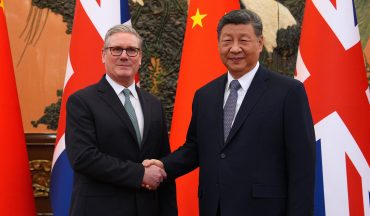
Keir Starmer’s arrival in Beijing on January 28 marked the first visit by a British prime minister to China since 2018, ending an eight-year hiatus. Leading a delegation of nearly 60 business and cultural leaders across four days, Starmer pursued what his administration termed a “consistent, pragmatic partnership” grounded in economic necessity rather than ideological alignment.
The visit’s significance extends beyond trade statistics. At its core, this engagement represents a technology recalibration between two nations navigating radically different positions than they occupied in 2018. China’s ascent as a “technology superpower” has fundamentally altered the bilateral dynamic. Chinese leadership in artificial intelligence, quantum computing, and pharmaceutical innovation has transformed potential collaboration from technology recipient to genuine partner, or in some domains, frontrunner.
Starmer’s meetings with President Xi Jinping and Premier Li Qiang centered on investment frameworks in emerging technologies, supply chain resilience, and cooperation where British innovation intersects with Chinese scale and deployment speed.
The Life Sciences Technology Play
The pharmaceutical sector emerged as the visit’s commercial centerpiece. AstraZeneca’s pledge of $15 billion through 2030 for expanded manufacturing and research in oncology, cardiovascular, and respiratory therapies targets China’s sophisticated pharmaceutical technology ecosystem, which has evolved dramatically since 2018.
For AstraZeneca, China generates 20% of revenue, but the strategic value extends further. China’s capabilities in high-throughput screening technologies, advanced bioprocessing, and regulatory science now rival Western markets. Investments in genomics research, precision medicine platforms, and AI applications in drug discovery have created infrastructure that pharmaceutical companies increasingly view as essential.
The commitment reflects calculated positioning around specific technology advantages. China’s investments in digital health infrastructure and real-world evidence platforms enable data collection and analysis at speeds Western regulatory frameworks struggle to match. Electronic health records integration, mobile health monitoring, and AI-powered diagnostic tools create research environments that can accelerate development timelines by months or years.
Britain’s Life Sciences Sector Plan targets 60% of technology appraisals published within 240 days by 2025/26. Achieving these timelines requires access to technology platforms and patient data at scale. Chinese institutions offer both, provided appropriate data governance frameworks can be negotiated. The collaboration extends to manufacturing technologies, with China’s advances in continuous bioprocessing and automated quality control offering efficiency gains traditional methods cannot match.

Quantum, AI, and Climate Technology Frontiers
Beyond pharmaceuticals, the agenda explored quantum science, artificial intelligence, and climate technology with notable specificity. Britain’s commitment of £22.6 billion in research and development funding through 2029/30 positions the government to pursue ambitious technology partnerships.
Quantum technologies emerged as a priority. Britain’s expertise in quantum sensing, communications, and early-stage computing could complement China’s manufacturing capabilities and deployment at scale. China has demonstrated quantum satellite communications and invested heavily in quantum computing infrastructure, areas where British theoretical advances could benefit from Chinese engineering prowess. The challenge lies in defining collaboration boundaries that enable joint progress without creating dependencies in technologies with national security applications.
AI discussions centered on deployment rather than foundational research. Britain’s January 2025 blueprint to accelerate AI deployment creates opportunities for learning from China’s experience integrating AI into industrial processes, urban systems, and public services. Chinese capabilities in computer vision, natural language processing, and resource-constrained AI systems offer practical insights.
However, conversations notably avoided AI chip technologies, foundational models with dual-use applications, and autonomous systems with military implications. This selectivity reflects recognition that AI collaboration must navigate trust deficits around data governance, surveillance technologies, and military-civil fusion dynamics.
Climate technology offered perhaps the most promising pathway. China’s Ministry of Foreign Affairs emphasized digital economy applications in climate science and clean energy, showcased at the 2025 China International Import Expo featuring AI in smart meteorology and environmental monitoring. Britain’s strengths in climate modeling, offshore wind, and carbon capture could integrate with China’s manufacturing scale in solar panels, battery storage, and electric grid management.
Discussions addressed mutual recognition of professional qualifications in engineering and technology fields, facilitating talent exchange. This mirrors Britain’s quantum collaboration with Japan initiated in March 2025, establishing frameworks for researcher mobility without compromising intellectual property protections.
Technology Dependencies
The absence of accords in electric vehicles or advanced manufacturing reveals cooperation limits. British concerns extend beyond market displacement to fundamental questions about technology dependencies. China’s dominance in battery technologies, rare earth processing, and EV supply chains creates vulnerabilities policymakers view with unease.
The £187 million TechFirst skills package announced at London Tech Week 2025 aims to bolster domestic technology capabilities while engaging abroad, targeting shortages in semiconductor design, AI engineering, and advanced manufacturing. This dual approach reflects recognition that technology sovereignty requires both domestic investment and strategic international relationships.
Huawei’s 2025 AI chip advancements despite U.S. sanctions demonstrate capabilities that complicate Western assumptions about technology leadership. These developments inform British calculations about where collaboration creates value versus where it risks creating dependencies constraining future policy options.
Market Response
Financial markets registered cautious approval with sector-specific nuances. AstraZeneca shares climbed 2.8%, reflecting confidence in pharmaceutical technology collaboration. The FTSE 100’s 0.5% advance masked divergent movements, with technology-exposed companies facing skeptical assessments about regulatory risks.
Analysts at Chatham House warned of China’s “invisible leverage” in technology dependencies extending beyond semiconductors to rare earth processing for quantum sensors, specialized chemicals for pharmaceutical manufacturing, and renewable energy components. These dependencies shape feasible collaboration boundaries.
Converting agreements into operational reality requires navigating friction points in technology governance. Britain’s strategic reviews identify China as presenting challenges in technology proliferation, cyber operations, and intellectual property protection. Recent cybersecurity advisories underscore vulnerabilities that could complicate integration in sectors involving sensitive data or dual-use technologies.
Forward Trajectory
Starmer’s engagement represents a studied attempt at technology sector equilibrium, seeking access to Chinese capabilities without compromising strategic autonomy. By concentrating on life sciences, climate technology, and selective quantum science and AI areas, Britain positions itself to benefit from collaboration while maintaining restrictions on semiconductors, telecommunications infrastructure, and technologies with national security implications.
For technology companies and investors, the visit signals pragmatic engagement remains viable in specific domains. The pharmaceutical technology sector’s prominence suggests industries with established operations, clear commercial logic, and manageable security externalities can expect government support. Conversely, sectors touching sensitive technologies face ongoing scrutiny and potential restrictions.
Success depends on disciplined execution with realistic expectations. The coming months will reveal whether this reset produces substantive technology transfers, joint research outputs, and commercial deployments, or whether implementation challenges constrain progress to symbolic gestures failing to achieve meaningful impact.