- Quantum & Chips
Nvidia's Blackwell Chips Set New Performance Records in AI Training
3 minute read
Next-Generation AI Accelerator Chips Double Training Speed While Reducing Energy Usage by 25x
Key Facts
- Nvidia’s Blackwell architecture leads MLPerf Training benchmarks, showing 2.2x performance increase over previous generations
- The company controls approximately 80% of the AI accelerator market with 60% annual growth since 2021
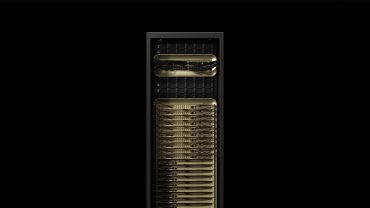
- Single DGX system with eight Blackwell GPUs achieves over 250 tokens per second per user on massive LLM models
Introduction
Nvidia’s Blackwell architecture emerges as the defining force in AI chip technology, setting new performance standards across industry benchmarks. According to VentureBeat, these chips demonstrate unprecedented capabilities in AI training and deployment, particularly excelling in the Llama 3.1 405B pretraining test. This technological breakthrough represents a significant leap forward in AI computing power and efficiency.
Key Developments
The Blackwell platform powers two cutting-edge AI supercomputers, Tyche and Nyx, which have achieved remarkable benchmark results. The architecture introduces innovative features including high-density liquid-cooled racks, second-generation Transformer Engine with FP4 Tensor Cores, and fifth-generation NVLink with NVLink Switch. These advancements enable AI training and real-time inference for models up to 10 trillion parameters.
Market Impact
Nvidia’s market dominance continues to grow, with the company’s share tripling over four years to 7.3%. Major cloud providers including AWS, Google Cloud, Microsoft Azure, and Oracle Cloud Infrastructure have committed to offering Blackwell-powered instances. The technology’s adoption spans across industries, with AI factories powered by Nvidia’s architecture generating valuable insights and transforming business operations.
Strategic Insights
The GB200 Grace Blackwell Superchip connects two B200 Tensor Core GPUs to the Grace CPU, enabling advanced capabilities in data processing and quantum computing. New Tensor Cores and the TensorRT-LLM compiler reduce LLM inference operating costs and energy consumption by up to 25x, addressing critical efficiency concerns in AI deployment.
Expert Opinions and Data
Dave Salvator, director of accelerated computing products at Nvidia, emphasizes the significance of MLPerf benchmarks in standardizing AI performance claims. The benchmarks reveal Blackwell’s superior performance, with DGX B200 systems delivering 2.5 times the performance compared to previous technology for Llama 2 70B LoRA fine-tuning.
Industry experts note Nvidia’s evolution from a GPU manufacturer to a comprehensive system solutions provider. The company’s ecosystem, supporting over 6 million developers, enables performance scaling across thousands of GPUs through tools like CUDA-X libraries and optimized frameworks.
Conclusion
Nvidia’s Blackwell architecture represents a significant advancement in AI computing capability, demonstrated through superior benchmark performance and widespread industry adoption. The technology’s impact extends beyond raw computing power, offering improved efficiency and reduced operational costs while enabling next-generation AI applications across diverse sectors.