- AI Hardware
- CPUs
- Edge AI
- Semiconductors
NVIDIA Moves From GPU Supplier
to the Heart of the PC
10 minute read
At GTC Taipei, Nvidia unveiled RTX Spark, a Grace CPU and Blackwell GPU superchip that repositions the company from component supplier to the computational core of the personal AI computer.
Key Takeaways
- RTX Spark integrates a 20-core Grace CPU with a Blackwell GPU and up to 128 GB unified memory, marking Nvidia’s first bid to own the central processing architecture of the Windows PC.
- Supporting 120-billion-parameter LLMs on-device, RTX Spark targets premium systems from ASUS, Dell, HP, Lenovo, and Microsoft Surface, with launches slated for fall 2026.
- RTX Spark deepens Nvidia’s CUDA moat from data center to device edge, expands its PC bill-of-materials share, and raises the competitive bar for Intel, AMD, and Qualcomm in premium AI PCs.
A New Role at the Center of the Machine
For most of its history, Nvidia has occupied a privileged but bounded position in personal computing. It supplied the graphics silicon that made games and creative work technically possible at the highest level, and more recently, the tensor hardware that made on-device AI inference credible. It was indispensable, yet still a component within a system whose central logic remained in other hands. On June 1, at its GTC Taipei event alongside Computex, that positioning changed.
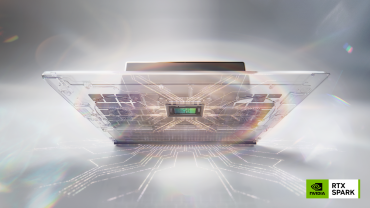
RTX Spark is Nvidia’s first consumer-oriented platform to integrate a high-performance CPU and GPU in a single package for Windows PCs. It combines a 20-core NVIDIA Grace CPU with a Blackwell RTX GPU carrying 6,144 CUDA cores and fifth-generation FP4 Tensor Cores, linked by high-bandwidth chip-to-chip interconnect and supported by up to 128 GB of coherent unified LPDDR5X memory. Nvidia claims up to 1 petaflop of FP4 AI performance within a power envelope that scales from single-digit watts to around 80 W, targeting premium thin-and-light laptops as slim as 14 mm and weighing roughly three pounds. This is not a graphics card announcement dressed in new language. It is a structural claim on the personal computer itself.
Architecture as Strategy
The technical choices embedded in RTX Spark are inseparable from the strategic ambition they represent. Unified memory architecture, in which the GPU accesses the full memory pool directly rather than shuttling data across a discrete bus, resolves a persistent constraint in conventional PC design. The approach mirrors what Apple has executed in its M-series silicon and what AMD has pursued in its APU line, but Nvidia brings a GPU compute capability and software stack that neither competitor currently matches in depth.
The Grace CPU is Arm-based, which raises the software compatibility questions that have long shadowed Windows on Arm. Microsoft and Nvidia have been working on this platform together for three years, yielding native Windows support for personal agents, new security primitives, and an NVIDIA OpenShell runtime for secure on-device execution. Microsoft’s Prism emulation layer has narrowed the legacy compatibility gap considerably since the early Snapdragon X launch period, but full native optimization across the creative and productivity application landscape remains an ongoing project rather than a solved problem. Adobe’s commitment to rearchitect Photoshop and Premiere Pro for RTX Spark, targeting roughly double the performance in AI and graphics tasks through unified memory and TensorRT integration, signals serious intent from one of the most demanding software constituencies.
The collaboration with MediaTek on the custom CPU design for power efficiency and connectivity adds another dimension. Nvidia is not simply repackaging its data center Grace architecture; it has made deliberate accommodations for the thermal and battery constraints of portable consumer hardware. Whether those accommodations translate to the claimed all-day battery life at real-world workloads will be validated only when devices ship.
Capabilities That Anchor the Pitch
Nvidia’s performance claims are specific enough to be meaningful. Rendering ultra-large 3D scenes exceeding 90 GB using OptiX and DLSS, editing 12K video, generating 4K AI video, and running 120-billion-parameter large language models locally with context windows up to one million tokens represent a coherent vision of what on-device intelligence looks like at the frontier. Gaming performance is positioned at sustained AAA play at 1440p above 100 frames per second with full ray tracing, DLSS, and Reflex on battery power, accompanied by new software capabilities including DLSS 4.5 Ray Reconstruction and enhanced RTX Video frame generation.
The 120-billion-parameter local inference figure deserves particular attention. It represents a meaningful threshold: models of that scale, running entirely on-device with no cloud dependency, can handle sophisticated reasoning, extended document analysis, code generation, and multi-modal tasks that were until recently the exclusive province of server infrastructure. For enterprise users handling sensitive data, legal and financial professionals working under confidentiality constraints, and creative professionals requiring low-latency generation, the privacy and performance combination carries genuine commercial weight.
Jensen Huang described the platform plainly: “This is the new PC. The personal AI computer.” Satya Nadella called it “a real breakthrough towards unmetered intelligence to every home and every desk.” Both statements reflect the same underlying logic: AI workloads increasingly demand local silicon capable of running large models continuously and privately, and RTX Spark is Nvidia’s answer to what that silicon looks like in a portable Windows device.
Competitive Pressure and Market Positioning
The announcement lands in a crowded field. Intel, AMD, and Qualcomm have each made significant investments in neural processing units and integrated AI acceleration. Apple’s M-series remains the benchmark for integrated silicon efficiency and total-platform coherence. Qualcomm’s Snapdragon X lineage has demonstrated that Arm-based Windows devices can achieve real productivity parity. RTX Spark enters this environment not by contesting the efficiency narrative directly, but by competing on raw capability at the frontier of AI and graphics performance, where Nvidia’s institutional depth is least contested.
The commercial stakes for Nvidia are straightforward. Data center AI will remain the company’s primary growth engine in any near-term horizon, but expanding into the PC system-on-chip market captures more of the bill of materials per device while reinforcing the CUDA ecosystem’s reach from cloud training to edge inference. Nvidia reported gaming revenue of $3.7 billion in its most recent fiscal quarter, up 47 percent year over year, partly on Blackwell demand. RTX Spark complements rather than displaces discrete GPU sales in enthusiast desktop configurations, but it represents a new addressable segment in premium mobility that the company has not previously owned.
Investor reaction was measured. Nvidia shares rose approximately 1.7 to 2 percent in pre-market and early trading on the announcement, a response that reflects recognition of a credible new vector without pricing in execution risk prematurely. Devices from ASUS, Dell, HP, Lenovo, Microsoft Surface, and MSI are slated for fall 2026, with Acer and GIGABYTE to follow. Premium positioning is apparent from the hardware specifications described: high-end displays, aluminum chassis, Wi-Fi 7. This is not a play for volume market share in the first cycle.
What the Platform Signals
The deeper significance of RTX Spark is not found in any individual specification. It lies in what the announcement reveals about where Nvidia believes the industry’s center of gravity is moving. Personal AI agents, always-on and private, represent a fundamentally different computing paradigm from the cloud-centric model that has defined the past decade. They require persistent local intelligence: large models available instantly, without network latency, without data leaving the device, without subscription fees per inference. Building the silicon to support that paradigm, at the power and thermal constraints of a thin laptop, is a serious engineering undertaking with equally serious market implications.
Nvidia has now staked a position at the intersection of the PC’s structural evolution and the migration of AI from the cloud to the edge. Whether RTX Spark achieves broad platform adoption will depend on the fall 2026 device launches, developer investment in native optimization, and Nvidia’s ability to sustain the software ecosystem investment that makes raw hardware performance commercially meaningful. The conditions for success are clear and the execution risks are real. What is no longer in question is the ambition: the company that once made PCs more capable is now defining what a PC is.