- AI Infrastructure
- Data Centers
- Earnings Season
- Semiconductors
Nvidia Delivers Record Fiscal 2026 as AI Demand Surges
11 minute read
Fiscal 2026 results reveal how Nvidia has moved beyond supplying a technology cycle to defining the economic architecture of artificial intelligence.
Key Takeaways
- Nvidia’s data center segment hit $62.3B in Q4 alone, now representing over 90% of total revenue, with networking revenue surging 263% year-over-year as AI model scaling accelerates demand for interconnect infrastructure.
- First-quarter guidance of $78B exceeds Wall Street consensus by $5.2B and excludes any China-related upside, suggesting the company’s visible demand pipeline remains structurally intact and geographically concentrated.
- With $96.6B in free cash flow and the Rubin platform promising 10x inference cost reductions over Blackwell, Nvidia is simultaneously monetising today’s AI buildout and engineering the next cycle’s dependency on its architecture.
The Magnitude of the Moment
There are quarters that confirm a trend, and there are quarters that redefine an industry’s center of gravity. Nvidia’s fourth quarter of fiscal 2026 belongs firmly in the second category. Revenue of $68.1 billion, a 73 percent increase over the prior year and 20 percent above the preceding quarter, would be a landmark result for almost any company. For Nvidia, it is the logical extension of a transformation that has been compounding, quarter by quarter, since the generative AI wave crested into mainstream enterprise deployment.
The full fiscal year told a story of similar proportions. Annual revenue of $215.9 billion, up 65 percent, with GAAP net income for the quarter alone reaching $43 billion. These are not figures that invite hedging. They are, instead, the financial expression of a structural shift in how the global economy allocates capital toward computation.
The Data Center’s Dominance
The architecture of Nvidia’s revenue has changed as decisively as its scale. The data center segment, which now accounts for over 90 percent of total revenue, generated $62.3 billion in the fourth quarter, up 22 percent sequentially and 75 percent year-over-year. Within that figure, compute revenue reached $51.3 billion, while networking contributed $11 billion, a 263 percent increase compared to the same period last year. That networking surge is not incidental. It reflects the adoption of NVLink fabrics, the high-bandwidth interconnect infrastructure that allows AI models of increasing complexity to scale across thousands of chips without bottlenecks. The hardware stack Nvidia sells is no longer merely a processing unit. It is a systems architecture.
Hyperscalers account for slightly over half of data center revenue, but the composition of the remaining growth is instructive. Non-hyperscaler customers, including enterprises building proprietary AI capabilities and governments pursuing sovereign AI strategies, are expanding their share. This diversification is a meaningful indicator of where the market stands: no longer a concentrated bet on the capital programmes of a handful of cloud giants, but a broadening deployment across industries and geographies.
Beyond the Headline Numbers
Gross margins held at 75 percent on a GAAP basis and 75.2 percent non-GAAP, defying the concerns that accompanied the high-volume ramp of the Blackwell architecture. That margins held through a major product transition is a reflection of pricing discipline and the degree to which Nvidia’s software ecosystem, built over years around the CUDA platform, sustains its commercial leverage. Customers are not simply buying chips. They are committing to an integrated environment that generates its own switching costs.
The contrast with Nvidia’s other segments illuminates the deliberate allocation of resources. Gaming revenue of $3.7 billion rose 47 percent year-over-year but fell 13 percent sequentially, partly a function of supply constraints as production capacity is directed toward data centre demand. Professional visualization reached $1.3 billion. Automotive and OEM segments remained modest contributors. These are not failing businesses, but they operate in a different register entirely from the data centre, and Nvidia’s investment priorities reflect that reality clearly.
The Technology Roadmap as Competitive Barrier
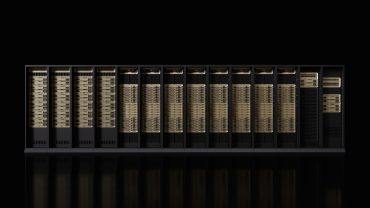
What distinguishes Nvidia’s position from a cyclical supplier is the pace at which it is extending its technical lead. At CES 2026 in January, the company unveiled the Rubin platform, a next-generation architecture promising inference cost reductions of up to tenfold compared to Blackwell. Commitments followed from AWS, Google, and Microsoft Azure, confirming that the largest buyers of AI infrastructure are not pausing to evaluate alternatives. They are extending their commitments through the next hardware generation.
Earlier in February, Nvidia expanded its Earth-2 open model family for climate and weather AI, and announced a multiyear supply agreement with Meta encompassing millions of Blackwell and Rubin GPUs. The Cosmos and GR00T physical AI models for robotics signal that the company is not limiting its ambitions to data centre compute. It is positioning for the next wave of AI deployment, where the interaction between digital intelligence and physical systems creates an entirely new demand vector.
The Blackwell platform’s commercial impact is already visible in the market. Inference providers such as Together AI have deployed it to achieve tenfold reductions in cost per token, a development that expands the addressable market for AI workloads by making inference economics viable at scale for a much wider range of applications.
Capital, Confidence, and the Forward Outlook
Free cash flow of $96.6 billion for the fiscal year has given Nvidia a balance sheet of considerable strategic flexibility. Cash reserves of $62.6 billion, combined with $41.1 billion returned to shareholders through buybacks and dividends, reflect a company managing its capital position with the confidence that comes from high earnings visibility. Supply commitments of $95.2 billion locked in for the year ahead confirm that demand is not speculative. It is contracted.
The guidance for the first quarter of fiscal 2027, at $78 billion plus or minus 2 percent, exceeded consensus by approximately $5.2 billion. Crucially, this projection excludes any contribution from China-related compute revenue, meaning that any resolution of export restrictions would represent incremental upside rather than a built-in assumption. For investors modelling the range of outcomes, that distinction matters.
Operating expenses rose 21 percent sequentially, a figure that merits monitoring but does not alter the fundamental earnings equation at current revenue levels. The more notable constraint may be on the gaming side, where a reported memory supply prioritisation toward AI infrastructure has led Nvidia to scale back RTX 50-series production and defer a 2026 gaming refresh, the first such gap in three decades. The decision is rational given the margin profile of each business, but it signals that resource constraints are real and that the company has made a clear choice about where to direct them.
Where the Market Stands
Nvidia (NASDAQ: NVDA) closed at $197.29, up approximately 1 percent following its results. The initial after-hours surge of more than 3 percent moderated as investors absorbed the guidance and weighed the sustainability of AI capital expenditure growth. That moderation is not a verdict on the business. It is the normal behaviour of a market that has spent considerable time pricing in strong outcomes and is now calibrating the margin of upside relative to an already elevated valuation.
The antitrust scrutiny building in both the United States and Europe, directed at Nvidia’s estimated 80 percent share of the AI chip market, is a known overhang. It has not impaired demand, but it introduces a dimension of regulatory uncertainty that institutional investors are incorporating into their analysis with increasing seriousness.
The Structural Read
Nvidia’s fiscal 2026 results are not simply a corporate earnings report. They are a data point on the pace and depth of the AI investment cycle. What the numbers confirm is that hyperscaler and enterprise commitment to AI infrastructure has not slowed. The scaling of model complexity, the expansion of inference workloads, and the emergence of agentic AI systems are creating demand that outpaces supply. Nvidia is the primary beneficiary of that imbalance, and with Rubin already committed by the largest buyers, it is positioned to remain so through the next hardware cycle.
The $310 billion annualized revenue run rate implied by current guidance is a figure that would have seemed implausible three years ago. It is now the baseline from which growth is being measured. Whether that baseline expands or compresses will depend on factors that Nvidia does not fully control, including the pace of AI adoption across industries, the trajectory of competitive alternatives from AMD and others, and the direction of regulatory frameworks that are still being written. What Nvidia does control is the quality of its engineering and the depth of its ecosystem. On both counts, the evidence of fiscal 2026 is unambiguous.