- Commercial Space
- Lunar Infrastructure
- NASA
- Space Economy
NASA Commits $700 Million to Commercial Lunar Infrastructure
11 minute read
NASA’s latest lunar contracts with Astrolab, Lunar Outpost, Blue Origin, and Firefly signal a decisive shift from episodic exploration to persistent, commercially driven infrastructure at the South Pole.
Key Takeaways
- NASA awarded roughly $700 million across four companies to build rovers, cargo landers, and autonomous drones, forming the operational backbone of a permanent lunar South Pole presence by 2028.
- Funding two competing rover designs from Astrolab and Lunar Outpost preserves technical optionality and competitive pressure while generating comparative performance data before larger follow-on commitments are made.
- Firefly’s 18.8% share price surge on announcement day reflects investor conviction that recurring NASA infrastructure tasking marks a structural inflection point for commercial lunar services revenue.
The Architecture of Permanence
For most of the past half-century, the Moon has been a destination. A flag planted, samples collected, a safe return accomplished. What NASA formalized on May 26 is something categorically different: the first tangible hardware layer of a lunar base, not as aspiration but as contracted obligation, with named companies, specific dollar figures, and launch windows measured in months rather than decades.
The agency’s selection of Astrolab, Lunar Outpost, Blue Origin, and Firefly Aerospace to provide crewed rovers, cargo delivery, and autonomous reconnaissance drones represents the operational translation of the Artemis program’s broader ambitions. Taken individually, each award is significant. Taken together, they constitute an architecture, one designed with overlapping capabilities, deliberate redundancy, and a logic that closely mirrors how serious infrastructure programs are built.
The total value across the announced contracts approaches $700 million in initial and option-period commitments. That figure will grow considerably as milestone completions trigger follow-on orders and as the competitive framework established by these selections channels further spending through the same commercial channels.
Two Rovers, One Strategic Purpose
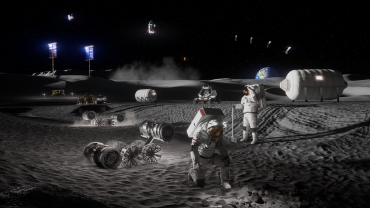
The centerpiece of the announcement is the parallel funding of two lunar terrain vehicles under Phase 1 task orders of the existing Lunar Terrain Vehicle Services contract. Astrolab received approximately $219 million for its CLV-1 rover, a descendant of the company’s FLEX architecture that weighs roughly 2,000 pounds and is engineered for speeds above 6 mph with strong emphasis on multi-mission adaptability. Lunar Outpost received approximately $220 million for its Pegasus rover, offering higher top speeds above 9 mph, up to a year of operational endurance, and a design philosophy inherited from its earlier Eagle concept.
The near-identical award values are not coincidental. NASA is running a structured competition in hardware form. Both firms will mature their designs, conduct crewed evaluations, and qualify flight units capable of autonomous traverses, terrain preparation, logistics movement, and astronaut transport, with deployment targeted for 2028 via the Commercial Lunar Payload Services framework.
The decision to fund two distinct platforms rather than consolidate immediately reflects a mature procurement posture. NASA is buying comparative performance data on different mass, speed, and autonomy trade-offs before committing to larger follow-on orders. Single-point failures in lunar hardware have historically been costly; the agency is structurally hedging against that risk while preserving competitive pricing pressure on both providers. The LTVS contract vehicle itself carries a maximum potential value across all providers of approximately $4.6 billion, and these task orders are the first meaningful execution step in what will be a prolonged competition.
The Delivery Problem, Solved Commercially
Surface vehicles require a surface. Getting hardware to the lunar South Pole, and specifically to terrain that combines near-continuous solar power with proximity to water ice deposits in permanently shadowed craters, demands precision landing capability that only a handful of systems can credibly provide.
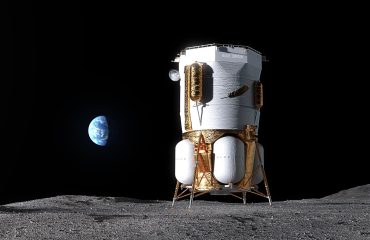
NASA awarded Blue Origin $188 million, with an option period valued at an additional $280.4 million, for two task orders under the CLPS 1.0 framework. Blue Origin will use its Blue Moon Mark 1 Endurance lander for the initial Moon Base I mission, targeting Shackleton Connecting Ridge no earlier than fall 2026. Early payloads will include instruments to study lander plume-surface interactions and retroreflector arrays for positioning. For Blue Origin, the contract represents an early flight opportunity that de-risks its larger human-landing architecture at NASA’s expense and on NASA’s timeline, a structurally favorable arrangement for a company investing heavily in lunar capability.
The logic of Shackleton Connecting Ridge is worth understanding. The South Pole’s value is not merely symbolic. Certain ridges receive near-continuous sunlight, enabling sustained solar power generation. Nearby craters hold permanently shadowed regions where water ice has accumulated over geological time. Rovers that can operate autonomously for months, cover meaningful distances, and feed logistics networks effectively transform a landing site from a static outpost into a mobile operations node spanning hundreds of square miles.
Drones and the Intelligence Layer
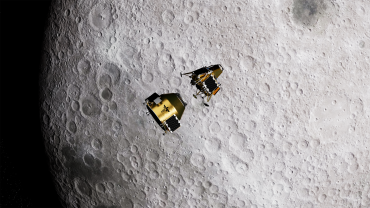
Beyond surface mobility, NASA made a selection that has received less attention but carries considerable strategic weight. Firefly Aerospace was awarded a $75 million subcontract from JPL to build and operate the Elytra spacecraft, which will deliver four autonomous MoonFall drones designed and operated by JPL. The mission targets launch no earlier than 2028.
The drones will perform short hops to map terrain, prospect for water ice in permanently shadowed regions, and collect high-resolution data across extended operating periods. In practical terms, they add a reconnaissance layer that crewed missions could never achieve efficiently and that rovers, constrained by terrain, cannot replicate at speed. The combination of surface mobility and aerial scouting creates a genuinely networked operational picture.
For Firefly specifically, the award is a strategic pivot point. The company successfully completed its Blue Ghost Mission 1 lunar landing in 2025, and this new role converts that landing heritage into a recurring orbital-to-surface delivery capability. The market responded accordingly: Firefly’s shares rose approximately 18.8% on the day of the announcement, closing at $58.81. That is not a speculative premium; it is an investor assessment that NASA has validated Firefly’s execution and created a template for higher-margin services revenue going forward.
The Commercial Lunar Economy Takes Shape
These awards sit within a broader competitive and commercial framework that has been building steadily since CLPS launched as a concept. The program has already placed more than 50 payloads on contract across 11 deliveries with a pool of 13 eligible U.S. companies. The new rover and drone contracts extend that same logic into mobility and persistent scouting, deepening commercial involvement across every layer of lunar operations.
Intuitive Machines, absent from the Phase 1 LTV task orders, continues to execute multiple high-value CLPS deliveries, including a $180.4 million award in March 2026 for its fifth task order, and retains its position in the original LTVS competitive pool. The breadth of active participants matters: NASA is deliberately maintaining a diversified vendor base across landers, rovers, and now drones, reducing concentration risk while sustaining the cadence of surface access required to build operational knowledge before crewed landings arrive.
For institutional investors with exposure to the broader space supply chain, the signal embedded in these awards is clear. Public seed capital continues to catalyze private capability, and the companies that demonstrate reliable end-to-end performance across landing, surface mobility, data return, and operational adaptability are positioned to capture not only follow-on NASA task orders but also the emerging commercial and international demand that a functioning lunar infrastructure will generate.

Execution as the Remaining Variable
None of this is without risk. Lunar landings and surface operations have historically been unforgiving, and several CLPS missions encountered partial or full shortfalls before recent successes established a more reliable baseline. Aggressive timelines, rover deployment by 2028 and drone scouting shortly after, will test integration, qualification, and supply-chain resilience across companies that remain relatively young as space hardware manufacturers.
The architecture, however, is coherent. Frequent robotic precursors generate operational data, characterize hazards, pre-position assets, and mature autonomy before astronauts arrive. Each mission informs the next. The infrastructure logic is sequential and deliberate, reducing both technical and political exposure for the crewed phase of Artemis while building the industrial base that a genuine lunar economy requires.
The contracts awarded on May 26 are early waypoints on a trajectory that will define the commercial space sector’s next decade. The companies selected have earned the right to demonstrate that commercial capability can meet the operational demands of sustained lunar presence. What NASA has done is create the conditions in which they must.