- Biotechnology
- Drug Discovery
- Healthcare
Lilly’s $2.75B Insilico Deal Completes AI Strategy
9 minute read
Lilly’s Insilico partnership caps a deliberate, three-part AI strategy that could redefine how the pharmaceutical industry finds its next blockbusters.
Key Takeaways
- Lilly’s deal with Insilico Medicine, worth up to $2.75 billion, is the third pillar of a coherent AI strategy that also includes the proprietary TuneLab platform and a $1 billion NVIDIA co-innovation laboratory.
- The financial architecture, with $115 million upfront against heavily milestone-weighted back payments, reflects disciplined capital allocation: Lilly pays for demonstrated progress rather than speculative promise.
- Big Pharma’s AI partnerships have moved from cautious pilot programmes to structured, high-value transactions that transfer early discovery risk to specialist platforms while preserving downstream commercial economics.
The Orchestrator’s Logic
Eli Lilly’s announcement of a collaboration with Hong Kong-listed Insilico Medicine, valued at up to approximately $2.75 billion, arrived with the kind of headline number that markets are conditioned to notice. The figure is substantial. It is also, in isolation, somewhat misleading. The deal’s real significance lies not in its size but in its position within a carefully sequenced strategic architecture, one that reveals how the most commercially successful pharmaceutical company of its generation is rethinking the earliest and most uncertain phase of drug development.
Lilly is not, at this stage, buying a pipeline. It is licensing a process. Under the agreement, Insilico’s Pharma.AI platform will supply preclinical-stage, novel oral therapeutic candidates across indications that include obesity, metabolic disorders, oncology, immunology, and fibrosis. Lilly receives exclusive worldwide rights to develop, manufacture, and commercialise these assets. Insilico receives $115 million upfront, with the remainder contingent on development, regulatory, and commercial milestones, plus tiered royalties. The structure places the discovery risk with the AI specialist and the development risk, along with its reward, with Lilly’s proven regulatory and commercial machinery.
Three Moves, One Strategy
To understand the Insilico transaction properly, it must be read alongside two earlier moves. In September 2025, Lilly launched TuneLab, a proprietary AI platform built on experimental data from hundreds of thousands of unique molecules, encompassing drug disposition, safety, and preclinical outcomes accumulated over decades of internal research. The company valued that dataset at more than $1 billion. Through federated learning, TuneLab allows selected biotech partners to access Lilly-trained models without exposing proprietary information, creating a collaborative intelligence layer that improves continuously as partners contribute their own data.
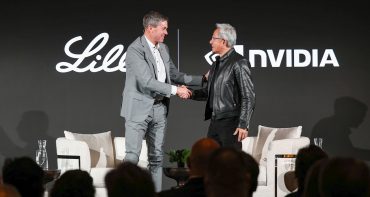
Four months later, in January 2026, Lilly and NVIDIA announced a co-innovation AI laboratory in South San Francisco, backed by commitments of up to $1 billion over five years in talent, compute infrastructure, and foundational model development. The laboratory’s stated ambition is to create a continuous learning loop between computational dry labs and agentic wet labs, powered by NVIDIA’s BioNeMo models. Lilly Chairman and CEO David Ricks described the goal as reinventing drug discovery. NVIDIA’s Jensen Huang called the venture a new blueprint for the field.
The Insilico deal completes a triangle. TuneLab builds and protects Lilly’s proprietary data moat. The NVIDIA laboratory develops the frontier infrastructure to exploit it. The Insilico partnership acquires externally generated AI assets to complement what internal discovery cannot produce quickly enough. Each investment hedges against the others’ limitations while reinforcing a common thesis: that the future of pharmaceutical R&D is computational at its core, and that no single platform, however sophisticated, captures the full upside of that transition.
Why Now, and With Whose Money
The timing of Lilly’s AI acceleration is inseparable from its recent commercial performance. Tirzepatide, sold as Mounjaro for type 2 diabetes and as Zepbound for obesity, has generated cash flows of a scale rarely seen in pharmaceutical history. That revenue is now being redeployed not merely into manufacturing expansion or incremental product extensions, but into the upstream architecture of discovery itself. The company is using its GLP-1 windfall to re-engineer the conditions under which the next major therapeutic franchise might be found.
This matters strategically. Patent expiry, competitive pressure from Novo Nordisk’s semaglutide franchise, and the inherent unpredictability of late-stage clinical outcomes all impose finite shelf-lives on even the most successful drugs. Lilly’s response is to shorten the cycle from target identification to clinical candidate nomination, improving the probability that its development engine always has high-quality material to work on. AI-powered discovery, if it delivers even a fraction of its theoretical efficiency gains, is the most plausible tool available for achieving that.
Insilico brings more to the relationship than algorithmic novelty. The company has already advanced multiple internally generated AI-designed programmes into clinical development across its own pipeline, providing empirical evidence that Pharma.AI can produce candidates capable of surviving biological scrutiny. The two companies began collaborating in 2023 on a software licensing basis, and a further research agreement followed in late 2025. The March 2026 transaction is therefore not a speculative leap but the commercial formalisation of a relationship already stress-tested at earlier stages.
The Industry’s Inflection Point
Lilly is not operating in isolation. Across the industry, the pattern of AI engagement has shifted materially over the past two years. The cautious pilot programmes and non-exclusive data-sharing arrangements that characterised the early 2020s have given way to structured, high-value partnerships with clear IP allocation, milestone-gated payments, and defined therapeutic focus areas. The underlying driver is competitive necessity: as AI platforms mature and accumulate proprietary training data, the cost of not engaging escalates alongside the cost of engaging carelessly.
What distinguishes Lilly’s approach is its coherence. Many large pharmaceutical companies have signed AI deals; fewer have articulated and executed a multi-layered strategy that simultaneously builds internal capability, acquires external assets, and establishes the computational infrastructure to sustain both. The risk of any single AI platform disappointing is real, but Lilly’s positioning distributes that risk across architecture rather than concentrating it in any one place.
Legitimate questions remain. AI-designed molecules have not yet produced a substantial wave of approved medicines. Regulatory agencies across major markets are still developing frameworks for evaluating algorithmic contributions to development dossiers. Clinical attrition rates, the pharmaceutical industry’s most stubborn problem, are unlikely to fall dramatically simply because a molecule was conceived computationally rather than experimentally. The preclinical assets licensed from Insilico carry the same inherent uncertainty as those produced by conventional chemistry: their value will ultimately be determined in Phase 3 trials, years from now.

Geopolitics and the Geography of Innovation
One dimension of the Insilico partnership that has received insufficient attention is its geopolitical texture. Insilico, founded by CEO Alex Zhavoronkov, has built its platform through operations spanning the United States, China, and Europe. Lilly’s willingness to deepen a relationship with a company of that geographic complexity, at a moment when technology and supply-chain concerns dominate U.S.-China policy discourse, reflects a pragmatic calculation: that scientific capability, wherever it resides, remains the primary input to pharmaceutical innovation.
Policymakers monitoring pharmaceutical supply-chain security and technological sovereignty will find the deal worth examining closely. It illustrates the difficulty of drawing clean national boundaries around discovery-stage science, and the extent to which AI may yet redistribute pharmaceutical leadership in ways that existing regulatory and trade frameworks have not fully anticipated.
Verdict
Lilly’s $2.75 billion commitment to Insilico Medicine is most accurately read as a data point in a larger transformation rather than a transaction in itself. The company that built its current dominance through manufacturing scale and clinical execution is now positioning itself as an orchestrator of AI-augmented discovery. TuneLab, the NVIDIA laboratory, and the Insilico partnership are three expressions of the same conviction: that computational biology will compress timelines, improve hit rates, and replenish pipelines faster than legacy approaches allow.
Whether that conviction proves correct will be judged in the clinic, not the market. But for institutional investors and industry observers, the more immediate signal is structural. Lilly is not waiting to see whether AI-native pharma arrives. It is building the infrastructure to ensure that when it does, Lilly is already inside it.