
- AI Travel
- Consumer Platforms
- Experiences
Airbnb Beats Q1 Estimates as Its Ecosystem Strategy Takes Hold
9 minute read
Airbnb’s first-quarter results beat expectations on revenue and bookings, signalling that its pivot toward a broader travel ecosystem is gaining measurable traction.
Key Takeaways
- Revenue rose 18% to $2.68 billion in Q1 2026, beating Wall Street estimates by roughly $60 million, with gross booking value climbing 19% to $29.2 billion and free cash flow margin reaching 64%.
- New product lines including in-home services, expanded experiences, and hotel pilots are generating cross-conversion, with one in four experience bookers subsequently making a stay reservation on the platform.
- Airbnb raised full-year revenue growth guidance to the low-to-mid teens, targeting adjusted EBITDA margins of at least 35%, backed by AI-driven cost efficiency and a fortified $12.1 billion balance sheet.
A Platform Finding Its Stride
For a company that once defined itself almost entirely by the simple proposition of renting a spare room, Airbnb’s first-quarter 2026 results carry a more ambitious implication. The numbers, released after market close on May 7, were strong by any credible measure: revenue of $2.678 billion, up 18% year over year and ahead of consensus estimates of roughly $2.62 billion; gross booking value of $29.2 billion, a 19% increase; and nights and experiences booked of 156.2 million, up 9%. Net income came in at $160 million, producing a 6% margin, while adjusted EBITDA of $519 million represented a 19% margin and 24% year-over-year growth.
What the headline figures do not fully capture is the degree to which these results reflect the compounding of deliberate, multi-year strategic decisions, rather than a favorable macro moment. Average daily rates rose 9% to $187, with foreign exchange providing a meaningful portion of that lift, though ex-FX growth of 4% still points to underlying pricing discipline. Mobile engagement hit a new watermark, with 63% of total nights booked via the app and mobile volumes up 22%. First-time booker growth of 10% was the strongest since early 2022. Each data point, individually unremarkable, forms part of a coherent picture of a platform deepening its hold on its users.
Geopolitical Friction and the Structural Advantage of Scale
The quarter was not without complication. Management flagged elevated cancellation rates across EMEA and Asia-Pacific, attributable to the ongoing conflict in the Middle East, which it estimated shaved approximately 100 basis points off nights-and-experiences growth. Tariff-related uncertainty from the prior year continued to influence consumer behavior in ways that are difficult to fully isolate or model.
Yet the company’s response to these pressures illuminates a structural feature that its competitors struggle to replicate. When geopolitical disruption or economic anxiety prompts travelers to reconsider destinations, a platform with millions of listings across price points, property types, and geographies can absorb that redirection. Demand does not necessarily leave the platform; it relocates within it. Expansion markets, notably Brazil, Japan, and India, contributed outsized origin-night growth during the quarter, a reminder that Airbnb’s global footprint is both a revenue diversifier and a buffer against regional volatility.
Free cash flow of $1.7 billion for the quarter, representing a 64% margin, reinforced the capital efficiency of the underlying business model. Trailing twelve-month free cash flow stood at $4.5 billion, a 36% margin. The balance sheet ended the period with $12.1 billion in cash, equivalents, and investments, following a $2.5 billion senior notes issuance and the repayment of $2 billion in convertibles. Share repurchases of $1.1 billion in the quarter extended a program that has reduced fully diluted shares by approximately 9% since the third quarter of 2022.
Product Innovation as a Demand Flywheel
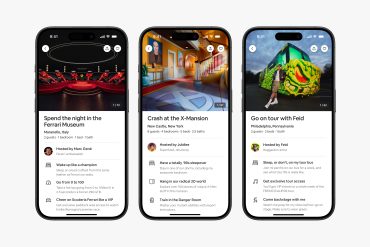
The more consequential strategic story in the quarter concerns what Airbnb is building beyond its core home-rental business. The 2025 Summer Release introduced Airbnb Services, offering in-home offerings including private chefs, massage therapists, and personal trainers, alongside a broader expansion of Experiences and an app redesign oriented around discovery. Early conversion data is instructive: roughly one in four new guests who booked an experience or service subsequently made a stay reservation. In hotel pilots, 55% of hotel bookers returned to book a home. These are not marginal metrics; they indicate that product extensions are functioning as genuine demand generators rather than ancillary features.
Reserve Now, Pay Later, which accounted for approximately 20% of global gross booking value during the quarter, has extended booking lead times and broadened access for price-sensitive travelers. The feature is particularly relevant in an environment where household budgets face competing pressures; the flexibility it provides shifts the cost-benefit analysis in favor of booking sooner and further ahead.
Artificial intelligence is accelerating the pace of internal execution. Nearly 60% of Airbnb’s code is now co-authored with AI tools, approximately double industry averages by the company’s own assessment. Customer-support resolution without human intervention exceeded 40% of cases, contributing to a roughly 10% year-over-year decline in cost per booking. The efficiency gains are not purely financial; faster iteration allows the company to test and ship product improvements at a cadence that would have been impractical under traditional development cycles.

Major Events and the Long Game
Airbnb’s approach to major global events deserves particular attention as a strategic asset. The company’s execution around the Milano Cortina Winter Olympics, which drew nearly 200,000 guests and generated 30% supply growth in host markets, demonstrated an ability to mobilize supply, manage logistics, and translate event-driven demand into lasting host relationships. The FIFA World Cup 2026, spanning 16 host cities, presents a materially larger opportunity. Over 100,000 new listings have already been secured across host cities, and the company expects record guest volumes. For investors, the World Cup is not merely a near-term revenue event; it is a customer acquisition and host onboarding exercise at scale.
The logic extends beyond the tournament itself. Host cities for major sporting events experience sustained elevation in inbound tourism well after the final whistle, as destination profiles rise in global consciousness and infrastructure investment makes travel more accessible. Airbnb’s strategy of entering these markets aggressively ahead of peak demand, securing supply, building local regulatory relationships, and converting first-time hosts into long-term participants, creates a compounding effect that does not fully appear in a single quarter’s results. Each major event functions as a beachhead: short-term in its revenue contribution, but durable in its impact on supply density, brand visibility, and host community depth in markets that will matter for years. With Los Angeles hosting the Summer Olympics in 2028, the pipeline of catalysts is already visible on the horizon.
Guidance, Market Reaction, and the Longer View
For the second quarter, Airbnb guided revenue of $3.54 billion to $3.60 billion, representing 14% to 16% growth and incorporating an approximately 3% foreign exchange tailwind. Gross booking value growth is expected in the low double digits. For the full year, revenue growth guidance was raised to the low-to-mid teens, with adjusted EBITDA margin targeted at no less than 35%.
After-hours trading on May 7 briefly reflected an EPS miss of $0.26 against consensus of roughly $0.30, the shortfall largely attributable to a one-time deferred tax adjustment of approximately $70 million. By the morning of May 8, shares had recovered to trade near pre-earnings levels around $140, a response that suggests the institutional investment community is orienting itself to Airbnb’s medium-term trajectory rather than quarterly noise.
That trajectory points toward a business evolving from a two-sided lodging marketplace into something more encompassing: a travel and lifestyle platform with diversified revenue streams, a capital-light operating model, and growing pricing leverage. The challenges ahead, including tougher year-over-year comparisons in the second half, sustained geopolitical risk, and the regulatory environment for short-term rentals in parts of Europe, are real and should not be dismissed. But they are navigable for a company that enters the peak travel season with a fortified balance sheet, operational momentum, and a product roadmap it appears increasingly capable of executing against. In uncertain conditions, that combination commands attention.