- Geopolitics
- Nuclear Energy
- Rare Earths
- Supply Chains
Japan and America Recalibrate Their Most Consequential Alliance
11 minute read
Takaichi’s Washington summit signals a deepening of economic and strategic ties that will reshape supply chains, energy infrastructure, and Indo-Pacific security for a generation.
Key Takeaways
- Japan’s $550 billion US investment commitment, anchored in nuclear energy and critical minerals, has moved from pledge to execution, with a potential $40 billion nuclear infrastructure package expected to be formalised during the March summit discussions.
- Hormuz disruptions have exposed Japan’s structural energy vulnerability, with roughly 90 percent of its oil transiting that chokepoint, accelerating Tokyo’s pivot toward diversified supply chains and long-term LNG agreements as instruments of economic security rather than mere trade policy.
- Takaichi’s landslide electoral mandate and record defence budget of ¥9.04 trillion give her unusual political latitude to deepen the alliance, though Japan’s constitutional framework continues to set clear limits on direct military burden-sharing, preserving domestic credibility at the cost of Washington’s preferred symmetry.
A Visit Freighted with Meaning
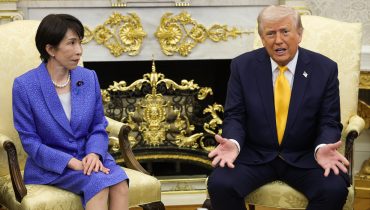
When Sanae Takaichi arrived at the White House on 19 March, she brought with her 250 cherry blossom saplings, a gift calibrated to mark America’s 250th anniversary. The gesture carried its own eloquence: rooted in postwar reconciliation, oriented toward a shared future. Yet the floral symbolism landed against one of the more turbulent geopolitical backdrops in recent memory. Oil prices volatile, the Strait of Hormuz under stress, and a US-Israel military campaign against Iran barely three weeks old. The summit between Japan’s first female prime minister and President Donald Trump was, in that sense, both a celebration and a reckoning.
Takaichi came to Washington with a stronger hand than most of her predecessors. Her Liberal Democratic Party secured a supermajority in February’s lower-house election, a mandate that grants her exceptional room to advance a conservative programme built around fiscal stimulus, defence modernisation, and a sharper posture on regional security. For the investors and policymakers who track this alliance most closely, her visit was a test of something more durable than diplomatic chemistry: it was a signal of how the world’s two largest advanced economies intend to hold their footing as the structures of globalisation shift beneath them.
The Architecture of Economic Interdependence
The foundations for this summit were laid in October 2025, when Trump visited Tokyo and the two governments unveiled what the White House called a “New Golden Age” of bilateral cooperation. The centrepiece was a landmark investment framework converting an earlier $550 billion pledge into a structured series of commitments touching nearly every node of strategic economic concern: nuclear energy, AI data infrastructure, electronics manufacturing, critical minerals processing, LNG offtake, and port capacity.
The figures involved are not rhetorical. Up to $332 billion has been directed toward critical energy infrastructure alone, with Japanese firms partnering with Westinghouse, GE Vernova, and Hitachi on AP1000 reactors and small modular reactor deployments across the United States. A separate critical minerals agreement was signed to reduce dependence on single-country supply chains. Reports citing White House officials suggest a $40 billion nuclear infrastructure package, centred on GE Vernova and Hitachi, could be formalised in Washington this week, extending the pattern of what both governments now openly call “friendshoring.”
This is not conventional foreign direct investment. It is strategic capital, deployed deliberately to reinforce supply-chain architecture in sectors where the United States and Japan share an overriding interest in reducing exposure to coercive economic leverage from elsewhere in Asia. For senior investors, the practical implication is significant: the US-Japan corridor is becoming one of the most policy-reinforced trade and investment axes in the global economy.

Energy Vulnerability and Strategic Response
No issue sharpens the stakes of this alliance more acutely than energy. Japan imports approximately 90 percent of its oil, much of it transiting the Strait of Hormuz. When the US and Israel launched military operations against Iran on 28 February, the resulting disruptions pushed Brent crude briefly above $119 per barrel. Tokyo responded by drawing down strategic petroleum reserves and coordinating with allies on market stabilisation. Both are sensible short-term measures; neither addresses the underlying exposure.
The longer-term response is written into the investment framework itself. By anchoring Japanese capital in American nuclear capacity and LNG infrastructure, Tokyo is simultaneously strengthening its ally’s energy base and diversifying its own import geography. The critical minerals agreement serves a parallel function: China controls an estimated 60 to 70 percent of global rare-earth processing capacity, and the bilateral framework is designed, with deliberate patience, to erode that dominance.
Market participants have absorbed these signals unevenly. The Nikkei 225 has traded with unusual volatility, pressured by rising energy costs and their downstream effect on corporate margins. The yen has faced periodic weakness, though Bank of Japan discipline and the natural hedge of export competitiveness have contained the damage. Defence-related equities, Kawasaki Heavy Industries and IHI prominent among them, have outperformed as security spending accelerates. Over a longer horizon, analysts see structural upside in critical minerals and advanced manufacturing, where deepened cooperation reduces geopolitical risk for investors willing to look past the near-term noise.
The Limits Washington Must Accept
Takaichi has been consistent and deliberate about one thing: Japan will act within its constitutional framework. Article 9 of the postwar charter constrains collective self-defence, and while Takaichi has pushed defence spending to a record ¥9.04 trillion for fiscal 2026, the 12th consecutive annual increase, the trajectory reflects domestic political management as much as alliance obligation. No warships for Hormuz escort operations are on the agenda. Tokyo has instead joined diplomatic statements emphasising energy-market stability alongside European partners, a posture that signals solidarity without inviting entanglement.
This nuance matters strategically. Washington’s transactional preferences sometimes demand symmetry that Tokyo cannot politically deliver. But a Japan that overextends its constitutional limits risks the domestic backlash that would undermine the long-term credibility of the alliance far more than any single burden-sharing shortfall. Takaichi understands this arithmetic. Her publicly stated view that a Taiwan contingency would be potentially existential for Japan represents a candour that aligns Tokyo closely with Washington’s forward posture, even as the military specifics remain appropriately ambiguous.
What Endures
The legacy of this summit will not be measured in communiqué language. It will be measured in gigawatts of new nuclear capacity coming online in the American Midwest, in processed lithium moving across the Pacific, in undersea cable systems hardened against disruption, and in the quiet accumulation of shared industrial interest that makes strategic decoupling between the two countries increasingly inconceivable.
Takaichi returns to Tokyo with her mandate intact and a clearer map of the transactional space available under the current American administration. The cherry saplings will take years to mature. So will the infrastructure being financed and the supply chains being redrawn. That is precisely the point. In an era defined by short-term volatility and strategic fragmentation, the most consequential work is often the least immediately visible: the patient, deliberate reinforcement of a partnership that both sides have decided, for reasons of self-interest as much as shared values, they cannot afford to let weaken.