- AI Economy
- Compute Infrastructure
- Data Centers
- Hyperscalers
France Lands €75 Billion SoftBank Deal in European AI Race
11 minute read
SoftBank’s landmark commitment to build 5 gigawatts of AI data-center capacity in France marks a turning point in how frontier compute is financed, sited, and geopolitically anchored.
Key Takeaways
- SoftBank will deploy up to €75 billion across three northern France sites, with €45 billion committed for an initial 3.1 GW phase by 2031, the largest AI infrastructure bet Europe has seen.
- Partnerships with EDF and Schneider Electric will localize energy supply and hardware manufacturing, embedding the project within France’s industrial economy rather than merely sitting atop it.
- The deal extends SoftBank’s vertical integration across silicon architecture, clean energy, and physical compute, a combination no other capital allocator has assembled at comparable scale.
The Weight of the Wager
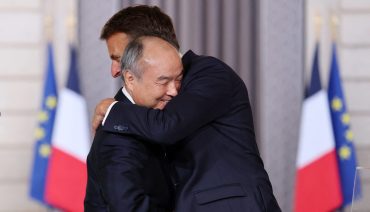
SoftBank Group arrived at President Emmanuel Macron’s Choose France summit not with a proposal but with a commitment: up to €75 billion, five gigawatts of AI data-center capacity, three sites across the Hauts-de-France region, and a targeted completion date of 2031. It is the largest single AI infrastructure bet Europe has seen from a private investor, and it lands at a moment when the continent’s deficit in frontier compute has moved from a policy talking point to a competitive liability.
The initial phase is concrete: €45 billion to deliver 3.1 GW across Dunkirk’s Loon-Plage zone, Bosquel, and a repurposed thermal plant at Bouchain. The remaining €30 billion covers additional sites not yet formally designated. The distinction matters, because it separates what is contractually underway from what remains aspirational. But even the firm commitment, taken alone, would rank among the most consequential infrastructure decisions made on European soil in a generation.
Europe has spent years watching the United States and China accumulate hyperscale compute at a pace the continent could not match. Power constraints, permitting timelines, regulatory fragmentation, and the absence of entities willing to deploy capital at the required scale all played their parts. SoftBank, in a single afternoon, reframed what Europe could attract.
Three Sites, One Argument
The choice of Hauts-de-France is not incidental. Industrial regions that have absorbed the loss of heavy manufacturing over decades tend to offer what data-center developers most urgently need: land, grid access, and political goodwill. Dunkirk’s port infrastructure brings logistics and supply-chain depth. Bouchain’s former thermal power station, being repurposed through a partnership with EDF, offers a ready energy connection and a narrative the French government can use: industrial decline transformed into digital capacity.
Bosquel completes the regional cluster. At full buildout, the three sites would constitute one of the most concentrated AI compute installations anywhere outside the United States. That concentration is partly a function of scale, but it is also a deliberate statement. Distributed, fragmented infrastructure produces neither the operational efficiencies nor the geopolitical visibility that a project of this ambition requires.
The Schneider Electric partnership at Dunkirk deserves particular attention, because it is where the project’s industrial logic becomes most explicit. SoftBank and Schneider will co-develop a robotized manufacturing cluster producing enclosures and prefabricated power modules, the dense, capital-intensive hardware that has historically been manufactured in Asia or North America and shipped to wherever data centers were being built. Producing that hardware adjacent to the facilities it will serve shortens procurement timelines, creates advanced manufacturing employment in a region that has long sought it, and begins to construct a supply chain that Europe has conspicuously lacked. It is one thing to build a data center. It is another to build the industry around it.
Vertical Integration as Strategy
To understand why SoftBank moved, rather than one of the American hyperscalers or a European sovereign fund, requires understanding what SoftBank has quietly assembled over the past several years. Masayoshi Son has said publicly, and with characteristic directness, that the nations and companies controlling the physical substrate of AI will exercise outsized influence over its trajectory. The France commitment is that conviction expressed in steel, concrete, and silicon.
The components of SoftBank’s current position are worth holding in view simultaneously. The Vision Fund segment recorded substantial gains in the fiscal year ended March 2026, driven primarily by the appreciation of its OpenAI holdings. Cumulative investment in OpenAI has reached approximately $64.6 billion for roughly 13 percent ownership, a position that gives SoftBank not merely financial exposure but proximity to the model development that will ultimately run on facilities like those being built in France. Arm Holdings, in which SoftBank retains a controlling interest, supplies the chip architecture underpinning a growing proportion of AI accelerators. SB Energy brings clean-power procurement and grid integration capabilities that are now inseparable from data-center economics. Physical infrastructure, owned or co-developed, completes the stack.
No other capital allocator has assembled comparable positions across all three layers, silicon design, energy supply, and physical compute infrastructure, at this scale and with this degree of integration. That is not a coincidence. It is the product of a long-term thesis being executed with unusual patience and, increasingly, with the financial capacity to match the ambition.
The France program sits alongside SoftBank’s Ohio campus plans and its participation in the Stargate initiative with OpenAI and Oracle. Geographic diversification of foundational AI infrastructure is no longer an abstract risk-management consideration; it is a boardroom imperative and a policy expectation. A European cluster of this scale serves both.
What France Offered That Others Could Not
The French government’s success in attracting this commitment did not happen by accident, and it would be a mistake to attribute it primarily to Macron’s personal salesmanship, formidable as that has proven in the Choose France context. What France assembled was a package: a grid that derives roughly 70 percent of its generation from nuclear, providing reliable, low-carbon baseload at a moment when data-center operators face scrutiny over their energy profiles that no quantity of renewable energy certificates can fully deflect; a permitting environment that, relative to much of the European Union, moves; identified industrial sites with existing infrastructure; and utility partners willing to structure bespoke arrangements.
Roland Lescure, serving as Minister for the Economy and Industrial Sovereignty, cited each of those elements. Bernard Fontana of EDF noted the project’s fit with repurposing industrial sites while delivering what he described as competitive, sovereign electricity. The word sovereign recurred throughout the announcement, and its repetition was not rhetorical inflation. For a French government that has made technological sovereignty a central organizing theme of its industrial policy, a commitment of this magnitude represents the most tangible proof point yet that the strategy is producing results denominated in capital rather than communiqués.
For local leaders in Dunkirk, the frame was employment: thousands of high-skilled positions in development, operations, energy systems, and the research linkages that large installations tend to catalyze with regional universities and engineering schools. The port city has been pursuing reindustrialization with a persistence that has already attracted battery manufacturing and green hydrogen investment. A cluster of AI data centers and the supply-chain manufacturing that accompanies them represents a significant next chapter.
The Market’s Verdict
Equity markets responded with measured approval. Shares of SoftBank Group rose approximately 5.1 percent on the session surrounding the disclosure, extending a year-to-date advance that had already exceeded 60 percent. The reaction was considered rather than euphoric, which is the appropriate response to a commitment that will take the better part of a decade to fully execute. Investors appeared comfortable with the thesis: that pairing high-conviction financial stakes in leading model developers with physical ownership of the infrastructure those models require is a coherent and potentially durable position.
SoftBank’s reported financial standing, with a substantial equity base and significant net asset value in its holdings, provides the capacity for multi-year capital deployment at this scale. The phased structure, €45 billion committed for the first 3.1 GW with the balance contingent on subsequent site development, limits concentration risk in any single period and creates performance checkpoints the market can evaluate as the project progresses. How SoftBank finances individual phases, whether through corporate balance sheet, project finance vehicles, or new co-investment structures, will shape the risk profile and the opportunity for other capital to participate. The precedent set by Stargate suggests openness to shared arrangements.
A Continent Watching Closely
SoftBank’s commitment does not resolve the structural challenges facing European AI competitiveness. Talent retention, regulatory inconsistency across member states, and the pace of domestic model development are not problems that any infrastructure project, however large, can address directly. What this commitment does is change the terms of the conversation.
For years, the argument that Europe could not attract frontier compute infrastructure at scale had a self-fulfilling quality: the absence of such infrastructure made it harder to make the case that it was possible. A €75 billion commitment, backed by one of the world’s most consequential technology investors, with industrial partnerships that embed the project in regional manufacturing and energy systems, is a different kind of data point. It demonstrates that the conditions exist, in at least one European market, to support infrastructure of this ambition.
Whether other governments can replicate that combination, the grid capacity, the permitting discipline, the industrial land, the political coherence required to present a credible package to capital of this scale, remains genuinely uncertain. France has assembled it. The rest of the continent is watching to understand how.
The Opening, Not the Conclusion
In industries defined by rapid iteration and enormous capital intensity, the announcements that matter most are rarely the ones that close a chapter. They are the ones that open a new set of possibilities and force everyone watching to revise their assumptions about what is achievable.
SoftBank has placed a wager of historic scale on the proposition that France, and by extension Europe, can host world-class AI infrastructure on genuinely competitive terms. The industrial logic is coherent. The financial capacity is established. The political conditions are, for now, aligned. What remains is execution, across years, across sites, across supply chains that are being built from scratch in a region that had largely been written out of the story of technological progress.
The market’s initial verdict is cautiously affirmative. History’s will depend entirely on what gets built, and when, and whether it performs as promised. That story is only beginning.