- IPO
- Private Markets
- Retail Investors
- Venture Capital
Robinhood Ventures Fund Opens Private Markets to Retail Investors
13 minute read
Robinhood Ventures Fund I’s NYSE debut marks a structural shift in private market access, testing whether retail capital can reshape the venture ecosystem.
Key Takeaways
- Robinhood Ventures Fund I raised up to $705.7 million through its NYSE IPO, offering retail investors direct exposure to late-stage private technology companies including Stripe, Databricks, and Revolut, with no accreditation requirements by virtue of its closed-end, publicly traded structure.
- Shares opened at $22, a 12% discount to the $25 offering price, reflecting measured market skepticism toward retail-oriented illiquid assets in a rate environment where Treasuries continue to compete meaningfully for investor attention.
- The fund crowns a period of remarkable institutional maturation at Robinhood: S&P 500 inclusion, record diluted EPS of $2.05, $333 billion in assets under custody, and a string of strategic acquisitions that have fundamentally reshaped the company’s competitive profile.
A New Argument, Priced at $25
When Robinhood Markets priced its Ventures Fund I on the evening of March 5, it was making an argument as much as an offering. The argument: that the structural walls separating retail investors from private markets have outlived their justification, and that a company built on democratizing public equity trading is the natural institution to dismantle them.
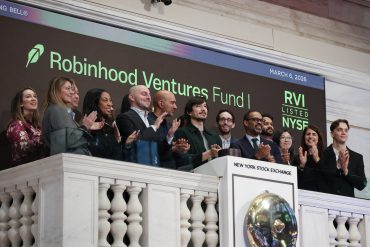
The fund began trading on the New York Stock Exchange on March 6, targeting $658.4 million through 12.6 million shares, with an underwriter option lifting the potential total to $705.7 million. By the opening bell, the market offered its verdict with characteristic bluntness. Shares (NASDAQ: RVI) opened at $22, a 12% discount to the offering price, settling near $22.50 by midday. Robinhood’s own stock, trading under the ticker HOOD, dipped 3.2%, shedding roughly $2.3 billion in market capitalization in a single session.
The numbers tell one story. The context tells a more consequential one.
The Architecture of the Offering
Robinhood Ventures Fund I is structured as a closed-end fund, trading on an exchange like a stock rather than issuing and redeeming shares at net asset value on demand. The distinction carries material consequences. Closed-end funds can trade at persistent premiums or discounts to their underlying portfolios, meaning buyers may pay more, or receive less, than the intrinsic value of the assets beneath them. The structure also insulates the fund from forced liquidations triggered by redemption pressure, a meaningful advantage when the underlying holdings are late-stage private companies that cannot be monetized on short notice. The prospectus makes the trade-off explicit: the fund does not anticipate paying quarterly dividends, reinforcing the patient capital orientation the vehicle demands from its shareholders.
Because the fund trades publicly, no accreditation is required to purchase shares. This is precisely how Robinhood sidesteps the thresholds that ordinarily restrict private market participation to individuals with net worth above $1 million or annual income exceeding $200,000, a barrier that excludes the overwhelming majority of American households. The closed-end structure, in this sense, is not merely a technical choice. It is the product’s central enabling condition.
The portfolio spans communication services, consumer discretionary, financials, industrials, information technology, and exposure to aerospace and defense, artificial intelligence, software, consumer technology, fintech, and robotics, with concentration exceeding 25% across those GICS categories. Named holdings include payments infrastructure firms Airwallex and Ramp, neobank Revolut, health technology company Oura, supersonic aviation developer Boom, enterprise data platform Databricks, and talent marketplace Mercor. Stripe, valued at more than $65 billion in its most recent private financing, joins the portfolio post-IPO. The fund carries a 2.00% annual management fee, reduced to 1.00% for the first six months following the offering, with no performance fee disclosed in the prospectus. Goldman Sachs served as sole bookrunner, a selection that signals institutional seriousness even as the product addresses a decidedly non-institutional audience.
Why Now, and Why Robinhood
The timing of this offering is not incidental. Venture capital deployment reached $170 billion in 2025, yet exit activity remained subdued: fewer than 120 technology IPOs globally, a fraction of the volume recorded at the market’s 2021 peak. Late-stage private companies have steadily extended their pre-IPO timelines, leaving a growing cohort of mature, revenue-generating businesses structurally inaccessible to investors without institutional mandates or established general partner relationships. The gap between where value is being created and where ordinary investors are permitted to participate has widened, quietly and persistently, for years.
Robinhood is not the first institution to identify this gap. It may, however, be the best positioned to close it. With approximately 28 million funded accounts at the close of 2025, assets under custody of $333 billion representing a 119% increase year over year, and net deposits of $68.1 billion for the full year, the company operates at a scale that few fintech entrants have approached. Its inclusion in the S&P 500 in September 2025, following four consecutive profitable quarters, was the institutional validation that completed a transformation long in progress. Shares rose 15% on the announcement. Full-year diluted earnings per share reached a record $2.05.
The company’s European moves reinforce how deliberately it has built toward this moment. In mid-2025, Robinhood launched tokenized stocks offering retail investors 24-hour, five-day access to more than 2,000 US equity and ETF tokens via the Arbitrum Layer 2 blockchain, with zero commissions and a modest foreign exchange fee. The product dissolved traditional market hours and custodial friction in a single offering, signaling that Robinhood’s democratization agenda operates well beyond the boundaries of domestic regulation.
A Platform Rebuilt From the Inside
In 2025, the company introduced Robinhood Cortex, an AI-driven analytical assistant supporting customizable market indicators and real-time portfolio insights. The Legend desktop platform extended its reach into professional-grade trading, enabling 24-hour, five-day index options and futures. Prediction markets, where users take positions on electoral and macroeconomic outcomes, saw more than 12 billion event contracts traded across the year, with the category contributing over $100 million in revenue. In January 2026, Robinhood’s joint venture Rothera acquired MIAXdx, securing a CFTC-licensed exchange and deepening the company’s regulated derivatives infrastructure in a single transaction.
The June 2025 acquisition of Bitstamp for $200 million was among the year’s most strategically significant moves. The deal added more than 50 regulatory licenses spanning the European Union, United Kingdom, United States, and Asia, alongside institutional lending, staking capabilities, and access to more than 85 digital assets. It was immediately EBITDA-neutral and expected to turn accretive within twelve months. Combined with the launch of crypto perpetual futures and Ethereum and Solana staking across European and US markets, Robinhood’s digital asset franchise now carries institutional depth alongside its retail breadth, a combination that most competitors in either category cannot match.
The credit card franchise has been central to this evolution. The Gold card, introduced in 2024 with a 3% cash-back structure tied to platform deposits, has attracted over 700,000 cardholders and generated over $10 billion in annualized spend. Just two days before the Ventures Fund IPO, on March 4, 2026, Robinhood announced at its “Take Flight” event the invite-only Robinhood Platinum Card: a premium offering plated in 99.9% pure platinum, carrying a $695 annual fee but delivering over $3,000 in annual value through elite rewards and luxury benefits. Authorized users may be added at no extra cost, receiving stainless steel cards with shared benefits and spending controls. As Deepak Rao, GM and VP of Robinhood Money, noted at the launch:
We built the Gold Card to be the best card for everyday spending, and customer demand showed us there was room to push the boundaries even further.
The Platinum Card’s timing, announced two days before the Ventures Fund IPO, was hardly accidental. It signals a company in deliberate pursuit of wealthier clients, deeper in-app engagement, and a comprehensive family finance relationship that extends well beyond trading.
What emerges from these pieces is a company that has methodically answered every criticism once leveled at it: too narrow, too speculative, too dependent on volatile crypto volumes, too American. The Ventures Fund I is the latest answer in that sequence, and perhaps the most ambitious.

Reading the Market’s Response
The opening-day discount warrants measured interpretation. Closed-end funds have historically launched at premiums during periods of elevated risk appetite and at discounts when caution prevails, which accurately describes the present environment. With 10-year Treasuries yielding near 4%, the illiquidity premium embedded in private market assets must clear a genuine hurdle to justify allocation from investors with lower-risk alternatives readily available.
Some observers dismissed the fund as more novelty than investment vehicle, better suited to speculative traders than long-term allocators. The criticism surfaces a real tension. Retail investors carry shorter investment horizons and lower tolerance for mark-to-market volatility than the patient capital venture portfolios have traditionally required. Whether a closed-end structure can adequately manage the behavioral risks of a retail shareholder base is a question performance alone will answer. Private markets have historically outperformed public equities by three to five percentage points annually, per Cambridge Associates data, but that outperformance is heavily skewed toward skilled managers and favorable vintage years. It does not distribute evenly or predictably.
What the market’s initial caution does not yet reflect is the cumulative weight of what Robinhood has actually built. A company that entered public markets in 2021 amid meme-stock controversy now sits in the S&P 500, reports record earnings, and holds $333 billion in assets under custody. That trajectory is not the backdrop to this story. It is the story.
The Precedent Being Set
What Robinhood has done with Ventures Fund I is less about this particular portfolio and more about the model it establishes. If the fund delivers competitive returns, others will follow. The convergence of public and private markets, long theorized and periodically attempted through interval funds and business development companies, would then arrive not through regulatory reform but through product innovation, distributed at consumer scale.
For senior investors, the fund introduces a category requiring analytical frameworks that combine closed-end fund mechanics with venture capital judgment. For policymakers, it tests whether the accreditation regime, designed to protect unsophisticated investors from illiquid risk, remains coherent when that risk is packaged in an exchange-traded wrapper. For business leaders, it suggests that the private capital pipeline funding the next generation of innovation may soon draw from a far broader pool than the institutional allocators who have historically controlled it.
The opening-day discount will either narrow as performance accumulates, or widen as a reminder that access and outcome are not the same thing. That tension, unresolved and generative, is precisely what makes this offering worth watching.