- Data Centers
- Memory Chips
- Semiconductors
Micron Earnings Surge as AI Memory Demand Explodes
9 minute read
As AI infrastructure spending accelerates, Micron’s fiscal Q2 results reveal a company that has moved from commodity supplier to indispensable technology partner.
Key Takeaways
- Micron posted Q2 revenue of $23.86 billion, a 196% year-on-year increase, with gross margins of 74.4% and record earnings per share of $12.07, driven by surging AI-related memory demand and constrained industry supply.
- HBM4 high-volume shipments have begun for NVIDIA’s Vera Rubin platform, delivering 2.3x bandwidth improvement over HBM3E, while Q3 guidance of $33.5 billion in revenue and ~81% gross margin signals further record-breaking performance ahead.
- Multi-year strategic customer agreements and over $25 billion in fiscal 2026 capital expenditure commitments reflect a structural transition: Micron is positioning itself not as a cyclical supplier but as a long-term infrastructure partner at the core of the AI economy.
Memory Becomes Infrastructure
For most of the semiconductor industry’s modern history, memory was treated as a commodity: essential, abundant, and ultimately interchangeable. Pricing moved in long, punishing cycles, and manufacturers competed primarily on cost discipline and yield management rather than differentiation. That framework no longer holds. Micron Technology’s fiscal second-quarter results, released on March 18, illustrate with uncommon clarity how artificial intelligence has redrawn the competitive map, elevating memory from a peripheral component to a defining constraint in the architecture of modern computing.
The numbers speak in superlatives. Revenue reached $23.86 billion for the quarter ended February 26, 2026, representing a 196% increase from $8.05 billion a year earlier and a 75% sequential jump from the prior period. Gross margin expanded to 74.4% on a GAAP basis, generating net income of $13.79 billion, or $12.07 per diluted share. Operating cash flow came in at $11.90 billion. Each of these figures represents a company record, and taken together they constitute a financial profile more commonly associated with dominant software platforms than with hardware manufacturers navigating the volatility of capital-intensive production cycles.
The Architecture of Demand
To understand what is driving these results, one must look past the headline figures and into the underlying demand structure. AI model training and inference at scale are memory-intensive workloads in ways that prior computing paradigms were not. As model architectures grow in complexity and context windows expand to accommodate emerging agentic applications, the bandwidth and capacity requirements placed on memory systems compound rapidly. High-bandwidth memory, long a niche product, has become a strategic chokepoint.
Micron’s Cloud Memory business unit generated $7.75 billion in revenue at a 74% gross margin, while its Core Data Center segment, which encompasses HBM critical to AI accelerators, delivered $5.69 billion at the same margin level, a 139% sequential increase. Mobile and Client contributed $7.71 billion at an exceptional 79% gross margin. DRAM accounted for 79% of total revenue, with NAND comprising the balance. Average selling prices rose materially across both categories as supply remained structurally constrained, a dynamic the company expects to persist through at least the end of calendar 2026.
Chief Executive Sanjay Mehrotra described the shift plainly in his prepared remarks, noting that AI has transformed memory and storage into strategic assets at the heart of the technology revolution. What lends that observation particular weight is not the rhetoric but the commercial evidence behind it: Micron has entered multi-year strategic customer agreements, including one spanning five years, which differ fundamentally from conventional long-term supply contracts in their scope and mutual commitment. That level of forward engagement from hyperscale customers suggests the demand inflection is durable, not episodic.
Technology Leadership in High-Bandwidth Memory
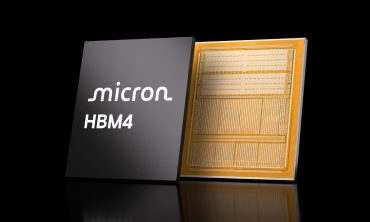
Two days before the earnings release, Micron confirmed the commencement of high-volume shipments of its HBM4 36GB 12-high stack, designed for NVIDIA’s Vera Rubin platform. The product achieves pin speeds exceeding 11 Gb/s and bandwidth greater than 2.8 terabytes per second, representing a 2.3 times improvement over its HBM3E predecessor, with more than 20% better power efficiency. Sampling of a 48GB 16-high variant is already underway, and HBM4E development is targeting volume production in calendar 2027 on Micron’s 1-gamma DRAM node.
These are not incremental refinements. The performance gap between HBM generations is widening at a rate that makes the transition strategically meaningful for data-center operators whose infrastructure decisions are shaped by total cost of ownership over multi-year cycles. Power efficiency, in particular, has become an increasingly critical variable as operators confront the energy economics of large-scale AI deployment. The combination of bandwidth leadership and power reduction positions Micron’s HBM4 not merely as a faster product but as a more economically rational one.
The broader portfolio reflects parallel ambition: PCIe Gen6 solid-state drives in G9 NAND, LP SOCAMM2 modules for data-center efficiency, and a 1-gamma DRAM node on course to become the highest-volume technology in Micron’s history, with the fastest ramp to mature yields the company has ever achieved.
Capital Commitment and Geographic Reach
Fiscal 2026 capital expenditures are now projected above $25 billion, with further meaningful increases anticipated in 2027. The investment is directed toward cleanroom construction and expansion across Singapore, Taiwan’s recently acquired Tongluo site, Idaho, New York, and India. The geographic breadth of this commitment reflects both the scale of anticipated demand and the geopolitical considerations now inseparable from semiconductor supply chain planning.
Industry context matters here. DRAM bit shipment growth is expected to register only in the low-twenties percent range in calendar 2026, with NAND at approximately 20%, constrained by cleanroom availability, the trade-offs inherent in allocating wafer capacity to HBM, and slower bit-per-wafer gains from node transitions. For the first time, data-center AI demand is projected to push both DRAM and NAND’s total addressable market share above 50%. Micron expects its own supply growth to track the industry, meaning the supply-demand balance remains favorable for sustained pricing power.
The Guidance and Its Implications
Third-quarter guidance of $33.5 billion in revenue, plus or minus $750 million, with gross margin approximating 81% and non-GAAP diluted earnings per share of $19.15, stands as perhaps the most consequential element of the earnings release. That single quarter’s projected revenue already exceeds Micron’s full-year revenue for any fiscal year through 2024. The board’s concurrent approval of a 30% increase in the quarterly dividend to $0.15 per share further underscores management’s conviction that current profitability levels are not transient.
Post-earnings share volatility, in which prices that had climbed to intraday records near $471 experienced pressure in after-hours trading, reflected investor deliberation over accelerated capital outlays and the sustainability of peak margins rather than any deterioration in demand. That distinction is worth preserving. Markets routinely price in a mean-reversion that may be slower to arrive than anticipated when structural supply constraints are genuine and demand growth is compounding.
A Structural Transition, Not a Cycle
What emerges from Micron’s second quarter is a portrait of a company that has navigated the transition from cyclical commodity producer to strategic infrastructure enabler with notable discipline. HBM supply is sold out through 2026. Strategic customer agreements extend visibility well beyond conventional forecasting horizons. Portfolio breadth spans the full range of AI infrastructure requirements, from training to inference to the emerging demands of agentic systems.
The risks are real: execution on greenfield construction at this scale is operationally demanding, and customer spending cadences can shift. But the structural conditions that produced this quarter, constrained supply, compounding AI demand, and technology differentiation at the product level, show little sign of near-term reversal. Micron enters the second half of fiscal 2026 not as a beneficiary of a temporary upcycle but as a company whose products have become load-bearing elements of the intelligence infrastructure being built at global scale.